

A Power of Attorney (POA) is a legal document that lets you choose someone you trust to make important decisions for you if you become unable to do so yourself. It’s not about giving up control; it’s about being prepared. Think of it as appointing a co-pilot for your life’s journey—someone who can take the controls if you’re ever incapacitated or unavailable.
A Simple Guide to Power of Attorney
Let's put this into a real-world context. Imagine you’re on a long deployment overseas. Who’s going to pay your bills, manage your bank account, or handle an unexpected financial emergency back home? A Power of Attorney is the exact legal tool designed to solve these problems.
Essentially, it's a formal, written document where you, as the “Principal,” grant legal authority to a trusted person, your “Agent” (sometimes called an “attorney-in-fact”). This person can then act on your behalf in the specific matters you outline in the document. This isn't just a casual handshake agreement; it's a powerful instrument for managing your life.
The Core Purpose of a POA
At its heart, a POA is your personalized instruction manual. It ensures your financial, legal, and even medical wishes are respected and carried out exactly as you want, even if you can’t voice them yourself.
This idea has been around for centuries. Originally, it was a practical way for landowners to have someone manage their property while they were away. Over time, it has evolved into a cornerstone of modern life planning, especially for handling situations involving disability or absence.
A POA gives you a direct say in your own future. It’s a key part of responsible planning that allows you to prepare for the unexpected with confidence and clarity.
Who Needs a Power of Attorney
There’s a common misconception that a POA is only for the elderly or the wealthy. The truth is, any adult can benefit from having one.
A Power of Attorney is one of the most important legal documents you can have. It provides a simple way to name someone to make your financial and healthcare decisions if you are unable to make them for yourself.
A POA becomes absolutely vital in situations like these:
- Military Deployment: It's standard practice for service members to set up a POA so a spouse or parent can manage their affairs while they are away.
- Sudden Illness or Injury: An unexpected accident could leave you temporarily unable to make decisions. An agent can step in immediately to handle medical bills and financial obligations.
- Extended Travel: If you're spending a long time abroad, an agent can manage your property or business matters back home without a hitch.
Creating a POA is a central piece of a larger strategy for your future. To really see the full picture, it's helpful to understand the broader concept of What Is Advance Care Planning. Taking this proactive step ensures that you—not a court—decide who manages your affairs. It's all about maintaining control, no matter what life throws your way.
Navigating the Different Types of POA
Choosing a Power of Attorney isn't a one-size-fits-all deal. Think of it like picking the right tool from a toolbox—you wouldn't grab a sledgehammer when you need a small screwdriver. Each type of POA is built for a specific job, a certain timeframe, and a unique set of circumstances. Getting a handle on these differences is the first real step toward creating a plan that genuinely protects you and what you’ve worked for.
The main things that separate one POA from another are the kind of authority you grant and when that authority kicks in. Some are sweeping and cover almost everything, while others are laser-focused on a single task.
This image lays out the main categories of Power of Attorney, giving you a visual on how they all relate.
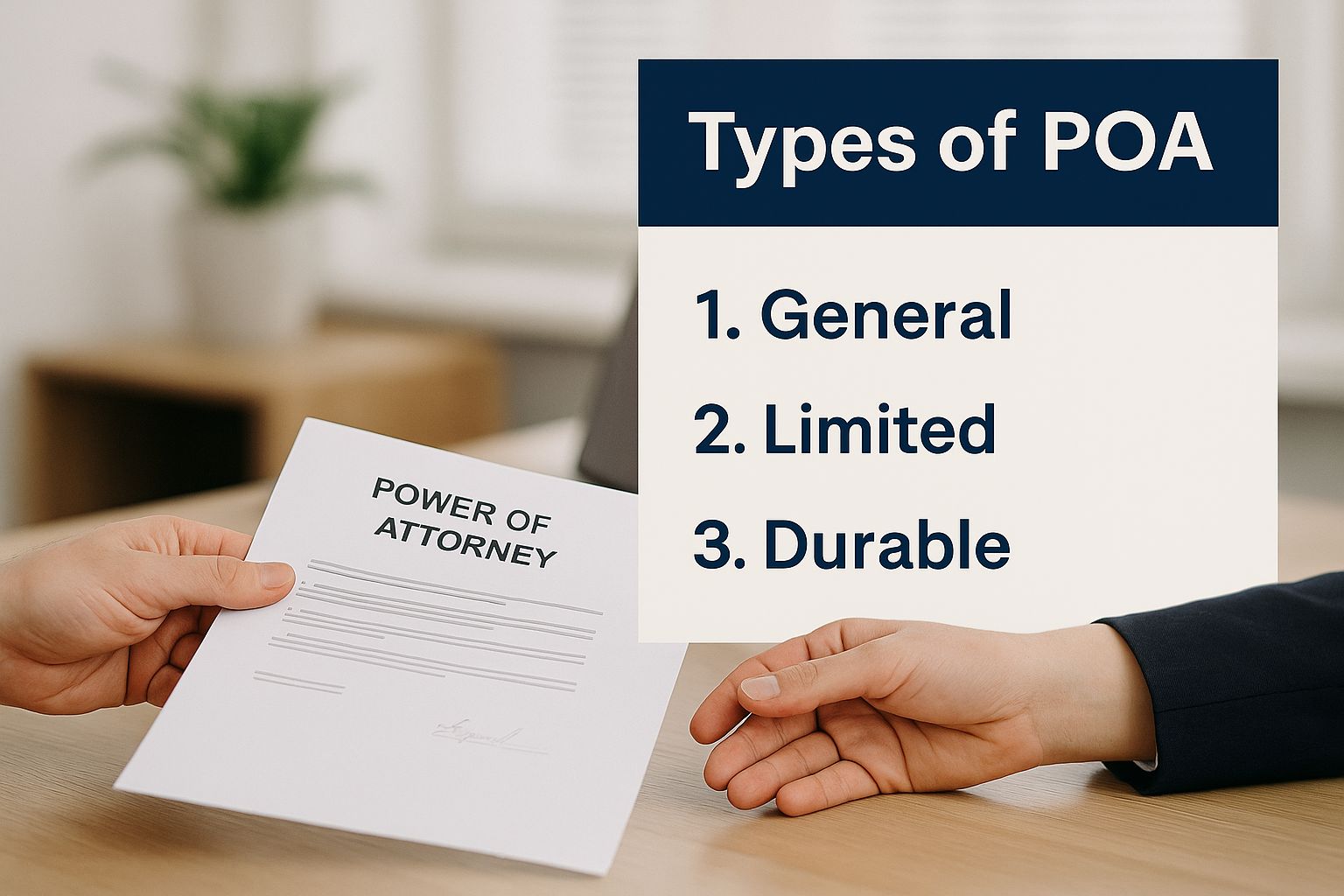
As you can see, POAs are split by their purpose (financial vs. medical) and by their durability—a crucial detail when you're planning for the long haul.
To help clarify these distinctions even further, let's compare the most common types side-by-side.
Comparing Key Types of Power of Attorney
This table breaks down the most common POA types, showing their purpose, how long they last, and when you would most likely use them.
| Type of POA | Primary Purpose | When It Ends | Common Use Case |
|---|---|---|---|
| General | Broad financial authority | Upon the Principal's incapacitation or death | A deployed service member needs a spouse to manage finances back home. |
| Special/Limited | A single, specific task | Once the task is completed or on a set date | Authorizing someone to sell a specific car or house on your behalf. |
| Durable | Ongoing financial authority | Upon the Principal's death | An aging parent wants their child to manage their affairs if they develop dementia. |
| Medical | Healthcare decisions only | Upon the Principal's death | Naming a trusted person to make medical choices if you're in a coma. |
This table offers a quick snapshot, but let's dive into the details of what each of these really means for you.
General Power of Attorney
A General Power of Attorney gives your Agent a wide lane to operate in, handing them broad authority over your financial and legal life. This can include everything from managing your bank accounts and paying bills to selling property or running your business. It’s a powerful document, but it comes with one huge catch: it automatically becomes void if you (the Principal) become incapacitated or pass away.
Because it doesn't survive incapacitation, a General POA is really best for short-term situations where you're mentally sharp but just can't be physically present to handle things yourself.
Special or Limited Power of Attorney
Just as the name implies, a Special Power of Attorney (sometimes called a Limited Power of Attorney) is much more constrained. Instead of handing over the keys to the kingdom, you’re giving your Agent the power to do one very specific thing.
This kind of POA is incredibly practical when you need help with a single, clearly defined job. The document will spell out the exact power being granted and often puts a time limit on it.
A Special POA ensures that your agent can only perform the duties you explicitly assign. It provides a safeguard against unintended overreach while still offering the help you need for a particular situation.
Common reasons to use a Special POA include:
- Selling a specific property: Letting someone handle the sale of your home while you’re out of the country.
- Managing investments: Allowing a financial advisor to make trades in one specific account for you.
- Vehicle transactions: Giving someone the authority to buy or sell a car in your name.
Once that specific task is done or the time is up, the Special POA dissolves.
Durable Power of Attorney
The Durable Power of Attorney is arguably the most essential tool for long-term life planning. The magic word here is "durable." It means the document includes a special legal clause that keeps the POA active even if you become mentally incapacitated. This is the critical feature that sets it apart from a General POA.
Without that durability clause, your Agent's power would vanish the moment you couldn't make decisions for yourself—which is precisely when you’d need them most. A Durable POA for finances makes sure someone you trust can step in and manage your affairs, helping you avoid a complicated and public court process to appoint a guardian.
A 2017 study found that 45% of adults aged 45 and older had no estate planning documents at all, which reveals a major gap in preparing for potential incapacity. A Durable POA is the bedrock document that fills that gap.
Medical Power of Attorney
While all the other POAs we've discussed deal with money and property, the Medical Power of Attorney is purely for your health. Also known as a healthcare proxy or durable power of attorney for health care, this document lets you name an Agent to make medical decisions on your behalf if you're unable to.
Your healthcare Agent can:
- Approve or refuse medical treatments.
- Make decisions about life-sustaining care.
- Select your doctors, hospitals, or nursing homes.
This person becomes your voice in the hospital, fighting to ensure your personal medical wishes are followed. It’s often prepared with a Living Will, a document where you state your preferences for end-of-life care. It’s vital to choose an Agent who truly understands your values and can stay calm and advocate for you under pressure.
How to Create a Legally Sound Power of Attorney

Knowing what a power of attorney is and which type you need is only half the battle. Now comes the crucial part: turning that knowledge into a legally solid document that will actually work when you need it most. This isn't just about filling in some blanks on a form; it's a careful process to ensure your wishes are locked in and legally protected.
Think of this section as your roadmap. It’s a step-by-step checklist to guide you from the first draft to the final, official signature. By following these steps, you can sidestep the common mistakes that can unfortunately render a POA useless.
The Essential Steps for a Valid POA
Crafting a power of attorney that holds up under legal scrutiny involves a few critical stages. Each step builds directly on the last, creating a chain of legal integrity that gives the document its real power. If even one link in that chain is weak, the whole thing can fall apart.
Here’s a straightforward guide to get it done right:
- Select the Right POA Type: First things first, you have to decide which kind of POA fits your situation. As we’ve discussed, a Durable Power of Attorney is usually the go-to for long-term planning, whereas a Special Power of Attorney is perfect for handling a single, specific transaction.
- Choose Your Agent Carefully: This is, without a doubt, the most critical decision in the entire process. Your agent must be someone you trust completely—someone who you know, deep down, will always act in your best interests.
- Draft the Document: You can start with state-specific templates or work with a lawyer to draft the document from scratch. Precision is everything here. The document needs to spell out exactly what powers you are granting, leaving no room for interpretation.
- Follow State-Specific Legal Formalities: Every state has its own unique rulebook for making a POA official. This is where many do-it-yourself attempts go wrong.
These first few steps get the foundation in place. But the true test of a POA often comes down to the signing ceremony itself.
Understanding Your State’s Legal Requirements
At the end of the day, state laws are the final word on what makes a Power of Attorney valid. These aren't just suggestions or "best practices"—they are strict, non-negotiable rules that a court will look at very closely. Overlooking even one of them can invalidate your entire document.
Key requirements almost always include:
- Notarization: Nearly every state requires the principal’s signature to be verified by a notary public. A notary is there to confirm your identity and that you are signing the document of your own free will.
- Witnesses: Some states also demand that one or two witnesses watch you sign. These witnesses generally can't be your agent or a relative who might benefit from the document.
- Specific Language: Certain states require specific warnings or notices to be printed directly in the document, especially for Durable POAs that grant sweeping powers.
A Power of Attorney is much more than a piece of paper; it’s a legal shield. Ensuring it’s properly signed, witnessed, and notarized according to your state’s laws is what gives that shield its strength. Without these formalities, you’re left unprotected.
To get started, you can often find essential estate planning forms online, which can serve as a great template. Just remember, even the best template is worthless if it isn't signed and witnessed according to the laws in your specific area.
The Case for Professional Legal Guidance
While DIY forms are available, the tangled web of POA laws makes hiring a professional a very smart move. An attorney who specializes in estate planning can make sure your document isn't just compliant, but is also perfectly customized to your family's unique situation and your personal wishes.
This professional touch is more important than ever. The demand for well-drafted POAs is on the rise, particularly within elder law and healthcare planning. People are planning for the future, and they need sound legal documents to do it.
An experienced attorney can help you:
- Navigate complicated family dynamics and potential conflicts.
- Write crystal-clear language to grant or limit your agent's powers.
- Guarantee full compliance with state laws, which can and do change.
- Add safeguards to protect you from a dishonest or irresponsible agent.
Ultimately, creating a legally sound power of attorney comes down to foresight and a keen eye for detail. Whether you start with a template or sit down with an expert, taking the time to do it right from the start delivers a peace of mind that is truly priceless.
Choosing Your Agent: The Most Critical Decision You'll Make
Picking the person who will act as your agent is, without a doubt, the single most important decision in the entire Power of Attorney process. This isn't just about choosing a favorite relative or someone you like. You're handing over immense control over your life, and that requires a clear-headed, logical evaluation, not just an emotional one.
Think of it this way: you're choosing your second-in-command. You need someone with integrity, solid judgment, and the ability to carry out your wishes, especially under pressure. The person you name as your agent must be someone you trust to manage your affairs with the exact same care and prudence you would.
This decision carries so much weight because, legally speaking, your agent's actions are considered your actions. Their competence—or lack thereof—will have a direct line to your financial security and personal well-being.
Essential Qualities of a Dependable Agent
Before you even think about putting a name on that dotted line, you have to honestly size up potential candidates against a strict set of qualifications. Trust is the bedrock, but trust alone isn't enough. Your ideal agent needs the right character and practical skills.
Look for these core attributes:
- Unwavering Integrity: This is the absolute deal-breaker. The person must have a rock-solid moral compass and a track record of making honest choices. You need to be certain they would never, ever put their own interests before yours.
- Financial Competence: Your agent doesn't need to be a Wall Street pro, but they absolutely must be responsible with money. Can they balance a budget, pay bills on time, and make sense of basic financial statements? If they have a history of money troubles, they are not the right person for the job.
- Assertiveness and Advocacy: There might be times when your agent has to stand up for you, pushing back against medical staff or even other family members who disagree with your wishes. They need to be your champion, not someone who crumbles under pressure.
- Organizational Skills: Managing a POA involves a surprising amount of paperwork, deadlines, and meticulous record-keeping. A disorganized person can quickly turn your affairs into a chaotic and expensive mess.
Your agent is more than a helper; they are your fiduciary. This is a legal term that means they have a duty to act with the highest degree of good faith and loyalty, solely in your best interests. Breaching that duty can lead to serious legal trouble.
Choosing someone who ticks all these boxes is the best insurance policy you can have for your future.
Family Member vs. a Professional
The default choice for most people is a spouse, an adult child, or a close sibling. But that isn't always the wisest move. It’s vital to weigh the real-world pros and cons of appointing a family member versus hiring a professional.
Choosing a Family Member:
- Pros: They know you, your history, and your values on a deep level. They're usually motivated by love and won't charge a fee for their help.
- Cons: Family dynamics can throw a wrench in the works, creating conflict and resentment among relatives. They might not have the financial or legal know-how required and could get easily overwhelmed by the responsibility.
Choosing a Professional (Lawyer, CPA, or Fiduciary):
- Pros: Professionals bring expertise, experience, and crucial emotional detachment to the table. They are bound by strict legal and ethical standards and are less likely to get tangled up in family drama.
- Cons: They charge for their services, which can add up. They also won’t have the same personal, intimate understanding of your wishes that a loved one would.
There’s no magic formula here. The best choice is deeply personal and depends entirely on your family situation and how complex your affairs are.
Final Checklist for Selecting Your Agent
Before you make the final call, ask yourself these tough but necessary questions. Be brutally honest in your answers.
- Do they live nearby? While not always a deal-breaker in our digital age, having an agent who is local can make managing day-to-day practical tasks infinitely easier.
- Are they willing and able to serve? Have a frank, no-holds-barred conversation with your top candidate. Do they truly understand what the job entails, and are they genuinely prepared to take it on?
- How do they handle stress? You need someone who stays calm and thinks clearly in a crisis, not someone who panics or shuts down.
- Will they communicate openly? A good agent will keep you (and any other people you designate) in the loop about the decisions they’re making on your behalf.
- Can they say no? They might have to deny requests from other family members who feel entitled to your money or property. Your agent's first and only loyalty must be to your wishes.
Taking the time to rigorously vet your choice of agent is the ultimate act of protecting yourself. It ensures this powerful legal tool will be used exactly as you intend, safeguarding your legacy and giving you true peace of mind.
The Upsides and Downsides: What You Need to Know About POAs
Giving someone a Power of Attorney is a massive act of trust. It can bring you incredible peace of mind, but it’s definitely not a decision you should rush into. Just like any powerful tool, it has amazing benefits but also carries some serious risks. Getting a handle on this trade-off is the key to making a POA work for you, not against you.
The biggest benefit is putting you in the driver's seat. When you create a POA, you’re the one who hand-picks the person to manage your affairs if you can't. Without one, you're often looking at a court-appointed guardianship. That process is public, expensive, and stressful—and a judge, not you, makes the final call. That can cause frustrating delays and put a total stranger in charge of your life.
The Real Prize: Peace of Mind
Think about what happens when a sudden medical crisis leaves someone unable to speak for themselves. Without a POA, their family often hits a brick wall of legal and financial problems. Bank accounts get frozen, bills can go unpaid, and crucial medical decisions hang in the balance until a court steps in. It's a recipe for chaos and conflict.
Now, imagine that same situation, but this time a well-drafted Durable Power of Attorney is already in place. The person you chose—your agent—can jump into action immediately. They can get to the funds needed for medical care, handle the mortgage payments, and keep things running smoothly. The family is spared a frantic legal fight, letting them focus on what really matters: their loved one's recovery.
This is the true gift of a POA. It’s a contingency plan that provides stability and preserves your dignity during life’s toughest moments. You get to make sure your life is managed by someone who actually knows you and understands your wishes.
Facing the Risks Head-On
Let's be honest: handing someone the keys to your financial or healthcare kingdom makes you vulnerable. The biggest risk, and the one that keeps most people up at night, is the potential for abuse. A crooked agent could use their authority for personal gain, and the financial fallout can be devastating.
This isn't just a hypothetical worry. Financial elder abuse is a huge problem, and a misused POA is often the tool used to do the damage. Studies consistently show that a significant chunk of financial exploitation against seniors is committed by people in a position of trust, including family members acting as agents.
A Power of Attorney legally requires your agent to be a fiduciary, meaning they must act only in your best interest. But that legal duty can't physically stop a dishonest person from doing the wrong thing. Your best defense is choosing the right person from the get-go and building in strong safeguards.
Even beyond outright fraud, there's the risk of simple mismanagement. A well-meaning agent who just isn't great with money could make poor investment choices or fail to keep good records, accidentally hurting your financial well-being.
How to Build a Safety Net
The good news is you aren't powerless here. You can, and absolutely should, build specific checks and balances right into your Power of Attorney document. These safeguards make it much harder for an agent to misbehave and much easier to spot trouble early.
Here are a few protective measures to consider:
- Require Regular Reports: You can legally require your agent to provide detailed financial reports to a third party, like another family member, a trusted friend, or your lawyer. Transparency is a great disinfectant.
- Appoint a Co-Agent: Naming two people to act together can create a built-in check and balance. You can require both to sign off on major transactions, preventing any one person from having total control.
- Designate a "Protector" or "Monitor": Some states let you name a "protector" in your POA. This person doesn't have the agent's powers but is given the authority to look at the books and even demand a formal accounting from the court if something seems off.
- Set Clear Limits: Be explicit. You can restrict your agent from making large gifts to themselves or from changing the beneficiaries on your life insurance or retirement accounts. Spell out what they can and cannot do.
By carefully weighing the benefits against the risks, you can make a smart, informed decision. Planning ahead also means looking at the bigger picture. Beyond the POA, it's smart to explore other important legal and financial considerations that round out your long-term plan. At the end of the day, a thoughtfully crafted POA with strong protections is one of the best tools you have to secure your future.
Common Questions About Power of Attorney
Once we've walked through what a Power of Attorney is, how to set one up, and the weight of choosing the right person for the job, a few practical questions always pop up. This is where we’ll tackle those lingering "what ifs" and "how much" questions. Think of it as the final piece of the puzzle, giving you the clarity and confidence you need to move forward.
Let's clear up some of the most common concerns about cost, flexibility, and what to do when things don't go as planned.
How Much Does It Cost to Get a Power of Attorney?
This is usually the first question on everyone's mind, and the honest answer is: it depends. The cost to get a Power of Attorney can swing from almost nothing to several hundred dollars. There's no one-size-fits-all price tag.
You really have two main roads you can take:
- The DIY Route: You can find state-specific forms or online templates for a very low cost. Often, you're just paying a small fee for the template and then the cost of getting it notarized. While it's tempting to save money this way, you run the risk of making a critical mistake if you don't fully grasp your state's laws.
- Hiring a Lawyer: Bringing in an attorney is the more expensive option, typically running from $250 to $750 or more, based on where you live and how complex your needs are. What you're really paying for, though, is peace of mind. You get professional guidance and a document that’s legally solid and built just for you.
For many people, that extra cost is a worthwhile investment to prevent much bigger, more expensive problems later on.
Can I Change or Cancel My Power of Attorney?
Absolutely. A Power of Attorney isn't carved in stone. So long as you are mentally competent—meaning you fully understand what you're doing and its implications—you hold all the cards. You can change the document or cancel it entirely.
Life changes, and your POA should be flexible enough to change right along with it. The official process for canceling is called revocation.
To properly revoke a Power of Attorney, you need to create a written "Notice of Revocation." This is a formal document stating you're canceling the old POA. Just like the original, it needs to be signed and notarized.
Don't just tear up the old document and call it a day. It's crucial that you formally notify your old agent and any places they did business for you (like your bank) that their authority is officially gone. This prevents any confusion about who’s really in charge.
What Happens if My Agent Acts Improperly?
This is a huge and valid fear. Thankfully, the law has your back if an agent abuses their power. Your agent is what's known as a fiduciary, a legal term that binds them to act in your best interest with complete loyalty. When they break that trust, there are serious legal consequences.
If you suspect your agent is misusing funds or ignoring your wishes, you or someone else can step in. The very first move, if you're able, is to revoke the POA immediately.
But what if you're incapacitated and can't act for yourself? Other family members or concerned friends can petition the court. A judge has the power to:
- Order a formal accounting, which forces the agent to produce detailed records of every single transaction.
- Remove the agent from their role if they've done something wrong.
- Appoint a new, trustworthy agent or a court-supervised guardian.
- Force the agent to pay back any money they misappropriated.
The best defense is a good offense—choosing your agent wisely from the start. But knowing you have legal recourse is a critical safety net that protects you and your assets.
Navigating legal documents and planning for the future can be a challenge, especially for those who have served our country. At Homefront Group, we specialize in providing veterans and first responders with the expert guidance they need. From estate planning to securing the benefits you've earned, our team is here to support you. Find out what you qualify for by taking our free 3-minute quiz.