

A Disability Benefits Questionnaire, or DBQ, is a specific form the VA uses to gather the right medical details about your disability. Think of it as a direct line of communication between your doctor and the VA employee rating your claim. It’s designed to make sure your condition is documented in a language the VA understands—the language of its rating criteria.
What Is a DBQ and Why Does It Matter?

Imagine you're trying to explain a complex engine problem to a mechanic over the phone. You might miss key details or use the wrong terms. A DBQ is like a detailed diagnostic checklist that your doctor fills out, ensuring the mechanic—in this case, the VA rater—gets the exact information they need to understand the problem.
This isn't just another form to fill out. A DBQ is a powerful tool created to make the claims process smoother and faster. It translates your medical reality into a standardized format that VA raters can process efficiently. The forms use a smart mix of checkboxes for symptoms, fields for specific measurements (like your range of motion), and targeted questions about how your condition affects you.
This structured approach directly addresses a long-standing headache in the VA claims world: vague and insufficient medical records. For years, veterans submitted doctor's notes that, while accurate, didn't speak to the specific criteria the VA needs to assign a disability rating. A DBQ bridges that gap.
A thoroughly completed DBQ provides objective, measurable evidence that lines up perfectly with the VA's Schedule for Rating Disabilities. This can significantly reduce guesswork and may even speed up your claim by providing the VA with everything it needs upfront.
The Core Function of a DBQ
At its heart, a DBQ’s job is to collect the precise evidence a VA rater requires to make a decision. It moves beyond a general health summary and drills down into the details that matter for your specific condition.
For example, a DBQ for a knee injury won't just ask if your knee hurts. It will ask for:
- Precise range of motion measurements in degrees.
- Whether you experience pain during movement.
- Any signs of instability or loss of function.
This level of detail gives the rater a crystal-clear picture of your disability's severity, allowing them to assign the correct rating. When you submit this information proactively, you're essentially handing the VA a "decision-ready" file. While the VA can still schedule a C&P exam, a strong DBQ often gives them all the evidence they need.
To put it simply, here’s a quick breakdown of what makes a DBQ so essential.
Breaking Down a VA DBQ at a Glance
This table provides a quick reference to understand the essential parts of a Disability Benefits Questionnaire and their role in your VA claim.
| Key Component | Its Purpose in Your Claim |
|---|---|
| Standardized Format | Ensures every rater receives the same type of information, promoting consistency. |
| Condition-Specific Questions | Focuses on the exact symptoms and functional impacts the VA uses for rating criteria. |
| Checkboxes & Data Fields | Translates medical findings into clear, measurable data (e.g., frequency of panic attacks). |
| Doctor's Medical Opinion | Provides a space for the examiner to connect your disability directly to your military service. |
By understanding these components, you can see how a DBQ is much more than a form—it's your opportunity to present a clear, compelling case for the benefits you've earned.
Why the DBQ Is So Important for Your VA Claim

To really get why the Disability Benefits Questionnaire (DBQ) is such a game-changer, you have to look at how things used to be. For a long time, the VA was drowning in medical records that were all over the place—some were incomplete, others were vague, and many just didn't have the specific details needed to make a rating decision.
This created a massive logjam. VA raters, who are adjudicators and not doctors, were often left trying to connect the dots or sending veterans back for more exams, which dragged the process out for everyone. The DBQ was designed to fix this exact problem.
It’s essentially a standardized form that guides a medical professional to provide the exact information the VA needs. By using a consistent format, it ensures all the legally required evidence is there, presented in a way a rater can easily use. Think of it as a translator, turning your medical condition into the language the VA speaks.
A properly filled-out DBQ gives the VA rater a clear and complete picture of your disability. This often means they don't have to send your file back for more information, which can help speed up your claim.
More Than Just Paperwork—It's Your Best Evidence
It’s tempting to look at a DBQ and see just another government form to fill out. But that’s a mistake. A DBQ isn't a hurdle; it's an opportunity to build a rock-solid case for the benefits you earned.
A detailed and accurate DBQ can do a few powerful things for your claim:
- It Eliminates Guesswork: The form asks very specific, targeted questions about your condition. This leaves no room for a rater to misinterpret how your disability affects you.
- It Ensures Completeness: A DBQ acts like a checklist for your doctor. It forces them to document everything that matters for a rating, from how often your symptoms occur to how they limit your ability to work or perform daily tasks.
- It Can Accelerate a Decision: When a rater gets a claim with a well-completed DBQ, they have what’s called a "decision-ready" claim. This means they can often make a decision right away instead of putting your file on hold.
Ultimately, knowing what a DBQ is means understanding the control it gives you. It takes your complicated medical journey and organizes it into a clear, actionable report. It’s one of the most effective tools you have for strengthening your claim and communicating the severity of your condition directly to the VA.
Navigating the Different Types of DBQs

It’s a common misconception that there's just one standard "DBQ form." The reality is quite different. The VA doesn’t use a one-size-fits-all document; instead, think of DBQs as a collection of highly specialized tools, with a specific one designed for nearly every type of medical condition.
This specialized approach is the whole point. The VA maintains over 70 different DBQ forms, each one crafted to gather the exact information needed to evaluate a particular disability. The questions on a heart condition DBQ are completely different from those on a hearing loss DBQ, and for good reason. You can check out the full list of publicly available DBQs to see just how specific they are.
This variety ensures that the evidence submitted is directly relevant to how the VA rates your specific condition. It cuts through the noise and gets right to what matters.
Condition-Specific Design
The real value of a DBQ lies in its laser-focused design. Each questionnaire is built to explore how one single condition affects your health and daily life, leaving very little room for guesswork on the rater's part.
Let's look at a couple of examples to see how this plays out:
- A DBQ for a Back Condition: This form is all about physical limitations. It will have sections for a doctor to record your precise range of motion measurements (using a goniometer), map out where your pain is, and note details about muscle weakness or spasms.
- A DBQ for PTSD: This form is completely different. It focuses on the psychological and social impacts, asking about the frequency of panic attacks, memory issues, mood disturbances, and how these symptoms interfere with your ability to work and maintain relationships.
Using the correct DBQ is not just a helpful tip—it's absolutely essential. Submitting the wrong form is like giving a mechanic a recipe for a cake and asking them to fix your car's transmission. The information is useless for the task at hand and will bring your claim to a halt.
Taking the time to find and use the correct form is a non-negotiable step. When your doctor fills out the right DBQ, you're essentially handing the VA rater a clear, easy-to-follow map that leads directly to a more accurate and fair rating decision for your claim.
How to Get a DBQ Completed for Your Claim
Getting a completed Disability Benefits Questionnaire is a crucial part of your claim, and you have two main ways to do it. Think of them as two different paths to the same destination. Picking the right one for you depends on things like your relationship with your doctors and how hands-on you want to be with your claim's evidence.
The most common route is letting the VA handle it. After you file a claim, the VA will typically schedule you for a Compensation & Pension (C&P) exam. The doctor at this exam, a C&P examiner, will fill out the DBQ for the VA. This is the standard process, but it also means you have very little say over who the examiner is or what goes into their final report.
The other path puts you in the driver's seat: having your own private doctor complete the form. This can be a game-changer because you're working with a professional who already knows your medical history, sometimes for years. This often results in a more thorough and personalized report, but it does mean you need to do a little homework to prepare your doctor.
Preparing Your Private Doctor to Complete a DBQ
If you decide to ask your own doctor to fill out a DBQ, preparation is everything. You can’t just drop the form on their desk and hope for the best. Your doctor is a medical expert, but they probably aren't an expert in the VA's specific requirements.
This image breaks down the basic steps for building a strong case, which applies perfectly to helping your doctor understand what's needed for your DBQ.
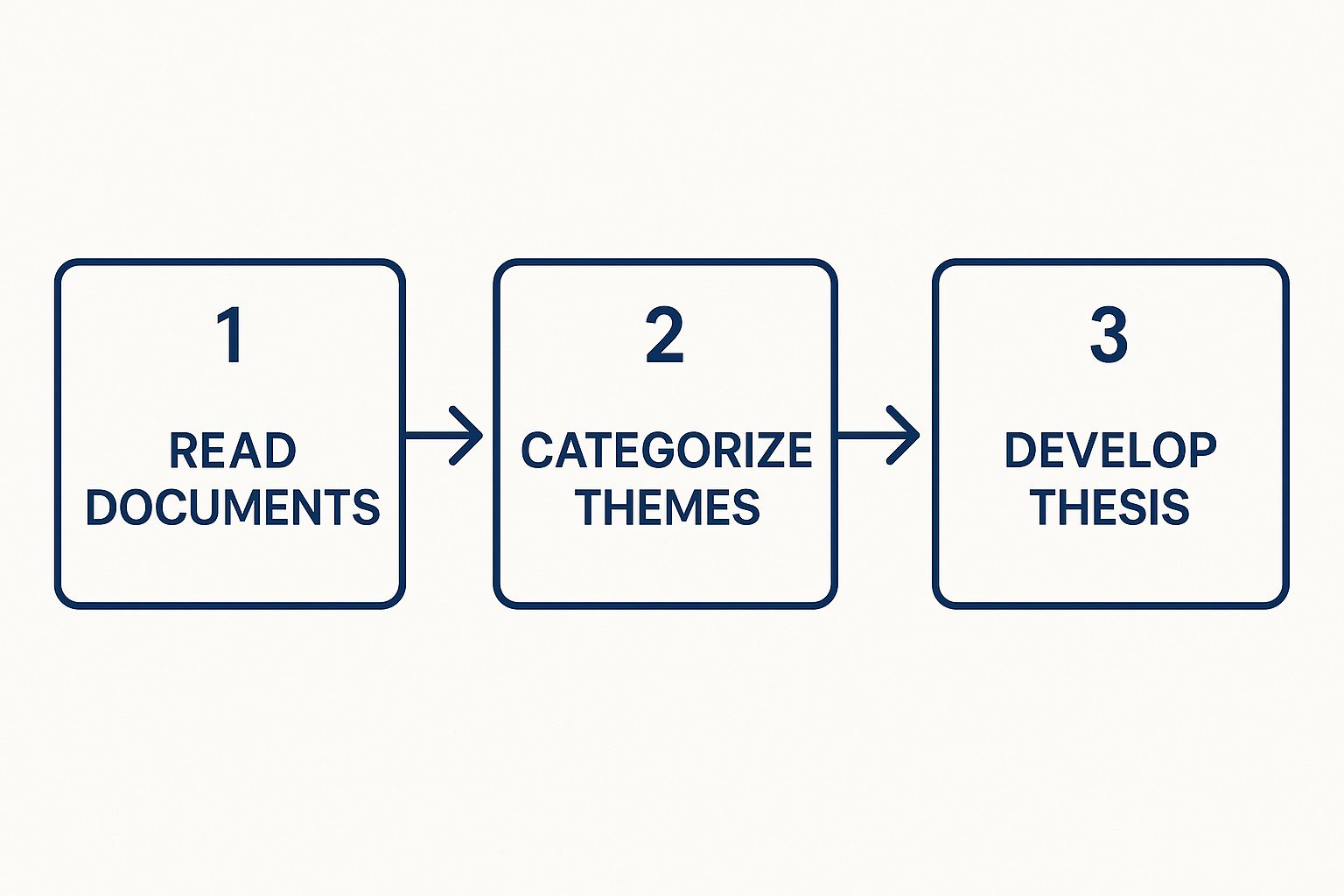
Just like the graphic shows, a powerful result comes from understanding the background, identifying the important details, and drawing a clear conclusion. To set your doctor up for success, treat your appointment like a mission and bring the right supplies.
Here’s a simple checklist to follow:
- Bring the Correct Form: Make sure you download the latest version of the specific DBQ for your condition directly from the VA’s official website. Forms get updated, so an old one won't cut it.
- Provide Key Medical Records: Don't make your doctor hunt for information. Bring the essential medical records that diagnose your condition and, ideally, connect it back to your time in service.
- Highlight How Your Symptoms Affect You: Go beyond just listing your symptoms. You need to explain their real-world impact. How do they affect your job, your family life, your ability to get through the day?
- Review Your Service Records: If you have service treatment records showing the original injury or event, bring them. This helps the doctor connect the dots for the "nexus" part of your claim.
A DBQ from your own doctor can be a powerful piece of evidence. While VHA Directive 1134(2) technically allows VA doctors to fill out these forms, many are often unwilling or too busy. Getting a private physician to provide a detailed, well-reasoned account of your disability is a huge advantage. It gives the VA rater a perspective from a doctor who knows you, not just someone who met you for a single 20-minute exam.
How to Make Sure Your DBQ is "Decision-Ready"
Getting a Disability Benefits Questionnaire (DBQ) filled out is one step, but submitting one that truly strengthens your claim is another beast entirely. The goal isn't just to hand the VA a completed form; it's to provide a document that tells the full, honest story of your condition.
The most critical part of this is being completely candid. It's a two-way street: never, ever exaggerate your symptoms. But just as important, don't downplay your daily struggles. So many veterans are used to toughing it out and minimizing their pain. A DBQ is not the place for that—it's the place for the unvarnished truth about how your condition impacts your life.
Connect the Dots: From Diagnosis to Daily Life
A powerful DBQ doesn't just list medical terms; it clearly connects your symptoms to their real-world consequences. It’s not just about telling the doctor what hurts, but showing them what that pain stops you from doing. Before you even walk into your appointment, take some time to think through specific examples.
- Impact at Work: Does your chronic back pain mean you can't sit at a desk for more than 20 minutes? Does that make holding down an office job a constant struggle?
- Impact on Your Social Life: Has your PTSD or anxiety made being in crowds so overwhelming that you avoid seeing friends or attending family events?
- Impact on Daily Routines: Does the instability in your knee make it a challenge to do simple things like carry a bag of groceries, play with your kids on the floor, or even just climb the stairs in your home?
When you give the examiner these concrete, real-life examples, you're handing them—and the VA rater who will eventually read the report—the context they need to grasp the true severity of your disability.
A strong DBQ goes beyond a simple diagnosis to paint a vivid picture of your functional limitations. It translates medical jargon into a clear story of how your service-connected condition gets in the way of you living your life.
The Final Review: Your Last Line of Defense
If you went to your own private doctor to get your DBQ filled out, it's absolutely vital that you review it before you submit it to the VA. Think of yourself as the final quality control inspector—your last chance to make sure this document is as effective as possible.
You're looking for three main things:
- Accuracy: Is everything correct? Check your diagnoses, symptoms, and the specific medical details. A small error can cause big problems.
- Completeness: Did the doctor fill out every relevant section? A single blank box on a crucial page can bring your claim to a screeching halt, causing significant delays.
- A Clear "Nexus": Does the report clearly and directly link your condition back to your military service? Without this connection, your claim is missing its most essential piece.
By taking the time to do this final check, you're not just submitting a form. You're submitting a powerful piece of evidence that does the heavy lifting for you, advocating on your behalf long after you've mailed it in.
Common Questions Veterans Ask About DBQs
Walking through the VA claims process can feel like navigating a maze, and it's only natural to have questions, especially about a key document like the DBQ. Let's clear up some of the most common things veterans ask. Getting these answers can give you the confidence to take the next step.
Can I Submit a DBQ From My Own Doctor?
Absolutely. In fact, it can be a game-changer for your claim. The VA is legally required to review all relevant medical evidence you send in, and that definitely includes a DBQ from your private doctor.
Think about it: a form filled out by a physician who has treated your condition for years can be incredibly compelling. They know your history inside and out. Just keep in mind that the VA can still schedule its own C&P exam to get a second opinion. Even so, a strong, well-documented DBQ from your doctor can heavily sway the outcome in your favor.
What if There Is a Mistake on the DBQ?
Don't panic—it happens, and you have a path to fix it. If you notice an error on a DBQ your own doctor filled out, simply ask them to correct it before you submit it. This is why you should always review every form carefully before it goes to the VA.
If you spot a mistake on a DBQ that a C&P examiner completed, you’ll need to challenge it. The best way to do this is by submitting a statement (VA Form 21-4138 is perfect for this) that points out the exact error. Be sure to back up your claim with conflicting evidence from your own medical records to make your case undeniable.
It is critical to download the latest version of the specific form for your condition directly from the VA's website. This ensures it aligns with current VA standards and requirements, preventing potential delays or issues with your claim.
Is Submitting a DBQ a Requirement for My Claim?
No, you aren't technically required to submit a DBQ. However, it is the VA's preferred format for getting medical evidence. If you file a claim without one, the VA will almost certainly schedule you for a C&P exam to get the information they need.
Submitting your own DBQ upfront puts you in the driver's seat. You’re proactively providing detailed, organized evidence from a medical professional you trust. This can often speed things up by giving the VA a "decision-ready" document right from the start.
Navigating the complexities of VA claims requires expertise and a dedicated advocate. Homefront Group provides specialized legal and professional services to ensure veterans get the justice and financial support they deserve. If you need help with your VA claim, our team of veterans is ready to assist. Take our 3-minute quiz to identify your qualifying benefits today at https://homefrontgroup.com/.