
Unlocking Your Veteran Benefits
Determining your veteran benefits eligibility can be confusing. This listicle clarifies eight key factors impacting your access to benefits. Understanding these requirements is crucial for filing successful claims, whether for service-connected disabilities, toxic exposure, medical malpractice, or other needs. This guide covers military service requirements, disability status, wartime service, length of service, income limits, discharge status, dependent status, and more. Knowing these factors will empower you to pursue the benefits you deserve. We'll help you understand how veteran benefits eligibility applies to your situation.
1. Military Service Requirements
The cornerstone of veteran benefits eligibility is meeting the required military service obligations. This means veterans must have served a period of active duty in the Army, Navy, Air Force, Marine Corps, Coast Guard, or Space Force, and received a discharge under conditions other than dishonorable. This foundational requirement is the first step in accessing the wide array of benefits offered by the Department of Veterans Affairs (VA). It underpins eligibility for healthcare, education, home loans, disability compensation, and numerous other programs designed to support those who have served their country. Understanding this fundamental aspect of eligibility is crucial for any veteran seeking to access VA benefits.

This requirement rightfully holds the top spot in determining veteran benefits eligibility because it defines the population the VA serves. Without documented active service, veterans are generally unable to access the support system provided by the VA. While the specific service time requirements vary based on the individual benefit program, the character of discharge remains universally important.
Features of Military Service Requirements:
- Active Duty Service: Requires service in one of the branches of the US Armed Forces: Army, Navy, Air Force, Marine Corps, Coast Guard, or Space Force.
- National Guard and Reserve Eligibility: Members of the National Guard and Reserve may qualify for certain VA benefits based on periods of active duty service, including deployments and specific training periods.
- Service Time Requirements: The length of service required varies depending on the specific benefit.
- Character of Discharge: The type of discharge a veteran receives is a critical factor in determining eligibility.
Pros:
- Inclusive of Various Service Paths: Recognizes active duty service across all branches of the military, including periods of active duty for National Guard and Reserve members.
- Short Service Periods Qualify for Some Benefits: Some benefits are available to veterans with as little as 90 days of active service.
- Recognizes Wartime and Peacetime Service: Eligibility considers service during both times of war and peace.
Cons:
- Dishonorable Discharge Impact: Veterans receiving a Dishonorable Discharge are typically disqualified from most VA benefits.
- Other Than Honorable (OTH) Discharges: OTH discharges can complicate the eligibility process and often require additional review and potential appeals. This is particularly relevant for veterans seeking benefits related to PTSD, TBI, or other service-connected conditions that may have contributed to the OTH discharge.
- Minimum Service Requirements: The required minimum service periods can exclude some veterans who served for shorter durations.
Examples of Service Requirements for Specific Benefits:
- Post-9/11 GI Bill: Requires at least 90 days of aggregate service after September 10, 2001.
- VA Home Loan: Eligibility typically requires minimum service periods, such as 90 days during wartime or 181 continuous days during peacetime.
- Discharge Upgrades and Eligibility: Veterans with OTH discharges stemming from PTSD or TBI may be able to regain eligibility through discharge upgrade processes. This is especially important for those seeking compensation for these service-connected conditions.
Actionable Tips:
- Obtain Your DD-214: Secure your DD-214 (Certificate of Release or Discharge from Active Duty) as it serves as official proof of your military service.
- Consult a Veterans Service Officer (VSO): If you received an OTH discharge, consult with a VSO to explore options for a discharge upgrade and understand how it impacts your veteran benefits eligibility. This is particularly relevant for those appealing denied claims due to discharge status.
- Research Specific Benefit Requirements: Different benefits have different service requirements. Carefully review the specific eligibility criteria for each benefit you are interested in pursuing.
This information is especially crucial for veterans appealing denied claims, navigating the complexities of toxic exposure claims, pursuing medical malpractice claims related to their military service, planning their estates and finances, dealing with motor vehicle accidents, seeking workers' compensation for work-related injuries, and for first responders facing similar challenges related to work injuries and toxic exposure. Understanding military service requirements is the first step in accessing the support and benefits earned through service.
2. Service-Connected Disability Status
Service-connected disability status is a cornerstone of veteran benefits eligibility. This status recognizes that a veteran's current disability is connected to an injury, illness, or event that occurred during their military service. Establishing this connection is crucial for accessing a wide range of VA benefits, including financial compensation and healthcare services. The process involves applying for disability compensation through the VA, which then evaluates the claim and assigns a disability rating. This rating, ranging from 0% to 100% in 10% increments, determines the amount of monthly compensation a veteran receives and their eligibility for other VA programs.

The VA considers both physical and mental health conditions when determining service connection. This means conditions like hearing loss, back injuries, PTSD, and even certain cancers can be linked back to military service. For instance, Vietnam veterans with conditions presumed to be related to Agent Orange exposure, post-9/11 veterans with respiratory issues from burn pit exposure, and combat veterans experiencing PTSD due to traumatic events are all potential candidates for service-connected disability benefits. This eligibility extends to a broad spectrum of veterans, including those seeking VA claim appeals, those affected by toxic exposure, those pursuing medical malpractice claims, and even those needing assistance with matters like estate planning, motor vehicle accidents, or workers' compensation claims. The principle of service connection remains a vital factor in their access to veteran benefits.
Features of Service-Connected Disability Benefits:
- Direct Link to Military Service: The disability must be connected, either directly caused by or aggravated by, an incident or condition during military service.
- Rated on a Scale: Disability ratings range from 0% to 100% in 10% increments, reflecting the severity of the condition and its impact on daily life.
- Determines Compensation and Eligibility: The assigned rating directly impacts the amount of monthly tax-free compensation received and determines eligibility for other VA programs.
- Encompasses Physical and Mental Health: Both physical and mental health conditions are considered, ensuring comprehensive coverage for veterans' needs.
Pros:
- Tax-Free Compensation: Monthly payments are tax-free, providing a significant financial benefit.
- Gateway to Additional Benefits: Opens doors to healthcare, education, housing assistance, and other valuable VA programs.
- Scaled Benefits: Higher ratings unlock increased compensation and access to a wider range of benefits.
- Apply Anytime: Veterans can apply for service-connected disability compensation at any time after their service, regardless of how long it has been.
Cons:
- Lengthy Application Process: The application process can be time-consuming, often taking 3-6 months or longer.
- Requires Medical Evidence: Strong medical evidence directly linking the condition to military service is essential.
- Potential for Examinations and Appeals: The process may involve multiple medical examinations and potentially appeals if the initial claim is denied.
- Challenges in Proving Connection: Certain conditions are more difficult to prove as service-connected, requiring thorough documentation and persistence.
Tips for a Successful Claim:
- Gather Comprehensive Records: Collect all relevant service medical records and any post-service treatment records before applying.
- Seek Expert Assistance: Work with a Veterans Service Officer (VSO). VSOs offer free, expert assistance in navigating the claims process.
- Thorough Documentation: Provide detailed documentation explaining how each claimed condition affects your daily functioning and quality of life.
- Attend all C&P Exams: Attend all scheduled Compensation & Pension (C&P) examinations. These exams are crucial for the VA's evaluation of your claim.
Service-connected disability status is a critical pathway to veteran benefits eligibility. Understanding the process, its requirements, and the available resources can greatly improve a veteran's chances of receiving the benefits they deserve.
3. Wartime Service Period Qualification
Wartime service is a critical factor in determining veteran benefits eligibility, especially for benefits like the VA pension. This qualification doesn't require seeing combat or deployment to a war zone; rather, it hinges on whether a veteran served during specific date ranges designated by Congress as "wartime periods." These periods are linked to recognized conflicts and expand eligibility for certain benefits to veterans who served during those times, even if their service wasn't directly in a combat role.
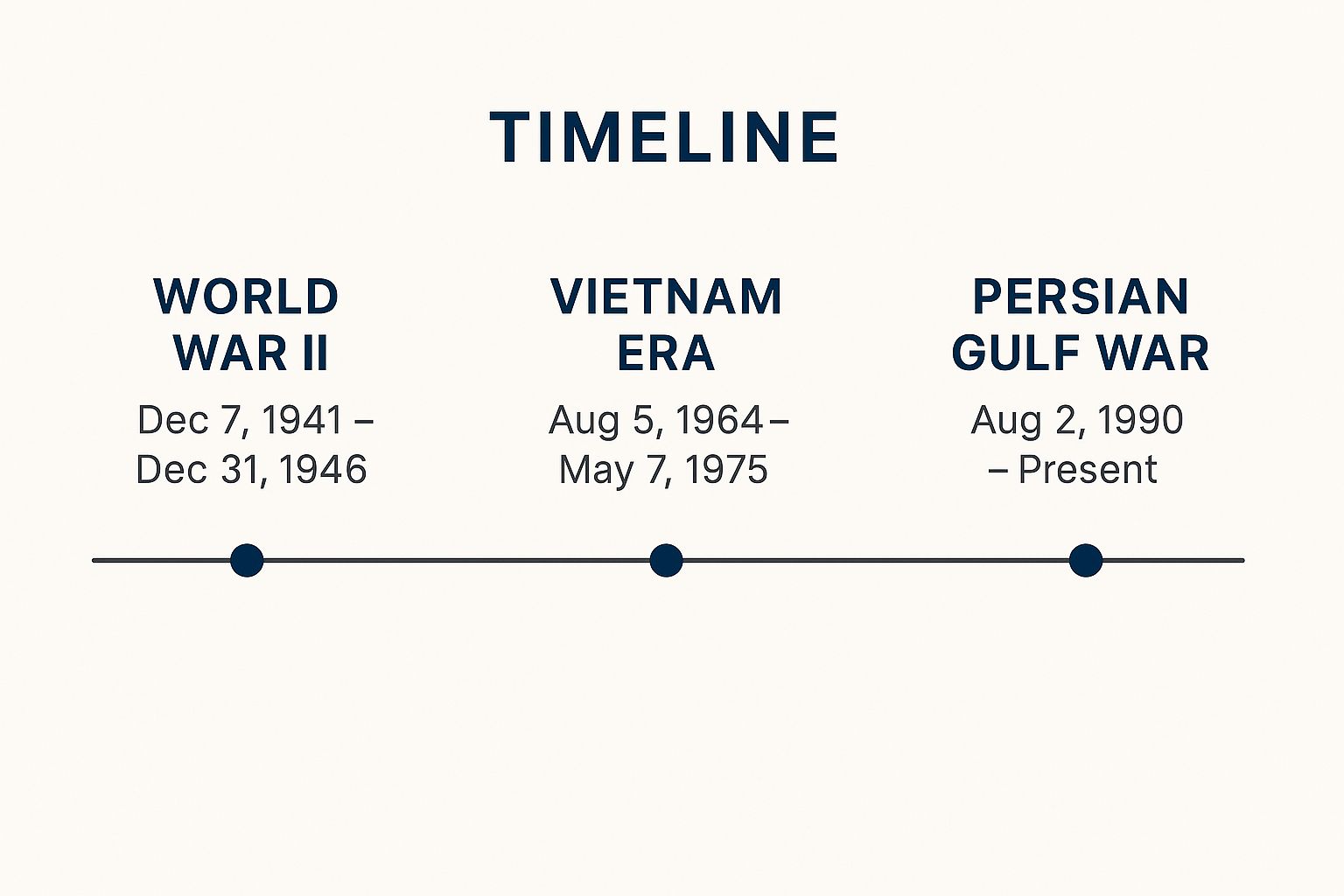
The infographic above illustrates the designated wartime periods recognized for VA benefits eligibility. It provides a clear visual timeline of these periods, outlining the start and end dates for World War II, the Korean War, the Vietnam War, and the Persian Gulf War. Note the extended duration of the Persian Gulf War period, encompassing ongoing operations from 1990 to the present day.
This visualization helps clarify how even a short period of service during a defined wartime period can impact veteran benefits eligibility. For example, a veteran who served only a few months during peacetime might not qualify for certain benefits, whereas a veteran who served just a few days during a recognized wartime period could be eligible. This distinction is crucial, particularly for pension eligibility, as wartime service is a foundational requirement.
Features of Wartime Service Qualification:
- Defined by Congress: The specific date ranges for wartime periods are established by Congress, not the VA.
- Includes major conflicts: The designated periods encompass major U.S. conflicts like World War II, the Korean War, the Vietnam War, and the Persian Gulf War (including ongoing operations).
- No combat requirement: Veterans do not need to have served in a combat zone or seen direct combat to qualify under the wartime service requirement.
- Key for VA Pension: Wartime service is particularly important for eligibility for the VA pension benefit.
Pros:
- Broadens eligibility: This criterion allows veterans who served during specific periods to access benefits they might not otherwise qualify for.
- Pension eligibility without service-connected disability: Wartime service allows veterans to potentially qualify for a pension even if they don't have disabilities directly connected to their service.
- Ongoing Gulf War period: The inclusion of the ongoing Persian Gulf War period (August 2, 1990 to present) extends eligibility to a significant number of veterans.
Cons:
- Excludes peacetime veterans: Veterans who served exclusively during peacetime are excluded from certain benefits tied to wartime service.
- Creates disparities: The system creates disparities in benefits between wartime and peacetime veterans.
- Additional requirements: Some benefits require a combination of wartime service AND other factors, like age, disability, or income limitations.
Examples:
- VA Pension: Eligibility requires wartime service, being age 65 or older, OR having a permanent disability, as well as meeting specific income and net worth limits.
- Gulf War period (8/2/1990 to present): Covers Operations Desert Shield/Desert Storm, Iraqi Freedom, Enduring Freedom, and Inherent Resolve.
Tips for Veterans:
- Verify service dates: Cross-check your service dates against the official wartime periods listed by the VA.
- Even a single day counts: Even a single day of service within a designated wartime period can potentially qualify you.
- Pension considerations: Remember that the pension also requires limited income and assets and other qualifying factors.
- Varying service requirements: Different wartime periods may have different minimum service duration requirements for specific benefits.
This wartime service period qualification deserves a prominent place on this list because it’s a fundamental element of veteran benefits eligibility. Understanding this criterion can be the key to unlocking various benefits, especially the VA pension, for veterans who served during designated wartime periods. This is particularly relevant for our target audience, including those appealing VA claims, dealing with toxic exposure, and pursuing other legal matters, as their eligibility for certain support systems and financial assistance can hinge on this crucial factor.
4. Length of Service Requirements
Length of service is a cornerstone of veteran benefits eligibility. This means the duration of your active duty service plays a critical role in determining which benefits you qualify for and the extent of those benefits. Understanding these requirements is crucial for any veteran seeking to access the support they’ve earned. This factor is especially important for veterans pursuing VA claim appeals, those affected by toxic exposure seeking benefits related to their condition, and even those navigating legal matters like medical malpractice claims, as service connection often impacts these cases. Even seemingly unrelated areas like estate planning and financial planning can be influenced by access to veteran benefits, making understanding these requirements vital.
Here's a breakdown of how length of service impacts veteran benefits eligibility:
How it Works:
The Department of Veterans Affairs (VA) establishes minimum service requirements for many of its benefit programs. These requirements ensure that benefits are directed towards those who have made a substantial commitment to military service. The length of required service often varies depending on the specific benefit, the era of service (wartime vs. peacetime), and the nature of the veteran’s discharge.
Features:
- Era-Dependent Requirements: Requirements are often different for wartime service versus peacetime service, with shorter service durations typically qualifying veterans for benefits during periods of war or national emergency.
- Benefit-Specific Requirements: The required length of service can vary significantly between benefit programs. For example, the requirements for VA healthcare differ from those for the VA Home Loan Guaranty program.
- Waivers for Disabilities and Hardship: Minimum service requirements may be waived for veterans with service-connected disabilities or those who received hardship discharges. This recognizes that a veteran’s service may be cut short due to circumstances beyond their control.
Pros:
- Accommodates Diverse Service Histories: The tiered system acknowledges both career military personnel and those who served shorter terms, particularly during wartime.
- Medical Discharge Considerations: The waiving of requirements for medical discharges protects veterans who were injured or became ill during their service.
- Partial Benefits: Some programs, like the Post-9/11 GI Bill, offer tiered benefits, allowing veterans with less than the full service requirement to still receive partial educational assistance.
Cons:
- Exclusion of Short-Term Service Members: Veterans who served for brief periods during peacetime may be excluded from certain benefits.
- Restrictive Peacetime Requirements: Longer peacetime service requirements can disadvantage veterans who served honorably during periods without conflict.
- Generational Differences: Changing requirements over time can create discrepancies in benefits eligibility between different generations of veterans.
Examples:
- VA Home Loan Guaranty: Minimum 90 days of service during wartime or 181 continuous days during peacetime.
- Post-9/11 GI Bill: 100% benefits require 36 months of service after September 10, 2001; partial benefits are available for those with 90 or more days of service.
- VA Healthcare: Generally requires 24 continuous months of active duty for those enlisting after September 7, 1980, although numerous exceptions apply.
Tips for Veterans:
- Medical Discharge: If you were medically discharged, inquire about waivers for minimum service length requirements.
- Research Specific Benefits: Don’t assume a blanket requirement. Carefully research the specific requirements for each benefit program you are interested in.
- Active Duty for Training: Be aware that active duty solely for training purposes might not count towards certain benefit requirements.
- Combining Service Periods: In some cases, multiple periods of service can be combined to meet the minimum length requirements.
Understanding length of service requirements is a fundamental aspect of navigating veteran benefits eligibility. By understanding how these requirements work and researching the specifics for each benefit, veterans can effectively access the resources and support they deserve. This is particularly important for veterans involved in claims appeals, pursuing compensation for toxic exposure, or those needing to demonstrate service connection for legal matters. It's a crucial piece of the puzzle for veterans seeking to maximize the benefits earned through their service.
5. Income and Net Worth Limits for Veteran Benefits Eligibility
Understanding income and net worth limits is crucial for determining eligibility for several key veteran benefits. These limits play a significant role, especially for needs-based programs designed to support veterans with limited financial resources. This factor deserves a place on this list because it can significantly impact a veteran's access to crucial support, including financial aid and healthcare services. Knowing how these limits work can save veterans time and prevent unnecessary application denials.
How Income and Net Worth Limits Work:
The Department of Veterans Affairs (VA) uses specific financial thresholds to determine eligibility for certain benefits. These thresholds, which vary by program, family size, and geographic location, are generally based on the total household income and, in some cases, net worth (assets minus liabilities). Your primary residence is typically excluded from net worth calculations. The VA updates these limits annually to reflect changes in federal poverty levels and cost-of-living adjustments. Therefore, it's crucial to check the most current figures when applying for benefits.
Features:
- Program-Specific: Each program (e.g., VA Pension, certain healthcare tiers) has its own income and/or net worth limits.
- Family Size: Limits often adjust based on the number of dependents in the veteran's household.
- Geographic Location: While not all programs account for regional cost-of-living variations, some might have adjustments based on location.
- Annual Updates: Income and net worth thresholds are typically revised annually.
Pros:
- Targets Need: The system prioritizes veterans with the greatest financial need.
- Medical Expense Deductions: Unreimbursed medical expenses can often be deducted from your countable income, potentially increasing eligibility.
- Primary Residence Exclusion: Your primary residence is generally not counted as an asset when calculating net worth.
- Special Monthly Pension (Aid & Attendance): Available for veterans requiring assistance with daily activities, this benefit offers a higher pension amount.
Cons:
- Disqualification for Modest Incomes/Savings: Even veterans with modest incomes or savings could be disqualified.
- Complexity: The calculations can be complex and difficult to understand without assistance.
- Regular Reporting: Changes in income or net worth must be reported promptly to avoid overpayments and potential penalties.
- Regional Cost-of-Living Disparities: The established thresholds may not accurately reflect the cost-of-living differences across various regions.
Examples of Programs Affected by Income and Net Worth Limits:
- VA Pension: This benefit provides monthly payments to wartime veterans with limited income and assets.
- Aid & Attendance Benefit: This benefit provides additional monthly payments for veterans requiring regular assistance with daily activities like dressing, bathing, or eating.
- VA Healthcare Priority Group Assignments: Income levels can influence your priority group assignment for VA healthcare, impacting cost-sharing requirements.
Actionable Tips:
- Deduct Medical Expenses: Track and deduct unreimbursed medical expenses from your countable income. This can significantly impact your eligibility.
- Report Changes Promptly: Inform the VA of any changes to your income or net worth as soon as possible to prevent overpayments and maintain eligibility.
- Seek Professional Assistance: A Veterans Service Officer (VSO) can provide invaluable assistance navigating the complex eligibility calculations and application process. They can help you understand how income and net worth limits apply to your specific situation.
- Apply for Healthcare Regardless of Income: Even if you believe your income may exceed the limits for certain healthcare benefits, applying ensures you're enrolled if you meet other eligibility criteria.
By understanding these income and net worth limitations, veterans can better navigate the VA benefits system and access the financial support and healthcare services they deserve. While these limits may seem daunting, working with a VSO can simplify the process and maximize your chances of receiving eligible benefits.
6. Discharge Status Requirements
Your discharge status plays a crucial role in determining your veteran benefits eligibility. This refers to the characterization of your separation from military service, and the VA uses it to assess your qualifications for various programs. Understanding this requirement is essential for anyone seeking to access VA benefits. This is especially critical for veterans seeking VA claim appeals, those affected by toxic exposure pursuing medical malpractice claims, and those needing assistance with estate planning, financial planning, motor vehicle accidents, or workers' compensation, as eligibility for related VA benefits can significantly impact their overall support network.
The type of discharge you received significantly impacts your access to benefits. Discharges are generally categorized as:
- Honorable: Reflects satisfactory service meeting all expected standards.
- General (Under Honorable Conditions): Indicates some minor infractions or failures to meet certain standards, but overall satisfactory service.
- Other Than Honorable (OTH): Issued for significant violations of conduct.
- Bad Conduct: Resulting from a Special Court-Martial conviction.
- Dishonorable: Resulting from a General Court-Martial conviction for serious offenses.
For most VA benefits, veterans must have received a discharge other than dishonorable. This means Honorable and General discharges generally qualify you for a wide range of benefits. However, some specific programs, like certain GI Bill benefits, may require a fully Honorable discharge. A Dishonorable discharge generally bars access to most VA benefits.
Other Than Honorable discharges present a more complex scenario for veteran benefits eligibility. These require a case-by-case review by the VA to determine eligibility. The VA will conduct a "Character of Discharge" determination, considering the nature of the offense leading to the OTH discharge and its relation to any claimed benefit.
Pros:
- The majority of veterans receive Honorable or General discharges, making them eligible for most VA benefits.
- The VA provides case-by-case evaluations for veterans with Other Than Honorable discharges, offering a pathway to potential eligibility.
- Recent policy changes, driven by increased awareness of mental health issues and their impact on service, have expanded eligibility for veterans with OTH discharges connected to PTSD, traumatic brain injury (TBI), or military sexual trauma (MST).
- Discharge upgrades are possible through dedicated review boards, providing an avenue for veterans to improve their discharge status and access more benefits.
Cons:
- A Dishonorable discharge effectively bars access to most VA benefits.
- Obtaining benefits with an Other Than Honorable discharge requires navigating a complex and sometimes lengthy case-by-case evaluation process.
- The discharge upgrade process, while potentially life-changing, can be time-consuming and demanding, requiring substantial documentation and legal support.
- For veterans with multiple periods of service and varying discharge types, the VA typically bases eligibility on the discharge from their last period of service.
Examples of Successful Implementation:
- Veterans with OTH discharges related to PTSD symptoms resulting from combat experience may now qualify for crucial mental health services through the VA.
- Veterans discharged under the now-repealed "Don't Ask, Don't Tell" policy may be eligible for discharge upgrades, opening doors to previously inaccessible benefits.
- While generally barring benefit access, even veterans with Bad Conduct Discharges resulting from General Courts-Martial may still qualify for certain limited benefits depending on the specific circumstances and the benefit sought.
Actionable Tips:
- Apply Even with an OTH Discharge: The VA is required to conduct a Character of Discharge determination, so don't assume ineligibility. Apply for the benefits you need, and let the VA make the determination.
- Pursue Discharge Upgrades: If you have an OTH discharge, explore the possibility of an upgrade. File DD Form 293 (within 15 years of discharge) or DD Form 149 (after 15 years).
- Gather Supporting Evidence: Compile all relevant documentation that supports your case for an upgrade, such as medical records, performance evaluations, and character witness statements. This is especially important for cases involving PTSD, TBI, or MST.
- Seek Expert Assistance: Consult with veterans law attorneys or Veterans Service Organizations (VSOs) specializing in discharge upgrades. They can provide invaluable guidance and advocacy throughout the process.
This item is crucial because discharge status is a foundational element of veteran benefits eligibility. Understanding its complexities empowers veterans to navigate the system effectively and access the support they deserve. Recent VA policy shifts, including the Hagel Memo (2014) and Kurta Memo (2017), have emphasized liberal consideration for discharge upgrades related to mental health conditions, reflecting a growing understanding of the impact of service on veterans' well-being. This focus makes understanding discharge requirements and pursuing upgrades even more important for veterans seeking to access the full range of available benefits.
7. Dependent and Survivor Status
Veteran benefits eligibility extends beyond the veteran themselves. Recognizing the sacrifices families make, the Department of Veterans Affairs (VA) offers a range of benefits for eligible dependents and survivors of veterans. This support system acknowledges that the impact of service, be it disability or death, ripples through the family unit. This section details the vital role dependent and survivor benefits play in the overall framework of veteran benefits eligibility.
These benefits are designed to provide financial and other forms of assistance to families facing hardship due to a veteran's service-connected disability or death. This includes spouses, children, and in some cases, dependent parents. Understanding these benefits is crucial for veterans planning for their families' future and for surviving family members seeking the support they deserve.
How It Works:
Dependent and survivor benefits encompass several areas, including:
- Education Benefits: Programs like the Survivors' and Dependents' Educational Assistance Program (DEA, Chapter 35) and the Fry Scholarship offer financial assistance for education and training.
- Compensation: Dependency and Indemnity Compensation (DIC) provides monthly payments to eligible survivors of service members who died in the line of duty or from service-connected conditions. A separate program, the Survivors Pension, is available for low-income families of wartime veterans.
- Healthcare: The Civilian Health and Medical Program of the Department of Veterans Affairs (CHAMPVA) provides healthcare coverage for dependents of permanently and totally disabled veterans.
- Other Benefits: This can include home loan guarantees, insurance, and burial benefits.
Examples of Successful Implementation:
- A surviving spouse of a veteran who died from a service-connected illness uses DIC to support their family and pursue further education.
- The child of a 100% disabled veteran utilizes Chapter 35 benefits to complete a college degree.
- The spouse of a service member killed in action receives the Fry Scholarship and attends vocational school to start a new career.
Actionable Tips:
- Apply Promptly: Apply for survivor benefits as soon as possible after a veteran's death to avoid delays.
- Gather Documentation: Keep essential documents, such as marriage and birth certificates, readily accessible.
- Transfer GI Bill Benefits While on Active Duty: Veterans wishing to transfer Post-9/11 GI Bill benefits to dependents must do so while still serving on active duty.
- Consider Lifetime Benefits for Disabled Children: Children with disabilities that onset before age 18 may qualify for lifetime benefits.
When and Why to Use This Approach:
It's essential to explore dependent and survivor benefits if:
- A veteran has a service-connected disability that impacts their family's financial well-being.
- A veteran is planning for their family's future and wants to ensure their loved ones are protected.
- A veteran has died, and their family needs financial and other support.
Pros:
- Provides crucial financial and other support to families in times of need.
- Offers educational opportunities for dependents, helping them build a secure future.
- DIC provides lifetime support for surviving spouses, offering long-term stability.
Cons:
- Remarriage before age 57 can terminate DIC benefits for surviving spouses.
- Educational benefits for dependents often have time limits.
- Eligibility criteria can be complex, especially for DIC.
- Some programs may have funding limitations or waiting lists.
Why this Item Deserves its Place in the List:
Dependent and survivor status is a cornerstone of veteran benefits eligibility. It recognizes that the impact of military service extends beyond the individual veteran and provides a safety net for families facing hardship. For veterans facing challenging circumstances like toxic exposure, service-connected disabilities, or even accidents leading to workers' compensation claims, understanding these benefits is crucial. This is especially important for those veterans also navigating complex legal matters like medical malpractice claims or requiring estate planning. Knowing that their families are protected can alleviate significant stress and allow veterans to focus on their own health and well-being. These benefits are a critical component of the overall support system designed to honor the sacrifices made by veterans and their families.
8. Legal Assistance for Veterans
Navigating the complexities of veteran benefits eligibility can be a daunting task. Many veterans face challenges when filing claims, appealing denied claims, or understanding their full range of benefits. This is where seeking legal assistance specifically tailored for veterans becomes crucial. Legal professionals specializing in veteran affairs can provide invaluable support and guidance throughout the entire process, increasing the likelihood of a successful outcome.

Legal assistance for veterans encompasses a broad spectrum of services, addressing various needs. This includes:
-
VA Claim Appeals: If your VA claim has been denied, a lawyer specializing in veteran law can help you navigate the appeals process, gather supporting evidence, and present a strong case for reconsideration. They understand the intricacies of VA regulations and can identify potential errors or omissions in the initial decision.
-
Toxic Exposure Claims: Veterans exposed to harmful substances during their service, such as Agent Orange or burn pits, may be eligible for disability benefits. A lawyer can assist in establishing the link between exposure and resulting health conditions, a critical component of a successful claim.
-
Medical Malpractice Claims: If you've experienced medical negligence within the VA healthcare system, a lawyer can help you pursue a malpractice claim. They can investigate the incident, gather medical records, and build a case to hold the responsible parties accountable.
-
Estate and Financial Planning: Legal professionals can assist veterans with estate planning, including drafting wills, establishing trusts, and ensuring their assets are protected and distributed according to their wishes. This is particularly important for veterans with dependents.
-
Motor Vehicle Accidents and Workers' Compensation: While not directly related to VA benefits, many veteran-focused law firms also assist with personal injury claims arising from motor vehicle accidents or workplace injuries, including workers' compensation for both veterans and first responders. This comprehensive approach addresses the diverse legal needs veterans may face.
Actionable Tips for Seeking Legal Assistance:
- Look for Accreditation: Seek out lawyers accredited by the Department of Veterans Affairs. This accreditation signifies they have met specific requirements and are authorized to represent veterans before the VA.
- Experience Matters: Choose a lawyer with extensive experience handling veteran-specific legal matters, particularly in the area you need assistance with (e.g., appeals, toxic exposure).
- Clear Communication: Ensure the lawyer communicates clearly and keeps you informed about the progress of your case.
- Fee Structure: Understand the lawyer's fee structure upfront. Many work on a contingency basis, meaning they only receive payment if your claim is successful.
Pros of Seeking Legal Assistance:
- Expertise: Veterans' law is complex. A lawyer provides the expertise needed to navigate the system effectively.
- Reduced Stress: Having legal representation can alleviate the stress and burden of managing the claims process on your own.
- Improved Outcomes: Lawyers can significantly increase your chances of a successful claim or appeal.
Cons of Seeking Legal Assistance:
- Cost: While contingency fees are common, it’s important to understand the percentage the lawyer will receive if your claim is successful.
- Time Commitment: Legal processes can take time, and you will need to be actively involved in providing information and attending hearings.
Legal assistance is an invaluable resource for veterans seeking to secure their rightful benefits. It deserves its place on this list because it empowers veterans to overcome the challenges inherent in the claims process and obtain the support they need and deserve. By seeking professional legal guidance, veterans can significantly improve their chances of achieving a positive outcome and accessing the full range of benefits available to them. Unfortunately, a specific website link for general veteran legal assistance isn’t applicable as resources vary by location and specific legal need. It’s recommended to search for "accredited veterans lawyers [your state/region]" to find local resources.
Veteran Benefits Eligibility Criteria Comparison
| Eligibility Criterion | Implementation Complexity 🔄 | Resource Requirements ⚡ | Expected Outcomes 📊 | Ideal Use Cases 💡 | Key Advantages ⭐ |
|---|---|---|---|---|---|
| Military Service Requirements | Moderate – Verification of service and discharge status needed | Low – Requires service records like DD-214 | Foundational VA benefits eligibility | Veterans with qualifying service and discharge | Broad inclusion of service types; peacetime and wartime recognized |
| Service-Connected Disability Status | High – Lengthy application, medical evidence, possible appeals | High – Medical records, exams, professional assistance | Tax-free compensation, enhanced benefit access | Veterans with service-related disabilities | Opens numerous benefits; scalable by disability rating |
| Wartime Service Period Qualification | Low – Verify service dates against official wartime periods | Low – Service records review | Eligibility for pension and other benefits | Veterans who served during defined conflict periods | Expands eligibility beyond disability criteria |
| Length of Service Requirements | Moderate – Varies by program and service dates | Low to Moderate – Documented service time | Qualification for benefits sensitive to service duration | Career and shorter-term veterans meeting time minimums | Flexibility with waivers for disabilities/hardship |
| Income and Net Worth Limits | Moderate – Complex financial assessments | Moderate – Detailed financial documentation | Needs-based benefits targeting low-income veterans | Veterans requiring financial need verification | Ensures benefits go to those with greatest financial need |
| Discharge Status Requirements | Moderate to High – Discharge verification and possible upgrade processes | Moderate – Access to military discharge records and legal support | Eligibility determination for most VA benefits | Veterans with complex discharge statuses | Allows case-by-case review and possible upgrades |
| Dependent and Survivor Status | Moderate – Verification of family relationships and veteran status | Moderate – Family documents and veteran proofs | Support for families of disabled or deceased veterans | Spouses, children, and survivors of qualifying veterans | Lifelong support and benefit transfer options |
Take the Next Step Towards Your Benefits
Understanding your veteran benefits eligibility can feel overwhelming, but breaking it down into key components makes the process more manageable. This article covered critical aspects of eligibility, including military service requirements, service-connected disability status, wartime service periods, length of service, income and net worth limits, discharge status, and dependent and survivor benefits. Mastering these concepts is crucial for accessing the support you’ve earned through your service. These benefits can significantly impact your financial well-being, healthcare access, and overall quality of life. Planning for your future also involves considering your assets; for example, if you own a business, understanding the tax implications of selling a business can be a crucial part of your long-term financial strategy. Source: What Are the Tax Implications of Selling Your Business? from Acquire.com.
Now is the time to take the next step. Don’t navigate this complex process alone. Determining your veteran benefits eligibility is the first step towards securing the support you deserve. Homefront Group offers a free 3-minute quiz to help you pinpoint your potentially qualifying benefits, along with expert legal guidance to navigate the often-challenging claims process. With $45 million in pending claims for injured veterans and nationwide support, Homefront Group is your trusted partner. Connect with Homefront Group today to start building a more secure future and get the benefits you've earned.