
If you're a veteran dealing with a constant ringing in your ears, you're not alone, and understanding the VA disability rating for tinnitus is your first step toward getting the benefits you've earned. The Department of Veterans Affairs (VA) has a very specific way of rating this condition under Diagnostic Code 6260: it’s a fixed disability rating of 10%, and that’s true whether the ringing is in one ear or both.
Understanding the VA Disability Rating for Tinnitus
Tinnitus is one of the most common service-connected disabilities, and for good reason. For so many of us, military service meant constant exposure to loud noises—from engine rooms and flight lines to rifle ranges and combat zones. That relentless ringing, buzzing, or hissing isn't just an annoyance; it can seriously interfere with your daily life, messing with your sleep, focus, and overall sense of peace.
Even though the impact can be profound, the VA’s rating for tinnitus is uniquely straightforward and, for many veterans, surprisingly rigid.
The Fixed 10% Rating Explained
I often tell veterans to think of the VA's tinnitus rating like a pass/fail grade. If the VA agrees your tinnitus is connected to your service, you get 10%. It doesn't matter if the ringing is a faint whisper or a deafening roar. It doesn't matter if it's in your left ear, your right ear, or both. The rating is 10%. Period.
This is the maximum schedular rating you can get for a tinnitus claim by itself. This often catches veterans by surprise, especially when the condition feels debilitating enough to warrant a much higher evaluation. But this is just how the VA’s rulebook is written, and knowing that upfront helps set realistic expectations for your claim.
Why This Rating Is So Common
Tinnitus isn't just common; it's the single most prevalent service-connected disability for U.S. veterans. In fact, more than 2.9 million of us are currently receiving benefits for it. The VA uses Diagnostic Code 6260 to assign that flat 10% rating. While that percentage might not seem like much on paper, the disruption to your quality of life can be enormous. You can dig deeper into how tinnitus became the top claimed disability for veterans over on the Hill & Ponton website.
Key Takeaway: The VA recognizes how widespread tinnitus is by granting a disability rating, but the rules are strict: the rating is capped at 10%. This number doesn't change based on how loud the ringing is or whether it affects one ear or both.
Getting this from the start is crucial. A 10% rating does provide monthly compensation and opens the door to VA healthcare, but it might not feel like it fully captures the daily struggle. That’s why we often look at filing for secondary conditions caused by tinnitus, like anxiety or insomnia, but we’ll get into that later.
For now, let's break down the core components of the rating itself.
Tinnitus VA Rating at a Glance (Diagnostic Code 6260)
The table below gives you a quick summary of how the VA looks at a tinnitus claim. It’s simple, but every detail matters.
| Rating Aspect | VA Specification | What This Means for Veterans |
|---|---|---|
| Diagnostic Code | DC 6260 | This is the specific code the VA uses to classify and rate tinnitus. |
| Maximum Rating | 10% | This is a fixed rate; it cannot be increased based on severity. |
| Affected Ears | One or Both | The rating remains 10% whether the condition is in one ear or both. |
Essentially, the VA’s approach is black and white. If you can prove your tinnitus is service-connected, you receive a 10% rating. Understanding these fixed rules is the foundation for building a successful claim.
How to Prove Service Connection for Tinnitus
Getting your VA disability claim for tinnitus approved boils down to one crucial thing: service connection. You have to build a rock-solid case that proves, without a doubt, that your tinnitus is a direct result of your military service.
Think of it like building a three-legged stool. If one leg is wobbly or missing, the whole thing comes crashing down. It’s your job to connect the dots for the VA reviewer, and you need to establish three key elements to do it successfully. Getting this right is often the difference between an approval and a denial.
This infographic breaks down what you'll need for your VA tinnitus claim.
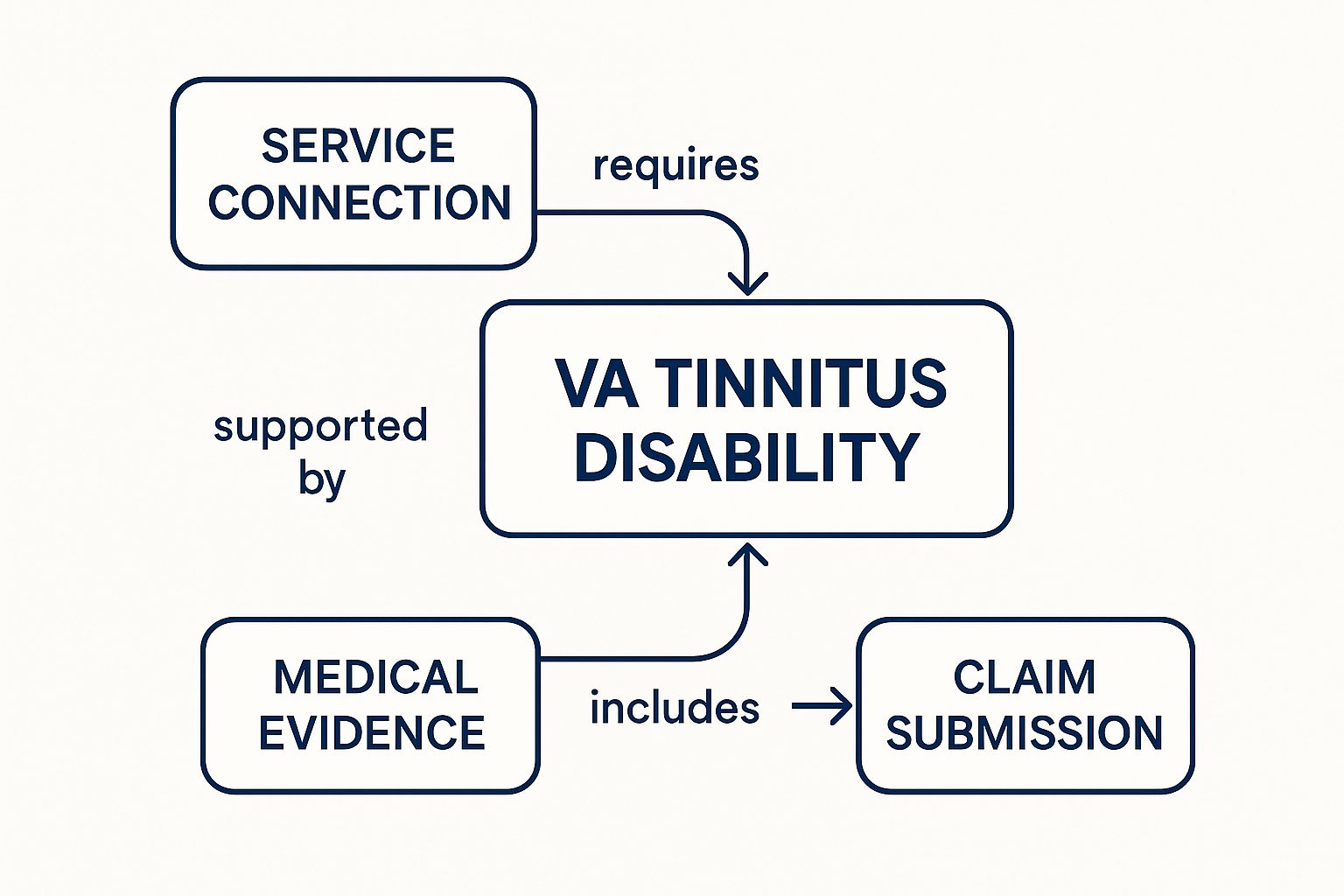
As you can see, the foundation of any strong claim is proving that connection to your service with solid evidence. Let's dig into the three pillars you need to construct.
Pillar 1: A Current Tinnitus Diagnosis
First things first, you need an official, current diagnosis of tinnitus from a medical professional. This isn't optional. Simply stating you have ringing in your ears won't cut it; the condition must be formally documented in your medical records.
An audiologist or an Ear, Nose, and Throat (ENT) specialist is your best bet for a diagnosis. While a diagnosis from your primary care doctor can work, one from a specialist who lives and breathes this stuff carries a lot more weight with the VA. This diagnosis is the first leg of your stool—it confirms your condition exists today.
Pillar 2: The In-Service Event or Injury
Next, you have to pinpoint a specific event, injury, or even a period of exposure during your service that likely caused your tinnitus. This is the "how" and "why" of your claim. For most of us, this comes down to acoustic trauma—damage caused by exposure to dangerously loud noises.
Your service records are your best evidence here. You need to show the VA you were in a noisy environment. Think about:
- Your Job (MOS/AFSC): Were you an 11B Infantryman, a 13B Artilleryman, or did you work on aircraft? Some jobs are practically a given for noise exposure.
- Combat Experience: Deployment records, especially if you have a Combat Infantryman Badge (CIB) or Combat Action Badge (CAB), paint a clear picture of exposure to gunfire and explosions.
- Service History: Even routine duties matter. Performance reports or training records that put you on a flight line, in an engine room, or on a firing range for extended periods are gold.
Comb through your memory and your records to identify the specific sources of noise. This documented exposure becomes the second, sturdy leg of your stool.
Pro Tip: Don't just focus on combat. Years spent as a rifle range instructor, working in a ship's engine room, or on an airfield tarmac are just as damaging. Documenting this day-in, day-out noise exposure is crucial.
Pillar 3: The All-Important Medical Nexus
Finally, you need the glue that holds it all together: the medical nexus. This is a statement from a medical expert that connects your current tinnitus (Pillar 1) to your noise exposure in the military (Pillar 2). It's a professional medical opinion that bridges the gap between your past service and your present condition.
The most effective nexus is a formal letter from your doctor or audiologist. A powerful nexus letter will use specific VA-approved language, stating that your tinnitus is "at least as likely as not" a result of your in-service noise exposure. That phrase is a legal standard the VA looks for, and having it in your file is incredibly important.
You can also back this up with lay statements, often called "buddy letters." These are personal accounts that add real-world context to your claim.
- From your spouse or family: They can write about how the constant ringing affects your sleep, your ability to concentrate, and your mood in daily life.
- From fellow service members: A buddy from your unit can confirm the noisy environments you worked in together, backing up your claims about exposure.
These personal stories add a human element that helps the VA reviewer understand the real-life impact of your condition. Once you have all three pillars firmly in place—a diagnosis, an in-service event, and a strong nexus—you've built a claim that’s ready for approval.
Navigating Your C&P Exam for Tinnitus

Your Compensation and Pension (C&P) exam is probably the most critical part of your tinnitus claim. Think of it as the VA's on-the-ground investigation. You'll meet with a doctor or audiologist—someone contracted by the VA—whose sole job is to assess your condition. They aren’t there to treat you; they’re there to write a medical opinion that a VA rater will use to decide your claim.
This appointment is your chance to connect the dots for the examiner. It’s where all the paperwork you've gathered comes to life through your own words. Going in prepared can make a world of difference, helping ensure the examiner's final report truly captures what you go through every day.
What to Expect During the Exam
The C&P exam for tinnitus is usually pretty straightforward and doesn't involve any invasive procedures. The examiner has two main goals: to confirm you actually have tinnitus and to understand how, when, and why it started. They're trying to piece together the story of your tinnitus and see how it links back to your military service.
You should be ready for some very specific questions. They will almost certainly ask:
- When did the ringing start? Be prepared to link the beginning of your tinnitus directly to your service.
- What does it sound like? Try to describe the specific noise—is it a high-pitched ring, a low buzz, a hiss, or even a clicking sound?
- Is it constant or does it come and go? Honesty is key here. Describe the frequency as accurately as you can.
- How does it impact your life? This is your moment to explain the real-world effects. Talk about your trouble with concentration, sleep, mood, and hearing.
This isn't the time to be the tough soldier who shrugs things off. It's also not the time to exaggerate. Just be completely honest and specific about what you experience.
The C&P examiner’s report is a make-or-break piece of evidence. Your job during the exam is to give them clear, consistent, and truthful information so they can understand the full impact of your tinnitus and its service connection.
Preparing for Your C&P Exam
Walking into your C&P exam prepared is the best thing you can do for your claim. It helps you communicate clearly and effectively, especially when you might be feeling nervous. Don't just try to recall everything from memory on the spot.
Here’s how you can get ready:
- Review Your Records: Before the exam, look through your service records. Refresh your memory on the specific equipment, weapons, or high-noise environments you were exposed to.
- Keep a Symptom Log: For a few weeks before your appointment, jot down notes in a simple log. Track how often you notice the tinnitus, how loud it is, and when it bothers you the most—like in a quiet room at night or during a meeting at work.
- Prepare to Describe the Impact: Think in terms of concrete examples. Instead of just saying, "It messes with my sleep," try something more specific like, "The ringing gets incredibly loud when my room is quiet, and most nights it takes me at least an hour to finally fall asleep because of it."
These specific details paint a clear picture for the examiner. Your firsthand account of how this constant noise disrupts your life is the crucial context needed to support your claim for a VA disability rating for tinnitus.
Using Secondary Conditions to Increase Your Rating
That 10% rating for tinnitus is a hard ceiling, but it's not the end of the road. It’s best to think of your service-connected tinnitus as the foundation. While that foundation has a fixed value, it can support a much larger structure. Those additional parts of the structure are secondary conditions—health problems caused or aggravated by your tinnitus.
For many veterans, this is the most critical part of their disability claim strategy. The constant, grinding nature of tinnitus often kicks off a domino effect, leading to other serious health issues. If you can successfully prove that your tinnitus is the root cause of these other problems, you can increase your overall disability rating to a level that truly reflects your day-to-day reality.
How Tinnitus Causes Other Health Problems
Living with a never-ending ringing, buzzing, or hissing in your ears is more than just a nuisance. It's a chronic stressor that chips away at you, both mentally and physically. This constant sensory assault can directly cause or worsen other conditions. Your job is to show the VA how the stress, sleep deprivation, and sheer frustration from your tinnitus are directly connected to these other health problems.
This isn't just a theory; it's a recognized medical fact. The daily burden of managing tinnitus symptoms frequently leads to a host of other debilitating issues that can qualify for their own separate VA disability ratings.
Key Insight: A secondary claim isn't about getting more compensation for tinnitus itself. It's about securing separate disability ratings for legitimate health conditions that developed because of your service-connected tinnitus.
Common Secondary Conditions Linked to Tinnitus
While you can link many conditions to tinnitus, some connections are more straightforward and frequently successful. These conditions usually have a clear, logical tie to the chronic stress and sleep disruption that severe tinnitus is known to cause.
Here are some of the most common secondary conditions to explore:
- Anxiety and Depression: It’s no surprise that a constant, intrusive noise can lead to heightened stress, irritability, and a sense of hopelessness. The mental fatigue from battling tinnitus is a well-documented cause of both anxiety disorders and major depression.
- Insomnia: Trying to fall asleep in a quiet room when a loud ringing is your only companion is incredibly difficult. Chronic insomnia is one of the most common fallout effects of tinnitus, which then leads to daytime fatigue and a cascade of other health complications.
- Migraines: The physical tension and mental stress from persistent tinnitus can be a powerful trigger for severe headaches and migraines. If you can show your migraines either started or got significantly worse after your tinnitus began, you might have a strong case for a secondary claim.
To successfully link these conditions, you'll need a solid medical nexus. This means getting a doctor to write a medical opinion stating that your secondary condition is "at least as likely as not" caused or made worse by your primary tinnitus disability.
Tinnitus as a Secondary Condition Itself
It’s also important to realize this connection works both ways. Sometimes, tinnitus isn't the primary problem but is instead a symptom of another service-connected disability. This offers another strategic path to getting a service connection for your VA disability rating for tinnitus.
For instance, tinnitus is often claimed as a secondary condition to:
- Hearing Loss: This is the most common link. Damage to the auditory system that results in hearing loss very often causes tinnitus, too.
- Traumatic Brain Injury (TBI): Tinnitus is an extremely common residual effect of a TBI.
- Neck or Head Conditions: Injuries to the head or neck can disrupt the auditory nerves, which can lead to tinnitus.
- Ménière’s Disease: This inner-ear disorder, which affects balance and hearing, lists tinnitus as one of its main symptoms.
This two-way street really highlights how interconnected many health issues are for veterans. In fact, the link between military service and auditory problems is undeniable. As of mid-2023, more than 3.6 million U.S. veterans were receiving disability benefits for hearing loss and tinnitus combined.
The statistics back this up. Research shows that veterans are roughly 30% more likely than non-veterans to have severe hearing impairment, and post-9/11 veterans experience hearing loss at four times the rate of their civilian counterparts. You can discover more insights about these veteran hearing statistics from the team at CCK Law.
Whether you're claiming conditions caused by your tinnitus or claiming tinnitus itself as secondary to something else, the strategy is identical. You have to build a strong case with clear medical evidence that connects the two conditions. For many veterans, this approach is the key to securing a combined disability rating that truly reflects the full scope of their service-connected health struggles.
It’s a gut-punch, pure and simple. Opening that letter from the VA and seeing your tinnitus claim was denied is incredibly frustrating. But I want to be very clear: this is not the end of the line. A denial isn't a final judgment; it's just the VA's first take based on the information they had at the time. You absolutely have the right to fight it.

Think of this as a new phase of your mission. The VA's appeals system, updated in 2019, gives you three different routes you can take. The very first thing to do is read that denial letter—and I mean really read it. Buried in the jargon is the exact reason why they denied you. Understanding that reason is the key to choosing your next move.
Choosing Your Appeal Pathway
Picking the right appeal option is like choosing the right tool for a specific job. Each path serves a different purpose, so you need to match your situation to the right one to have the best shot at success.
- Supplemental Claim: This is your best bet if you have new and relevant evidence that wasn't in your original file.
- Higher-Level Review: This is for when you think the VA made a mistake with the evidence you already provided. No new evidence is allowed here.
- Board Appeal: The most formal route, where you take your case to a Veterans Law Judge for a completely fresh review.
Let's dig into the two most common options veterans use after a tinnitus claim gets denied.
A denial is not a final judgment. It is an opportunity to strengthen your case and resubmit it with a clearer, more compelling argument. Your fight for the VA disability rating for tinnitus you deserve has simply entered a new phase.
Filing a Supplemental Claim
Did your denial letter mention you were missing a current diagnosis? Or that you didn't prove a specific event in service caused the ringing? Maybe it said there was no "nexus" linking your condition to your military career. If you see any of that, the Supplemental Claim lane is made for you. This path is all about filling in the blanks.
For a tinnitus claim, that new evidence could look like:
- A brand new nexus letter from an audiologist directly connecting your tinnitus to your service.
- "Buddy letters" from friends you served with who can back up your story about noise exposure.
- Updated medical records that provide a more detailed tinnitus diagnosis.
The entire goal here is to find the weak spot the VA pointed out and fix it with solid, new proof. If they said there was no link, a powerful nexus letter is the perfect fix.
Requesting a Higher-Level Review
But what if you read the denial and think, "Wait a minute, all the proof was in there! They just missed it."? If you’re confident that you had a rock-solid case and the rater simply made an error, then a Higher-Level Review is the way to go.
When you choose this option, a more senior VA reviewer takes a completely fresh look at your file. You can’t add any new evidence—they are restricted to seeing the exact same documents the first person saw. This makes it the ideal choice when you believe the evidence for service connection was already strong and a simple mistake was made the first time around.
Answering Your Top Questions About VA Tinnitus Claims
Going through the VA claims process for the first time can feel like you're trying to solve a puzzle with a lot of moving parts. It’s completely normal to have questions as you put together your claim for tinnitus, and getting clear answers is key. Let's walk through some of the most common questions veterans have.
Is it Possible to Get More Than a 10% Rating for Tinnitus?
This is probably one of the most frequent questions I hear. The short answer is no, not for tinnitus by itself. The VA’s rating schedule, under Diagnostic Code 6260, assigns a maximum rating of 10% for tinnitus. It’s a flat rate, which means it doesn't matter if you have it in one ear or both, or how loud the ringing is—the rating stays at 10%.
But that's not the end of the road. While tinnitus itself maxes out, you can absolutely get a higher combined disability rating by connecting other conditions that have developed because of your tinnitus. Think about it: constant ringing can easily lead to things like migraines, anxiety, depression, or insomnia. Each of those can be claimed as a secondary condition and receive its own, separate rating.
What's a Buddy Letter, and Does it Actually Help?
A "buddy letter" is the informal name for what the VA officially calls a lay statement. It’s a written account from someone who knows you well and can speak to your condition. This could be your spouse, a parent, a close friend, or even a service member you served with.
Don't underestimate the power of these letters. They are incredibly valuable pieces of evidence. For a tinnitus claim, a buddy letter can:
- Corroborate your story about being exposed to loud noises in service.
- Describe the real-life impact of your tinnitus—how it messes with your sleep, focus, or even just your ability to enjoy quiet moments.
- Offer a personal perspective that backs up the more clinical evidence in your file.
A strong buddy letter brings your claim to life. It gives the VA rater a glimpse into the person behind the paperwork, showing them how tinnitus truly affects you day-to-day.
Do I Really Need to Hire a Lawyer to File?
You absolutely do not need a lawyer to file your initial claim. Plenty of veterans navigate the process on their own or get free, expert help from an accredited Veterans Service Officer (VSO). VSOs are fantastic resources and can guide you through the initial steps.
Where a lawyer becomes a game-changer is if your claim gets denied and you have to appeal. The appeals system is a different beast altogether, with its own set of complex rules. An experienced VA-accredited attorney lives and breathes this stuff and can be your best ally in turning a denial around, especially if your case is complicated.
What Should I Do If My Claim Was Denied for Lacking a Service Connection?
Getting a denial for "lack of service connection" is frustrating, but it's a common hurdle. It simply means the VA wasn't convinced there was a solid link—or "nexus," in VA terms—between your tinnitus and your time in the military.
The best way to fight this is to strengthen that link. You'll want to get a powerful nexus letter from a medical expert, like an audiologist or your primary care doctor. This letter needs to use specific language, stating that it is "at least as likely as not" that your military service is the cause of your tinnitus. Once you have that letter, you can file a Supplemental Claim, submitting it as new and relevant evidence.