
Getting a denial or a low rating on your VA disability claim is tough, but don't think for a second that it's the final word. It’s simply a signal to shift your strategy. The clock starts now: you have one year from the date on that decision letter to fight back. Knowing your options is the critical first step to getting the benefits you rightfully earned through your service.
Making Sense of Your VA Decision and Picking Your Path
When you open that VA decision letter and the outcome isn't what you expected, it's easy to feel frustrated. But that letter is your new roadmap. Before you do anything else, find the "Reasons for Decision" section and read it carefully. This is where the VA lays out its cards, explaining exactly why they denied your claim or gave you a lower rating than you deserve.
Once you’ve pinpointed their reasoning, you can decide on the best way to move forward. The VA has three main appeal lanes, and each one is built for a different kind of fight.
How To Choose Your Appeal Lane
This is probably the most important strategic decision you'll make in the entire process. The lane you pick determines what kind of evidence you can use, how your case gets reviewed, and how long you might be waiting for a new decision.
Here's a breakdown of your options:
-
Higher-Level Review (HLR): Think of this as asking for a second opinion. You should choose this path if you're confident the VA made a mistake with the evidence they already had. You can't add anything new. A more senior reviewer will take a fresh look at your file to see if the original decision was correct based on the facts and law.
-
Supplemental Claim: This is your go-to if you have new and relevant evidence to add to your case. This is often the most common and successful route because it lets you directly address the VA's reasons for denial. Did they say you lacked a current diagnosis? Get one. Did they question the link to your service? A strong medical nexus letter can make all the difference.
-
Board of Veterans' Appeals (BVA): This is the most formal option, sending your case up to a Veterans Law Judge. It’s usually reserved for more complicated legal arguments or after you've tried the other lanes. While it offers a chance for a formal hearing, be prepared for a much longer wait.
This flowchart can help you visualize where to start after receiving your initial decision.
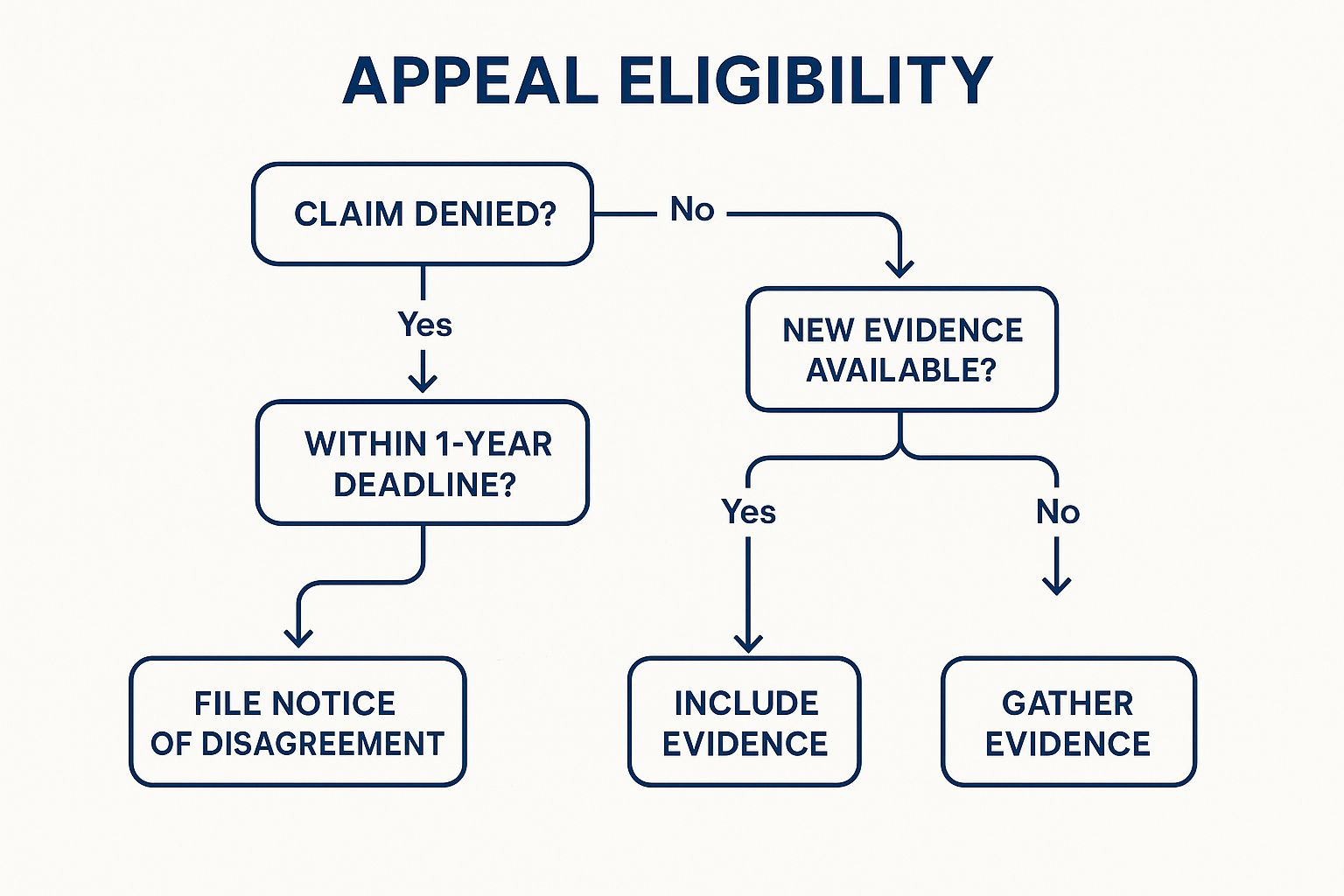
As you can see, the two biggest factors right off the bat are that one-year deadline and whether you have new evidence ready to go.
To help you see the differences more clearly, here's a side-by-side look at your options.
Comparing Your VA Disability Appeal Options
This table provides a side-by-side comparison of the three main VA appeal lanes to help you choose the best path for your situation.
| Appeal Type | When to Use It | New Evidence Allowed? | Typical Success Rate |
|---|---|---|---|
| Higher-Level Review | You believe the VA made a clear error with the evidence they already had. | No | Around 50% |
| Supplemental Claim | You have new and relevant evidence to strengthen your case (e.g., new medical records, buddy letters). | Yes | Around 50% |
| Board of Veterans' Appeals | For complex legal issues or after other options have failed. You can choose from three dockets. | Depends on the docket you choose. | Around 38% |
Choosing the right lane from the start can save you a tremendous amount of time and frustration. The data shows that preparing a strong case at the regional office level often yields better and faster results than escalating to the Board.
What the Numbers Say About Strategy
The appeal route you select has a real, measurable impact on your chances of winning. It's not just about preference; it's about playing the odds based on solid data.
As of early 2025, both Higher-Level Reviews and Supplemental Claims have a success rate hovering around 50%. In stark contrast, appeals that go all the way to the Board of Veterans’ Appeals see a success rate closer to 38%.
What does this tell us? It strongly suggests that your best bet is often to either pinpoint a clear error for an HLR or, more commonly, to build a stronger case with new evidence for a Supplemental Claim. Rushing to the Board might feel like a bigger step, but statistically, it's often a less effective one. These figures highlight why a well-prepared, strategically sound appeal at the initial stages is so critical. You can always dig deeper into the latest VA appeal success rates to help guide your decision.
How to Build a Winning Supplemental Claim

So, the VA denied your claim. If you have fresh evidence that could turn the tables, the Supplemental Claim lane is often your best bet for a successful VA disability claim appeal. This isn't just about throwing more paper at the problem. It’s a strategic move to fill the specific gaps the VA pointed out in its denial letter.
The entire process hinges on two words: new and relevant. "New" means the VA has never seen this piece of evidence before. "Relevant" means it directly addresses why they denied you. Just resubmitting the same old records won't cut it. You need something that forces them to re-evaluate their decision.
What Counts as New and Relevant Evidence?
Let’s walk through a real-world scenario. Say the VA denied your PTSD claim because they found no proof of a current diagnosis in your file. In this case, "new and relevant" evidence would be a brand-new medical report from your psychiatrist formally diagnosing you with PTSD. It’s new because it wasn’t in the original submission, and it’s relevant because it directly provides the missing piece of the puzzle.
On the flip side, sending in ten more buddy letters that all repeat the same story as your first batch? That’s not new or relevant. Your goal is to give the VA rater a legitimate reason to see your claim in a new light.
Key Takeaway: The single most powerful piece of evidence you can get for a Supplemental Claim is often medical. A targeted report from a specialist carries immense weight. It provides an objective, professional opinion that can be the final word in connecting your condition to your service.
Gathering Powerful Medical Evidence
A solid medical opinion is the foundation of many successful appeals. Two documents, in particular, can be absolute game-changers for your claim.
-
Independent Medical Opinion (IMO): This is a detailed assessment from a private doctor who isn't affiliated with the VA. A good IMO involves the provider reviewing your entire claims file and then writing a clear, evidence-backed opinion on your condition. If the VA denied your knee claim, an IMO from an orthopedic surgeon concluding that your arthritis is "at least as likely as not" caused by your in-service injury can be the knockout punch.
-
Nexus Letter: This is a laser-focused type of IMO. Its sole purpose is to establish the "nexus," or connection, between your current disability and an event, injury, or illness from your military service. If the VA agrees your back is a mess but denied service connection, you need a nexus letter. Getting one from a doctor who can explain precisely how your duties as an infantryman led to your spinal degeneration is exactly the tool for the job.
When pulling together evidence, a thorough review of your entire medical history is essential. To speed this up, you might even consider using an AI-powered medical record analyzer to help pinpoint the most relevant information buried in your records.
Securing Compelling Lay Evidence
While medical records are king, don't sleep on the power of "lay evidence," also known as buddy letters. These are sworn statements from people who know you—spouses, friends, or fellow service members—and have witnessed your condition firsthand.
A weak buddy letter says, "John has had back pain since the Army." A strong buddy letter gets specific. It paints a picture: "I served with John in Iraq. I was there when he fell from the MRAP in 2008. Before that day, he never once complained about his back. Ever since, I’ve watched him struggle to even stand up straight, and he can no longer help me with projects around the house like he used to."
These personal stories add a critical human element. They can corroborate the events in your service records and make your claim far more compelling and believable to the person reviewing it.
Completing VA Form 20-0995
Once you have all this powerful new evidence, you’ll submit it using VA Form 20-0995, Decision Review Request: Supplemental Claim. Pay close attention to Part II, "New and Relevant Evidence." This is where you must clearly list every single new piece of information you’re providing.
Don't be vague and just write "medical records." Be specific.
Instead, list:
- "Dr. Smith's Nexus Letter dated May 15, 2025"
- "Buddy Letter from Jane Doe"
- "MRI report from XYZ Imaging dated June 1, 2025"
This clarity makes the VA rater's job easier and immediately shows them what's new and why it matters to your appeal.
Using a Higher-Level Review to Correct Errors

What if you get your decision letter and think, "Wait a minute, they completely missed something"? If you’re convinced the VA simply made a mistake with the evidence already in your file, a Higher-Level Review (HLR) is your most direct path forward.
This isn't about submitting new documents. It's about getting a fresh set of eyes on the existing record. Think of it as asking a more senior, experienced reviewer to take a second look because you believe the first decision was flawed. The entire goal is to point out a clear error in how the VA interpreted the facts or applied the law.
When it works, it’s often the quickest way to get a denial overturned, with a new decision typically coming back in 4–5 months.
Framing Your Argument for an HLR
Success with an HLR boils down to one thing: clearly identifying a specific mistake. Simply saying "I disagree" won't get you anywhere. You have to build a logical case showing the original rater either overlooked crucial information or misunderstood what was there.
For example, a powerful argument is pointing out that the rater completely ignored a key medical report that was already in your claims file. Let's say your denial letter claims there's no evidence of chronic knee pain, but your service treatment records document multiple complaints and a diagnosis. That’s a perfect scenario for an HLR. You're holding the VA accountable for the evidence they already had in their hands.
Another angle is arguing an error of law. This is a bit more complex, but it happens when the VA applies the wrong legal standard to your case. A common example is misinterpreting the "at least as likely as not" standard of proof required for service connection.
Preparing for the Informal Conference
When you file VA Form 20-0996 to request your HLR, you'll see an option for an informal conference. My advice? Almost always take it. This is your one shot to speak directly with the senior reviewer assigned to your case.
This isn't a formal, intimidating hearing; it's just a brief phone call. But it's your chance to personally state your case and guide the reviewer.
Pro Tip: Don’t waste this call by just rehashing your entire claim history. Your mission is to direct the reviewer’s attention to the specific error you believe they made. Be a guide, not just a storyteller.
Meticulous preparation is key. Here’s how to make that call count:
- Create a simple outline or script. Write down your main points. Start by clearly stating the error, then point to the exact evidence in your file that proves it.
- Practice your delivery. You only have a few minutes, so be concise, calm, and professional.
- Reference specific documents. Have your C-file ready. You want to be able to say, "If you could please turn to page 78 of my service medical records, you'll see that Dr. Jones noted…"
This informal conference is your best opportunity to advocate for yourself and ensure your VA disability claim appeal gets the fresh look it deserves. It turns your appeal from a stack of papers into a direct, human conversation, which can truly make all the difference.
Taking Your Appeal to the Board of Veterans' Appeals
If you've hit a wall with other appeal options, or if your case hinges on tricky legal arguments, it might be time to take your claim to the Board of Veterans' Appeals (BVA). This is the last stop within the VA itself. Your file goes before a Veterans Law Judge (VLJ) who gives it a fresh, independent look.
Taking this step is a big deal, but knowing how the process works can give you the confidence you need to see it through.
The first, and most important, decision you'll make is which of the three BVA dockets, or "lanes," you want your appeal to enter. This choice dictates what evidence the judge can look at and whether you can speak to them directly. Be aware: once you choose a lane, you're locked in for this appeal, so think carefully about your strategy here.
Which BVA Lane is Right for You?
Each of the three dockets is designed for a different situation. The best choice really depends on the specifics of your case.
The Direct Review Docket
Think of this as the fast track. You’re essentially telling the BVA, "The previous decision was wrong based on the evidence you already have." You can't add any new evidence. Not a single new document.
This lane is your best bet if you're confident there was a clear mistake in how the law or the facts were applied to your case. If the existing file tells the whole story and you just need a fresh set of expert eyes on it, this is the way to go.
The Evidence Submission Docket
This is the middle ground. It lets you add new, relevant evidence for the judge to consider. Once the VA receives your BVA appeal notice, a 90-day clock starts ticking. You have to get all your new evidence submitted within that window.
Choose this option if you've recently gotten a powerful new piece of information—maybe a private medical opinion that connects your condition to your service, or newly discovered service records. If new proof is what will turn your case around, this is the lane for you.
The Hearing Docket
This lane is for veterans who believe their own testimony will make the difference. It's your opportunity to speak directly to the Veterans Law Judge, tell your story, and answer their questions face-to-face. You can also submit new evidence, just like in the Evidence Submission lane.
A hearing can be incredibly powerful. It puts a human face to the name on the file. But there's a major catch: it's by far the slowest path, and you could be waiting well over a year for your turn.
The decision to request a hearing shouldn't be taken lightly. While looking a judge in the eye and explaining your situation can be compelling, you have to weigh that benefit against the significant delay. Is what you have to say personally worth the extended wait?
Getting Ready for Your BVA Hearing Testimony
If you do opt for a hearing, preparation is absolutely crucial. This is your chance to breathe life into the cold, hard facts of your file. Your goal is to connect your personal experience directly to the legal requirements of your claim.
Your testimony needs to be focused and credible, and it must align with the evidence already in your record. A judge will want to know about your symptoms, the specific event in service that caused your injury, and exactly how your disability impacts your day-to-day life.
Practice telling your story, but don't just memorize a script. Be ready to explain things clearly. For instance, instead of just saying, "My back hurts," paint a picture for the judge. Try something like, "The pain in my lower back is so bad now that I can't pick up my granddaughter. I haven't slept in my own bed in months because I have to use a recliner."
Details like that make a world of difference.
While the VA has made huge strides in processing initial claims—with over 60% of claims granted in Fiscal Year 2025 and an accuracy rate hitting 92%—the BVA is where the most difficult cases land. The VA's recent success with its record-breaking claim volume is a great sign, but at the Board level, solid, persuasive evidence is still what wins an appeal. You can learn more about these VA disability claim processing advancements and what they mean for the system as a whole.
Understanding Appeal Deadlines and Representation

When you're staring at a VA decision letter you don't agree with, two things immediately become critical: time and support. The most important rule to burn into your memory is the one-year deadline. From the date stamped on that decision letter, you have exactly one year to file your appeal.
If you miss that window, your right to challenge that specific decision is gone. It’s a hard and fast rule.
Sticking to this deadline does more than just keep your case alive. It also preserves what the VA calls your "effective date." This is huge, because if your appeal is eventually granted, a preserved effective date is what determines how much back pay you receive. We’re talking about potentially thousands of dollars.
The VA system is a massive operation. In Fiscal Year 2025 alone, they managed to process an incredible two million disability claims, paying out over $120 billion in benefits to veterans. You can read more about the VA's recent claim processing achievements on their site. But even with these improvements, getting a denial letter still stings, and it requires a smart, timely response. The good news is, you don’t have to figure it all out on your own.
Choosing the Right Advocate for Your Appeal
Deciding who will help you with your appeal is just as important as deciding how you'll appeal. You’ve basically got three main options for getting representation, and each has its own pros and cons.
-
Veterans Service Officer (VSO): These are trained, accredited professionals who work for respected organizations like the VFW, DAV, or The American Legion. Their help is 100% free. A VSO is an excellent first stop for most veterans, as they can help you get your paperwork in order and make sense of the VA's process.
-
Accredited Claims Agent: These are non-attorneys who have passed an exam and been accredited by the VA to represent veterans. They function much like attorneys, working on a contingency fee basis—meaning you don't pay them unless they win your case.
-
Veterans Law Attorney: For particularly complicated appeals, especially those headed to the Board of Veterans' Appeals (BVA), an attorney can be a game-changer. They bring deep legal expertise to the table, helping you build a strong case, gather the right kind of evidence, and represent you at hearings.
A Pro Tip From Experience: You are never required to hire someone to help you. But a good advocate can make all the difference. Both attorneys and accredited agents work on contingency, which means they only get paid if you win. Their fee is a percentage of the back pay you're awarded, usually between 20-33%. They never touch your future monthly benefit payments.
So, who should you choose? It really boils down to how complex your case is and what you're comfortable with. For a relatively straightforward appeal, a VSO is a fantastic, no-cost resource. But if you're dealing with tricky legal issues or have been denied before, investing in the focused expertise of an attorney or accredited agent might be the smartest move you can make.
Got Questions About Your VA Appeal? We've Got Answers.
When you're staring down a denied VA claim, a flood of questions is completely normal. Getting solid, straight-up answers is the first step toward figuring out the best way to fight for the benefits you earned. Let's walk through some of the biggest concerns veterans have when they decide to challenge a VA decision.
One of the most common questions I hear is, "Why did my appeal fail?" More often than not, it comes down to one thing: a lack of medical evidence. The VA needs to see a clear, undeniable "nexus" connecting your current disability to your time in service. Without new and relevant medical proof that spells out that connection, an appeal is almost guaranteed to hit a wall.
Can You Change Your Mind About an Appeal Lane?
This is a big one. What if you start down one path and realize it's not the right one? The short answer is yes, you can switch, but you have to do it in the right order.
For example, if a Higher-Level Review (HLR) doesn't go your way, you can absolutely file a Supplemental Claim afterward, provided you have new evidence to submit. The key is that you can't file an HLR and a Supplemental Claim for the same issue at the same time. You have to pick one, see it through, and then decide on the next step.
How Long Is This Actually Going to Take?
Patience is a virtue, but waiting on the VA can test anyone. The timeline for an appeal really depends on the lane you choose.
- Higher-Level Review: This is usually the quickest option, with the VA aiming for 4-5 months.
- Supplemental Claim: This path also averages about 5 months, but it can stretch out if your new evidence is complex and requires more review.
- Board of Veterans' Appeals: Brace yourself, because this is the marathon. An appeal to the Board can easily take a year, and sometimes much longer, especially if you've requested a hearing with a Veterans Law Judge.
The VA posts its processing time goals online, which can be a helpful guide. But remember, those are just averages. Your case could be simpler and move faster, or it could hit a snag and take longer.
What's the Deal with Paying for a Lawyer?
Do you have to pay someone to help you? Absolutely not. You have every right to handle your VA disability claim appeal yourself or work with a Veterans Service Officer (VSO). VSOs are a fantastic, free resource, and they do great work for veterans every day.
But if you decide to bring in an accredited attorney or a claims agent, you don't pay them upfront. They work on what's called a contingency fee basis, meaning they only get paid if you win.
This fee is taken out of the back pay the VA owes you—it's not a cut of your future monthly benefits. The fee is typically 20-33% of your retroactive payment. This setup means your representative is just as motivated as you are to win your case. If you don't get paid, they don't either.
At Homefront Group, our team of veteran advocates and lawyers understands these challenges because we've lived them. We're here to provide the expert guidance you need to navigate the complexities of the VA system. Take our free 3-minute quiz to see what benefits you qualify for and let us help you build a winning strategy. Find out more at https://homefrontgroup.com/.