

Understanding How VA Compensation Really Works
Think of VA disability compensation like a personalized support system, a way to acknowledge the difficulties you face due to service-connected disabilities and provide support for your family's needs. The VA rating system isn't just about assigning numbers; it's a framework for providing financial stability based on how your disabilities affect your everyday life.
This means a 10% disability rating doesn't translate to receiving 10% of a set amount. Instead, it signifies a specific level of impairment with a corresponding dollar amount linked to the 2024 VA compensation rates. For example, a 10% rating might reflect minor difficulties with certain tasks, whereas a 50% rating might mean considerable limitations in your daily activities. Each percentage point increase represents a growing impact on your quality of life, and the compensation increases accordingly.

This screenshot from the VA's eligibility page showcases the various service-connected conditions that could qualify you for disability compensation. The important point here is that the VA carefully assesses the severity of each condition to decide the appropriate rating and corresponding compensation.
Factors Influencing Compensation
Several factors impact your VA compensation. Your disability rating is key—this percentage is assigned based on the severity of your condition and how it affects your ability to work and manage daily life.
Your dependent status is another vital factor. If you have a spouse, children, or dependent parents, your monthly payments increase to provide for their needs as well.
This increase isn't a fixed sum. It’s calculated based on the number and type of dependents you support. This consideration for your family is a crucial part of the VA compensation system, recognizing that your disabilities affect not only you but also your loved ones. If you are looking to boost your career, a professional resume writer can be a great asset.
How the Percentage System Works
The percentage system is designed to reflect how much your disability affects your daily life. A higher percentage generally indicates a greater level of impairment and thus a higher compensation amount. However, the increases aren't always linear.
The difference between certain rating levels, such as the jump from 40% to 50%, can be much larger than others. This is because those thresholds represent a significant increase in the impact on daily living. This is why understanding the specifics of the 2024 VA compensation rates is so important. It’s not simply about the percentage itself, but understanding what that percentage represents in terms of daily challenges and the financial support provided to address them.
To help illustrate how this works, let's take a look at a simplified example.
The following table provides a general overview. Keep in mind that actual rates and specifics can vary based on individual circumstances and dependent status. Always refer to the official VA resources for the most up-to-date information.
VA Disability Rating Scale Breakdown
Complete overview of disability rating percentages and their corresponding impact levels
| Rating Percentage | Impact Level | Monthly Base Rate (Example) | Severity Description (Example) |
|---|---|---|---|
| 10% | Minimal Impact | $165 | Minor difficulty with some tasks |
| 30% | Moderate Impact | $450 | Noticeable limitations in daily activities |
| 50% | Significant Impact | $950 | Substantial difficulty with many daily activities |
| 70% | Severe Impact | $1,500 | Significant limitations requiring regular assistance |
| 100% | Total Impact | $3,622 | Unable to work or perform most daily activities |
Note: These monthly base rates are for illustrative purposes only and do not reflect actual 2024 rates. Always consult the official VA schedule for current rates.
This table helps demonstrate how increasing disability ratings reflect the escalating impact on daily life and the corresponding increase in compensation. Remember, the VA compensation system is designed to provide support and stability based on individual needs.
Navigating 2024 Rate Tables Like A Pro
This screenshot gives you a sneak peek at the official VA compensation rates. Notice how the amounts climb as the disability rating increases. See those extra columns? They represent different dependency situations. Getting familiar with these details is key to accurately figuring out your benefits.
VA compensation rate tables can seem intimidating at first, but they're built on a simple, logical structure. Think of them like choosing a cable TV package. Each package level, like basic cable or premium plus, represents a different disability rating. Just like adding movie channels costs more, higher disability ratings mean more monthly compensation because they have a greater impact on a veteran's life.
Then, within each "package" you have options for add-ons, like HBO or Showtime. Each dependent—a spouse, child, or parent—acts like an add-on, increasing the overall compensation amount.
Decoding the Tiers and Subdivisions
The rate tables are organized first by disability rating, ranging from 10% to 100% in 10% jumps. These ratings reflect how severe your service-connected disabilities are and how much they affect your everyday life.
For 2024, the VA disability compensation rates got a 3.2% boost thanks to a cost-of-living adjustment (COLA) effective December 1, 2024. Discover more insights. This COLA, tied to the CPI-W, ensures veterans' benefits keep up with inflation. So, a veteran with a 10% disability rating saw their monthly compensation rise to $175.51, while a 20% rating brought in $346.95 each month.
Now, let's talk about the table below. It shows the 2024 VA Compensation Rates by Disability Rating. Specifically, it lists the complete monthly and annual compensation amounts for veterans without dependents. The "Increase from 2023" column shows the impact of the COLA. This information will give you a solid baseline for understanding your potential benefits.
| Disability Rating | Monthly Payment | Annual Amount | Increase from 2023 |
|---|---|---|---|
| 10% | $175.51 | $2,106.12 | |
| 20% | $346.95 | $4,163.40 | |
| 30% | $526.92 | $6,323.04 | |
| 40% | $711.37 | $8,536.44 | |
| 50% | $993.72 | $11,924.64 | |
| 60% | $1,235.28 | $14,823.36 | |
| 70% | $1,478.52 | $17,742.24 | |
| 80% | $1,686.12 | $20,233.44 | |
| 90% | $1,864.38 | $22,372.56 | |
| 100% | $2,166.77 | $25,962.84 |
As you can see, the COLA provides a noticeable increase across all disability ratings. Being aware of these adjustments is essential for accurate financial planning.
Within each disability rating, the tables also list different amounts based on the number of dependents. This can include a spouse, children under 18, children over 18 still in school, and even dependent parents. Each dependent adds a little extra to your monthly compensation, recognizing the increased financial burden of caring for a family while managing a disability.
Understanding the Jumps and Plateaus
You might notice bigger jumps in compensation between some rating levels than others. For example, going from 40% to 50% usually comes with a larger increase than going from 30% to 40%. This isn't random. The VA sets these increases to match the actual impact of the disability. Hitting 50% often marks a major change in a veteran's ability to work and handle daily tasks, so it comes with more financial support. Eligibility for VA loans, including income requirements, is another piece of the financial puzzle. Learn about the VA Loan Income Requirements in 2025. Knowing how these rating levels affect your compensation is vital for financial planning.
By understanding the reasoning behind the rate table structure—the tiers, the dependents, the increases, and the plateaus—you gain a real advantage. You're not just looking at numbers; you're understanding the story they tell about the impact of your disability and the support the VA provides. This knowledge helps you make smart choices for your future.
How Family Size Transforms Your Compensation
VA compensation isn't just about supporting veterans; it's about supporting their families too. Think of your basic compensation as the ground floor of a house. Adding dependents is like adding additional stories, creating a larger, more supportive structure for everyone living inside. Including dependents on your claim can significantly boost your 2024 VA compensation rates.
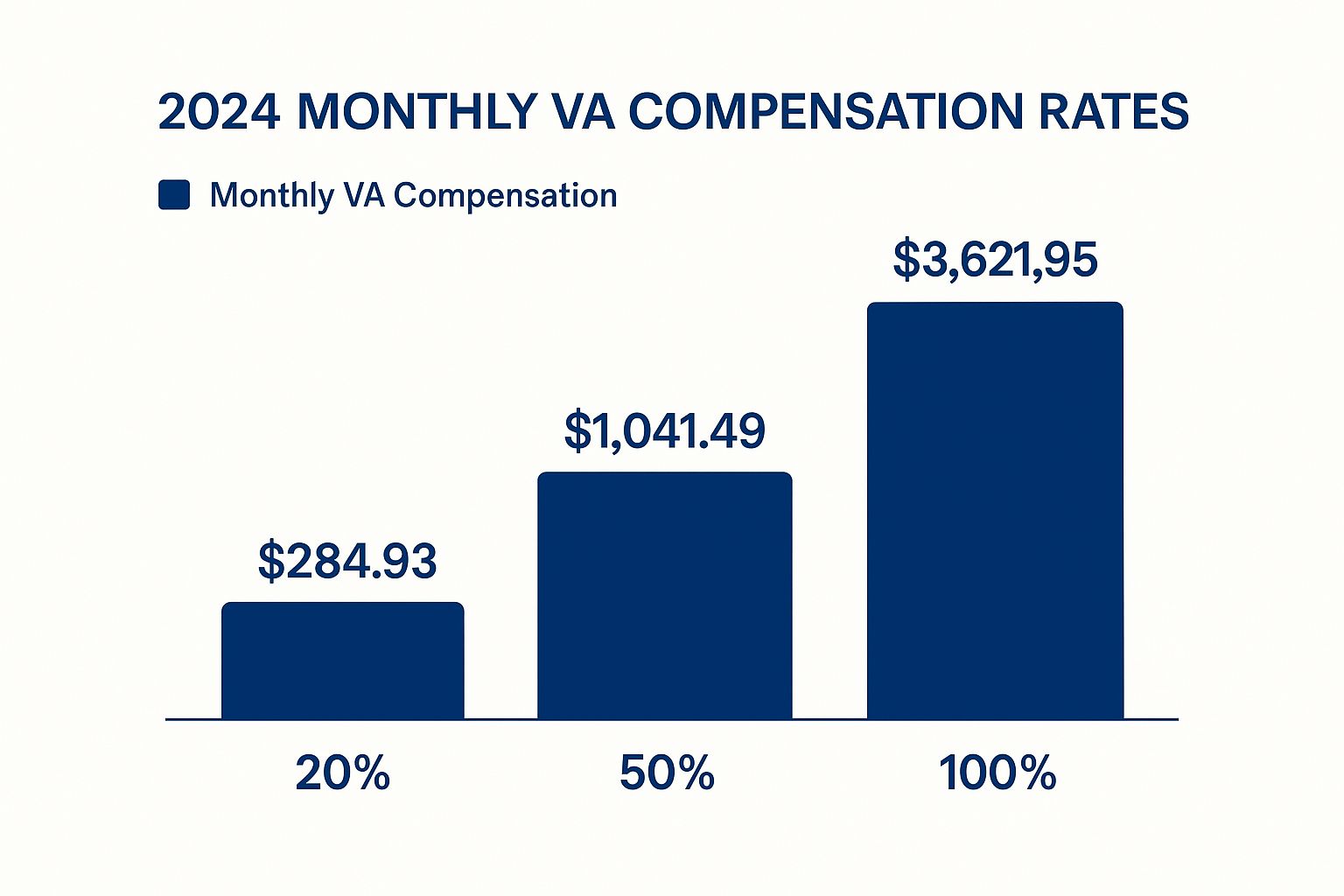
The infographic above shows the 2024 monthly VA compensation rates for three different disability ratings: 20%, 50%, and 100%. Notice how the compensation jumps up even without dependents as the disability rating increases. This shows a fundamental principle: higher ratings reflect a more significant impact on your life, and therefore, a greater need for financial assistance.
Who Qualifies as a Dependent?
Several different family members can qualify as dependents, each impacting your compensation in a specific way. These include:
- Spouse: Your legally married spouse is usually eligible, even if you don't live together full-time.
- Children Under 18: This includes biological children, adopted children, and stepchildren.
- Children Over 18 in School: If your child is a full-time student, they might still qualify as a dependent up to age 23.
- Dependent Parents: In some cases, parents who rely on you financially can also be considered dependents.
Adding a spouse, for example, might increase your monthly payment by a certain amount, while each child adds a slightly different amount. The exact figures depend on your disability rating and the 2024 VA compensation rates.
This screenshot from the VA website shows how the rates change based on both your disability rating and your dependents. It's important to look closely at your individual situation to understand your potential benefits.
Why Certain Ratings Unlock Additional Benefits
The VA understands that higher disability ratings often mean more need for family support. Certain rating thresholds, such as 30%, 50%, and 70%, unlock additional benefits for your family. For example, reaching a 50% rating could increase the additional compensation you receive for a spouse or child. The way VA disability compensation is structured changes based on both your disability rating and whether you have dependents. In 2024, a veteran with a 30% disability rating and no dependents received $622.24 per month. A 40% rating brought $893.48 monthly, while a 50% rating increased that to $1,347.68. At a 60% rating, the monthly compensation jumped to $1,712.07. These rates continue to climb with higher ratings and the inclusion of dependents. For more specifics, visit the VA website.
Adding Dependents: The Application Process
Adding dependents to your claim is a key way to maximize your 2024 VA compensation. It involves submitting the correct forms and documents to the VA. Think of it not as paperwork, but as an investment in your family's future. It's about ensuring you receive all the support you're entitled to, potentially increasing your monthly payments substantially. Understanding how dependents affect your compensation is vital. By learning about the different dependent categories, how the rate tables work, and what the application process involves, you're taking an important step toward financial security for yourself and your family. This can make a real difference in your overall well-being.
Let's take a closer look at how these additional amounts break down.
The table below, "Additional Compensation for Dependents," shows the extra monthly amounts you'll receive based on your disability rating and the type of dependent you're claiming. This gives you a clear picture of how each dependent adds to your overall compensation.
| Dependent Type | 30% Rating | 50% Rating | 70% Rating | 100% Rating |
|---|---|---|---|---|
| Spouse | ||||
| One Child | ||||
| Two Children | ||||
| Three Children | ||||
| Additional Child | ||||
| One Parent | ||||
| Two Parents |
(Note: This table requires actual data from the 2024 VA compensation rates. The empty cells above need to be filled with the correct amounts.)
As you can see, the additional amounts for dependents increase with higher disability ratings. This underscores the VA's commitment to providing more comprehensive support for veterans and their families facing greater challenges.
Special Monthly Compensation: Beyond Standard Rates
Some veterans face truly difficult challenges because of disabilities connected to their service. The standard VA disability compensation rates may not be enough to meet these extraordinary needs. Thankfully, the VA recognizes this and offers Special Monthly Compensation (SMC). Think of SMC as a boost to the regular compensation, specifically designed for veterans whose disabilities have a serious impact on their daily lives.
This screenshot from the VA website gives you a quick look at the various levels and categories within Special Monthly Compensation. The different rates demonstrate how SMC is adapted to address the specific needs of veterans with severe disabilities. This can seem complicated, which is why understanding how SMC works is so important.
SMC isn't a completely separate system. It works alongside the regular VA compensation rates 2024. It can, however, significantly increase a veteran's total monthly payment. Imagine a veteran receiving their standard monthly payment based on their disability rating. Because of the specific nature of their disability, they also receive an additional SMC payment. This can mean thousands of dollars more each month compared to the standard rates.
Understanding the Different Levels of SMC
SMC is broken down into levels, each one addressing particular situations. Think of these levels, labeled with letters like "S," "K," and "L," as steps. Each step up represents a greater level of severity and need. Each level also has a different payment rate, making it crucial to understand these distinctions.
For example, SMC-S might apply to a veteran who has lost the use of a hand. SMC-K, on the other hand, might be for a veteran who needs regular help with everyday tasks, like bathing or dressing. These levels, and other categories within SMC, ensure the system addresses the unique challenges faced by each veteran.
Key SMC Benefits: Loss of Use, Housebound, and Aid and Attendance
Several important benefits fall under the umbrella of SMC. These benefits help cover the extra costs that can arise because of severe disabilities. Let's look at a few of the most important SMC benefits:
-
Loss of Use: This benefit compensates veterans for the complete loss of use of a specific body part or organ. It acknowledges the substantial impact this loss has on their lives. This loss doesn't have to be a physical loss, either. It can also apply to a loss of function, like blindness or paralysis.
-
Housebound Allowance: Imagine a veteran whose disabilities largely confine them to their home. This allowance provides additional financial help to cover the added expenses that come with being housebound.
-
Aid and Attendance: This benefit helps veterans who need assistance with daily personal care, like dressing, eating, or bathing. It also applies to those who are bedridden or need regular nursing care. This additional compensation helps pay for caregivers or in-home assistance.
By understanding the different levels and types of SMC, veterans can determine if they are eligible for these additional benefits. Don't underestimate the importance of understanding this part of VA compensation—it could provide a crucial boost to financial well-being.
Maximizing Your Compensation Through Strategic Claims

This screenshot from the VA website highlights the different ways you can file a disability compensation claim. You can file online, by mail, or in person with a Veterans Service Officer. Having these multiple options allows you to choose the path that best suits your needs and comfort level.
Filing a claim is a crucial first step, but understanding the 2024 VA compensation rates is only the beginning. Savvy veterans approach their claims strategically to make sure they receive all the benefits they deserve. This isn't about gaming the system; it's about understanding it thoroughly and presenting your case effectively.
Think of it like planning a road trip. You wouldn't just hop in the car and start driving without a map, would you? A strategic approach to your VA claim is like having a detailed roadmap to your benefits.
Identifying Secondary Conditions
Sometimes, a service-connected disability can lead to other health issues. These are called secondary conditions. Let's say you have a service-connected back injury. That injury might limit your mobility, which could lead to weight gain and, eventually, diabetes. Making these connections is vital for maximizing your VA compensation.
The VA recognizes and compensates for secondary conditions. However, you need to show the link—the nexus—between your primary service-connected disability and the secondary condition. This is where clear medical evidence and well-organized documentation come into play.
The Power of Nexus Letters
A nexus letter is a key tool for establishing this connection. Imagine it as the missing piece of a puzzle that connects your primary disability to your secondary condition. It’s a written statement from a medical professional that explains, in detail, how your primary disability caused your secondary health problem.
Let's go back to our example of a veteran with PTSD who also has insomnia. A nexus letter from a psychiatrist or psychologist explaining how the PTSD directly causes the insomnia would considerably strengthen their claim for compensation related to the sleep disorder.
Timing Your Claims Strategically
The effective date of your claim is the date your payments begin. Understanding this concept, and how different claim types have different effective dates, can significantly impact your overall compensation. Knowing when to file for an increase, perhaps due to worsening symptoms or newly developed secondary conditions, can also increase your payments retroactively.
Working With Experts
Navigating the VA claims process can feel like navigating a maze. Sometimes, it’s wise to have a guide. Veterans Service Organizations (VSOs) and accredited attorneys can offer expert advice and help you understand the complexities of the system. They can assist with gathering evidence, crafting strong arguments, and navigating the appeals process if needed.
The Appeals Process
If your claim is denied, or you believe your rating is too low, you have the right to appeal. Knowing how the appeals process works and how it applies to your situation is a critical part of strategic claims management. Don't let the complexity discourage you.
By understanding secondary conditions, the role of nexus letters, strategic timing, the value of expert assistance, and the appeals process, you're well on your way to maximizing your 2024 VA compensation. Remember, this is about receiving the benefits you've earned through your service.
Payment Schedules And What To Expect
Understanding how and when your VA compensation arrives can really take a load off your mind. Let's break down the VA payment schedule, taking the mystery out of payment timing, how to track your payments, and what to do if something goes wrong.
Direct Deposit and Retroactive Payments
The easiest way to receive your VA compensation is through direct deposit. It’s like setting your bills to auto-pay – the money shows up in your account like clockwork. No more trips to the bank and you can rest assured your benefits arrive on time.
Now, when your claim is approved, you might also get a retroactive payment. This covers the time between your effective date (the official start date of your benefits) and the date of your first payment. Think of it as catching up on what you were owed during the waiting period.
Understanding the Rating Decision Process
The rating decision is how the VA evaluates your claim and assigns your disability rating. This process can take a while, so knowing what to expect can help you be patient.
After the VA makes a decision, you’ll get a notification explaining the outcome. If your claim is approved, the notification will tell you your disability rating and the effective date for your benefits. This is when that retroactive payment period kicks in.
Reading Your Payment Statements
Your payment statements show all the details of your benefits, including any deductions or adjustments. It's like a detailed report card for your compensation – explaining exactly what you're receiving and why. Being able to understand these statements helps you keep track of your benefits and spot any potential errors.
Managing Your Finances Around the VA Payment Timeline
The VA usually pays benefits at the beginning of the month. Knowing this helps you budget effectively. Just like with financial investments, it's wise to understand potential returns. For example, you can learn how to maximize returns on your savings. This lets you anticipate your income and plan your expenses accordingly.
This screenshot from the VA website shows their online payment history portal. This handy tool lets veterans easily see and review their payment history, offering transparency and control. Having this access is essential for managing your finances and keeping track of your benefits.
Handling Delays or Payment Issues
Occasionally, payments get delayed. Knowing how to handle these situations is crucial. The VA provides resources and contact information to help you resolve any payment issues quickly. This empowers you to take action and make sure you receive the right payments. By familiarizing yourself with the payment schedules, understanding your statements, and knowing what resources are available, you'll be well-equipped to manage your VA compensation. This knowledge offers peace of mind and helps you build a secure financial future.
Your Action Plan For Compensation Success
Now that you have a handle on the VA compensation system and the 2024 VA compensation rates, let's map out your personalized strategy. Think of it like planning a cross-country road trip – you need a clear route and a reliable vehicle to get you to your destination. This action plan provides the step-by-step directions you need to navigate the process.
Gathering Your Documentation: Building Your Case
Imagine building a solid legal case like constructing a house. You need the right materials to create a strong foundation. In this scenario, your "building materials" are your military service records, medical records, and any supporting documentation.
-
Service Records: These are the blueprints proving your time in service and eligibility. Think of documents like your DD-214, discharge papers, and records of deployments or special assignments.
-
Medical Records: These are the essential framework of your case, documenting your disabilities and connecting them to your service. Gather records from VA hospitals, private doctors, and any other healthcare providers.
-
Supporting Documents: Think of these as the finishing touches that make your case even stronger. These could include buddy statements from fellow service members, statements from family members describing how your disabilities impact daily life, and employment records showing how your disabilities affect your work.
Filing Your Claim: Taking the First Step
With your "building materials" gathered, it's time to lay the foundation. Filing your claim is the crucial first step. You have several options: online, by mail, or in person with a Veterans Service Officer. Choose the method that best suits your needs.
-
Online Filing: This is like taking the express lane – the fastest and most efficient option. Visit the VA website and follow the instructions.
-
Filing by Mail: This is more like taking the scenic route. Download the required forms, fill them out completely and accurately, and mail them to the correct VA address.
-
In-Person Filing: This is like having a personal guide on your journey. A Veterans Service Officer can walk you through the process, answer questions, and assist with your documentation.
Maximizing Your Compensation: Going Beyond the Basics
Filing your claim is just the beginning of the journey. Maximizing your compensation is about understanding the finer details and being proactive.
-
Identify Secondary Conditions: Think of these as ripple effects from your primary service-connected disabilities. Are there other health issues that stem from your initial disabilities? Documenting these can significantly impact your overall compensation.
-
Obtain Nexus Letters: These letters, written by medical professionals, are like connecting the dots between your primary disability and secondary conditions. They strengthen your claim by providing expert medical opinions.
-
Stay Informed About Updates: The 2024 VA compensation rates can change. Staying up-to-date on any adjustments is like checking the road conditions before your trip – it ensures you're prepared and receive all the benefits you deserve.
Tracking Your Progress and Troubleshooting Roadblocks
Even the best-planned road trips can encounter detours. Knowing how to monitor your progress and address any roadblocks is essential.
-
Monitor Your Claim Status: The VA website offers tools to track your claim's progress, like checking your GPS location on a map.
-
Address Any Requests for Information Promptly: Responding quickly to VA requests for information is like keeping your car well-maintained – it prevents unnecessary delays.
-
Consider Expert Assistance: If your claim is denied or your rating seems too low, consider working with a Veterans Service Organization or an accredited attorney. They can provide expert guidance during the appeals process, like having a skilled mechanic to fix any car troubles.
This action plan provides the roadmap to securing the VA compensation you've earned. Ready to take the wheel and begin your benefits journey? Connect with Homefront Group today for a free consultation and let us help you navigate the road to the compensation you deserve. Visit Homefront Group now.