

The Real Timeline: VA Claim Processing in Action
Understanding the VA claim processing time can be a source of stress for veterans. This section offers a realistic overview of the process, including current wait times, influencing factors, and how to best prepare.
Current VA Claim Processing Time Expectations
The VA aims for efficient claim processing, but various factors affect the timeline. Some claims are processed quickly, while others require more time. Initial disability claims generally take longer than supplemental claims, and appeals often have the longest wait times. The infographic below visualizes average processing times for these common claim types.
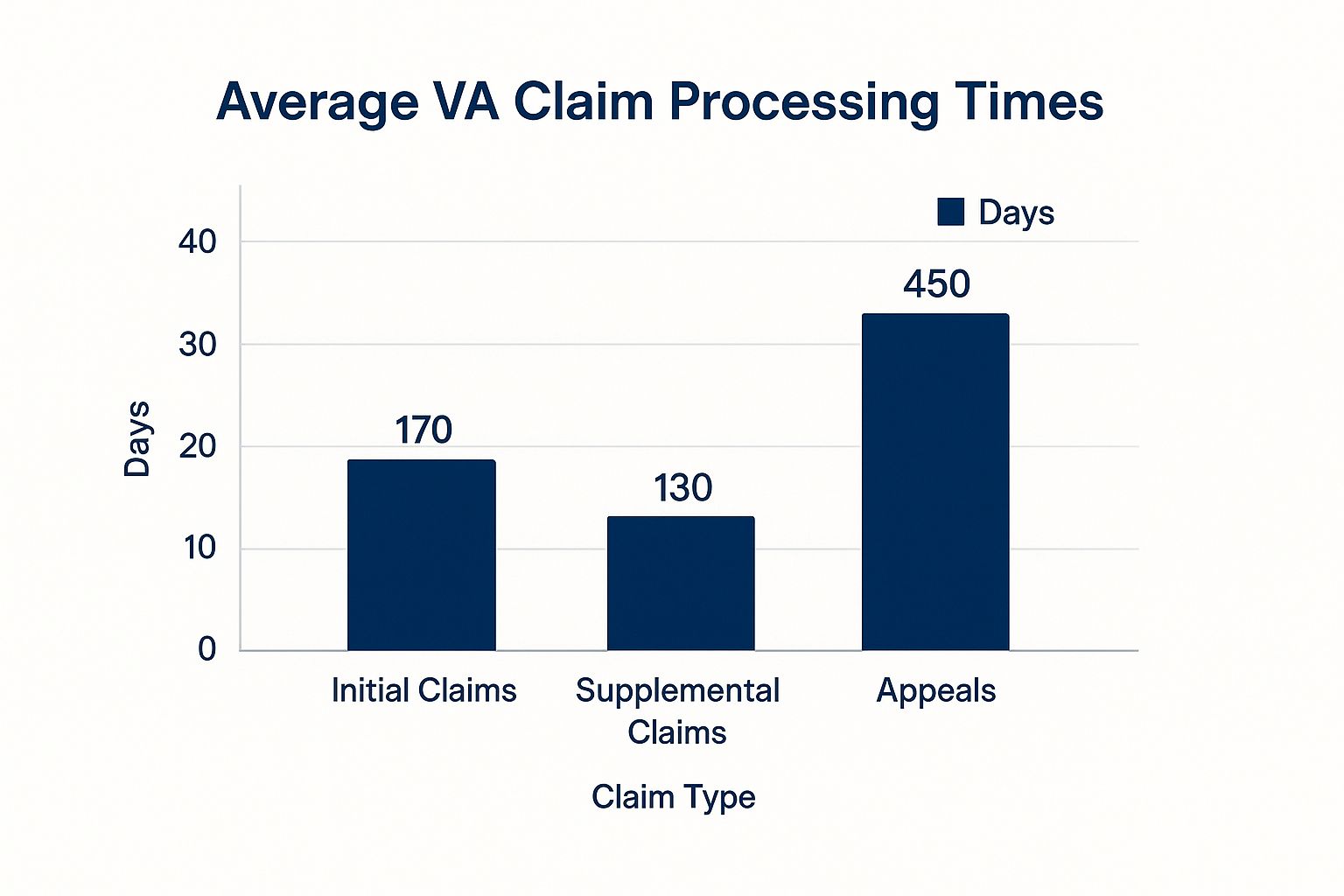
Initial claims average around 170 days, supplemental claims average 130 days, and appeals average 450 days. Submitting a complete and accurate initial claim can potentially prevent a lengthy appeals process. The VA continually strives to improve efficiency. In Fiscal Year 2025, over one million disability claims were processed significantly faster than the previous year, despite a rise in claims received. Over 60% of processed claims were granted. Learn more about VA claim processing efficiency here.
Factors Influencing Processing Time
Several factors influence VA claim processing time. Claim complexity is a key factor. Claims involving multiple disabilities or extensive medical records require more processing time. The quality of evidence is also important. Organized, comprehensive documentation streamlines the review, while incomplete evidence can cause delays.
Regional variations in workload and staffing also affect processing times. Some VA regional offices process claims faster due to staffing and claim volume. Understanding these factors helps manage expectations and highlights the importance of preparation.
Preparing for the Process
While some influencing factors are beyond your control, thorough preparation can significantly impact VA claim processing time. Gathering all necessary medical records, service records, and supporting documentation upfront can streamline the initial review.
Working with an accredited representative, like an attorney or Veterans Service Officer, can ensure your claim is complete and accurate. This proactive approach minimizes potential delays. To understand the current average processing times for different claim types, refer to the table below.
Average VA Claim Processing Times by Claim Type
| Claim Type | Average Processing Time | Improvement from Previous Year |
|---|---|---|
| Initial Disability Claim | 170 days | Data not available in original content |
| Supplemental Claim | 130 days | Data not available in original content |
| Appeal | 450 days | Data not available in original content |
Note: Improvement data from the previous year was not provided in the original text. This table summarizes the current average processing times for various claim types, emphasizing the substantial difference between initial claims, supplemental claims, and appeals. This information reinforces the importance of meticulous preparation and a complete initial submission to avoid potential delays down the line.
Why Your Claim Takes So Long: Hidden Factors Revealed
Many veterans find the VA claim process unpredictable. This is often because they don't understand the behind-the-scenes factors affecting the timeline. This section clarifies those hidden factors, providing insights gleaned from interviews with VA raters and claims specialists.
Claim Complexity and Evidence Quality
One of the biggest factors impacting processing time is claim complexity. A claim for multiple disabilities or one requiring a large number of medical records naturally takes longer than a simpler claim. For example, a claim for a single, well-documented disability will be processed faster than one involving several interconnected conditions.
The quality of the evidence you submit also matters. Organized, comprehensive documentation makes the review process much smoother. Incomplete or poorly documented evidence can trigger requests for more information, significantly delaying your claim. This highlights the importance of submitting a Fully Developed Claim (FDC).
Regional Office Workloads and VA Prioritization
Processing time is also affected by the workload at different regional VA offices. Some offices process claims faster due to staffing levels and claim volume. This can cause significant variations in timelines for similar claims.
The VA also prioritizes some claims. Claims involving severe disabilities or financial hardship may be expedited. While necessary, this prioritization system can impact the processing time for other claims. Understanding this helps veterans manage their expectations.
To help you understand the factors you can control, let's look at a detailed breakdown:
Understanding these factors can help veterans develop more realistic expectations regarding their individual VA claim processing time. To help you understand the factors you can control, let's look at a detailed breakdown:
Impact Factors on VA Claim Processing Speed
This table details factors that can affect how quickly your VA claim is processed.
| Factor | Impact Level | Within Veteran's Control? | Mitigation Strategy |
|---|---|---|---|
| Claim Complexity | High | Partial | File a Fully Developed Claim (FDC) with all required documentation upfront. |
| Evidence Quality | High | Yes | Organize medical records chronologically and ensure all relevant documents are included. |
| Regional Office Workload | High | No | N/A |
| VA Prioritization | Medium | Partial | Clearly document the severity of your disability and any related financial hardships. |
As you can see, while some factors are outside your control, focusing on submitting a well-prepared FDC with high-quality evidence can significantly improve your chances of a faster processing time.
Common Misconceptions and Realistic Expectations
Several misconceptions about VA claim processing time exist. Some veterans believe all claims are handled on a first-come, first-served basis. However, as mentioned, the VA prioritizes based on various factors.
Another misconception is that contacting the VA frequently will expedite the process. While staying informed is important, excessive contact can slow down the process by diverting resources. By understanding how the system works and having realistic expectations, veterans can navigate the process more effectively and reduce stress. For additional assistance, consider a free consultation with Homefront Group to discuss your situation and explore options to potentially expedite your claim.
Track Your Claim Like A Pro: Beyond Basic Status Updates
Stop wondering about your VA claim processing time. This section empowers you to take control of the information flow regarding your claim. We'll explore the different tracking systems available, helping you understand their advantages and disadvantages.
Navigating The VA.gov Tracker
The VA.gov website offers a primary tool for tracking your claim. This portal provides basic status updates, giving you a general overview of your claim's progress. However, it's important to understand its limitations. The updates can be somewhat general.
Veterans often need more detailed information. For example, a status of "evidence gathering" lacks specifics. You won't know what evidence is being gathered or how long the process will take. Understanding the VA's financial health adds context to processing times. For more insight into financial reporting, you can explore resources on financial statements.
Exploring eBenefits and VA Mobile Apps
Beyond the VA.gov tracker, resources like eBenefits (now transitioning into VA.gov) and VA mobile apps may provide additional information. These platforms sometimes offer more detailed updates on your claim's specific stages. You might see updates about scheduled medical exams or requests for more documentation. This added detail allows you to stay informed and anticipate the next steps.
The Power of Direct Communication: Phone and Representatives
While online tools offer convenient access, direct communication with VA representatives by phone can be extremely helpful. Speaking with a representative can clarify confusing updates. They can also offer personalized context for your specific claim.
Working with an accredited representative, such as a Veterans Service Officer, provides another level of support and advocacy. These representatives can access your claim file and offer detailed insights into its progress.
Mastering The Art of Claim Tracking
Effective claim tracking isn't about constant monitoring. It's about strategically gathering information. Create a realistic schedule for checking, such as weekly or bi-weekly. This approach allows for progress without increasing anxiety.
If tracking systems seem to contradict each other, document the discrepancies. Reach out to a VA representative to clarify the information. Maintaining detailed personal records is crucial. Keep track of status updates, communication logs, and submitted evidence. This meticulous approach empowers you to stay informed, address any inconsistencies, and proactively manage your VA claim processing time.
Speed Up Your Claim: Strategies That Actually Work

Beyond general advice, this section dives into proven strategies to genuinely reduce VA claim processing time. We'll explore actionable techniques based on insights from VA insiders and veteran advocates.
The Power of a Fully Developed Claim
One of the most effective ways to expedite your claim is to submit a Fully Developed Claim (FDC). This involves providing all necessary evidence upfront. This includes medical records, service records, and any other supporting documentation. Submitting an FDC minimizes back-and-forth requests for information, which can significantly reduce processing time.
Think of it as being fully prepared before embarking on a journey. Having all your necessary documents assembled from the outset streamlines the process.
Understanding Hardship Fast-Tracking
The VA offers fast-tracking options for veterans facing severe financial or medical hardships. These options prioritize claims based on urgent need. If you meet specific criteria, your claim could be moved ahead of others.
Clearly documenting your hardship with supporting evidence is crucial. For instance, proof of impending homelessness or urgent medical needs strengthens your case for expedited processing. This process can be complex. Consulting with an accredited representative can be invaluable.
Schedule a free consultation with Homefront Group to explore your eligibility for fast-tracking.
Effective Engagement With Congressional Assistance
Engaging your Congressional representative can sometimes help resolve roadblocks and expedite your claim. This leverages their ability to investigate delays or access information, bringing attention to specific issues affecting your claim.
However, this shouldn't be your first course of action. It's most effective when other avenues have been exhausted or a clear systemic problem is identified. For example, if your claim is inexplicably stalled despite providing all required documentation, Congressional assistance may be a worthwhile option.
Real-World Examples and Documentation Approaches
Streamlining your documentation is essential for faster processing. Organize medical records chronologically and label them clearly. Ensure all relevant documents are included and easily accessible to VA reviewers. This organized approach simplifies their review and speeds up the process.
Responding promptly and completely to evidence requests is also crucial. Provide precisely what the VA requests, avoiding unnecessary documents. This targeted approach prevents further delays. Working with an accredited representative can significantly improve your documentation and response strategies.
The Influence of Accredited Representatives
Accredited representatives, such as attorneys or Veterans Service Officers (VSOs), play a vital role in expediting VA claims. They understand the system's complexities and ensure your claim is complete, accurate, and strategically presented. They can also help you navigate the often confusing process of gathering evidence and responding to VA requests.
By understanding these strategies and proactively managing your claim, you can significantly impact processing time and increase your chances of a timely decision. Contact Homefront Group today for a free consultation to discuss your specific situation.
Inside the VA Backlog: Understanding the Bigger Picture
The VA backlog is a major concern for veterans waiting for benefits. A deeper understanding of its complexities can help manage expectations and clarify the factors influencing VA claim processing time. This section explores the backlog's size and nature, examining its impact on different claim types.
Defining the Backlog: Official vs. Veteran Perspectives
The VA officially defines backlogged claims as those pending for over 125 days. However, veterans often perceive the wait to be much longer. This discrepancy underscores the importance of understanding both the official definition and the actual impact on veterans.
Historically, the VA backlog has fluctuated. Recent initiatives have aimed to reduce it, yet challenges persist. To potentially speed up your claim, consider the benefits of background screening automation.
Claim Types and the Backlog
Some claim types tend to experience more extended delays. Appeals, for instance, often encounter substantial wait times. Complex claims involving multiple disabilities or requiring significant medical records also contribute to the backlog. Understanding how your claim type fits into this system can give you a more realistic timeframe.
Impact of Technology, Staffing, and Process Reforms
The VA has implemented initiatives to address the backlog and improve VA claim processing time. Technology improvements aim to make the claims process more efficient. Staffing adjustments and process reforms also play a key role in tackling these challenges.
For example, the shift to electronic claims processing has greatly improved efficiency compared to paper-based systems. Increased staffing in certain areas also contributes to faster processing. However, the impact of these efforts varies, and continuous refinements are underway.
Real-World Impact on Processing Times
While reforms have made some positive changes, the backlog remains a substantial obstacle. The impact on processing times is apparent in the long waits many veterans experience. Understanding the combined effects of factors like claim type and reform efforts is essential for successfully navigating the system.
Future Outlook and Realistic Expectations
The VA continues its efforts to streamline processes and reduce the backlog. Maintaining realistic expectations, however, is essential. While some progress is evident, the system is still complex. This means processing times can be lengthy, particularly for specific claim types or unique situations.
Staying informed about ongoing reforms and understanding your claim's place within the larger context can help you navigate the VA claims process. Managing expectations based on the current system's realities, while staying positive about future improvements in VA claim processing time, is vital.
Making the Wait Worthwhile: Productive Steps While You Wait
The VA claim process requires patience. However, instead of viewing this waiting period as wasted time, consider it an opportunity to prepare proactively. This section, drawing from the experiences of successful veterans and advice from VA claims specialists, offers strategies to make the most of your wait time.
Strengthening Your Claim With Additional Evidence
While your claim is being processed, you can actively gather supporting evidence. This is particularly helpful if you suspect your initial submission might have had weaknesses. For example, if your initial medical records were limited, now is the time to obtain more comprehensive documentation. This provides a clearer picture of your condition and strengthens your overall claim.
Additionally, consider obtaining buddy statements. These are statements from fellow service members who witnessed your disability while you were in service. They provide valuable firsthand accounts and corroborating testimony, similar to character witnesses in a trial.
Preparing for Different Decision Scenarios
It's wise to anticipate different possible outcomes. Prepare for the possibility of a partial approval, a denial, or a request for additional information. Outline a plan of action for each scenario. For example, if your claim is denied, familiarize yourself with the appeals process and gather the necessary documents for a robust appeal.
This proactive approach minimizes delays in the VA claim processing time and empowers you to act efficiently. Having a plan in place also reduces stress and allows you to navigate the process confidently.
Addressing Financial Needs During the Wait
Extended wait times can sometimes cause financial strain. Research resources available to veterans while their claims are processing. Several organizations offer financial assistance programs specifically for veterans in this situation. Also, consider speaking with a financial advisor to discuss strategies for managing your finances while awaiting your benefits. Proactive financial planning can help alleviate stress during this period.
Managing the Mental and Emotional Challenges
The waiting period can be emotionally challenging. Uncertainty and potential financial difficulties can impact your mental health. Connect with veteran support groups or mental health professionals who understand the unique challenges veterans face. Sharing your experiences and learning coping mechanisms from others can be immensely beneficial. Prioritizing your well-being during this time is crucial.
Connect with Homefront Group today for a free consultation. Our team understands the complexities of VA claims and can provide guidance and support. We can assist with gathering evidence, preparing for different outcomes, and connecting you with valuable resources to address financial and emotional needs. Don't navigate this challenging process alone; let Homefront Group be your advocate.