

If you spent your time in the military working on or around jets, you know the smell of JP-8 or JP-5 all too well. It’s the smell of the flight line, the hangar, and for many, a daily reality of service. Now, years later, you might be dealing with health problems and wondering if that constant exposure is the cause. The good news is, the VA is finally recognizing the connection, and you can get the benefits you earned.
Are You Eligible for Jet Fuel Exposure Benefits?
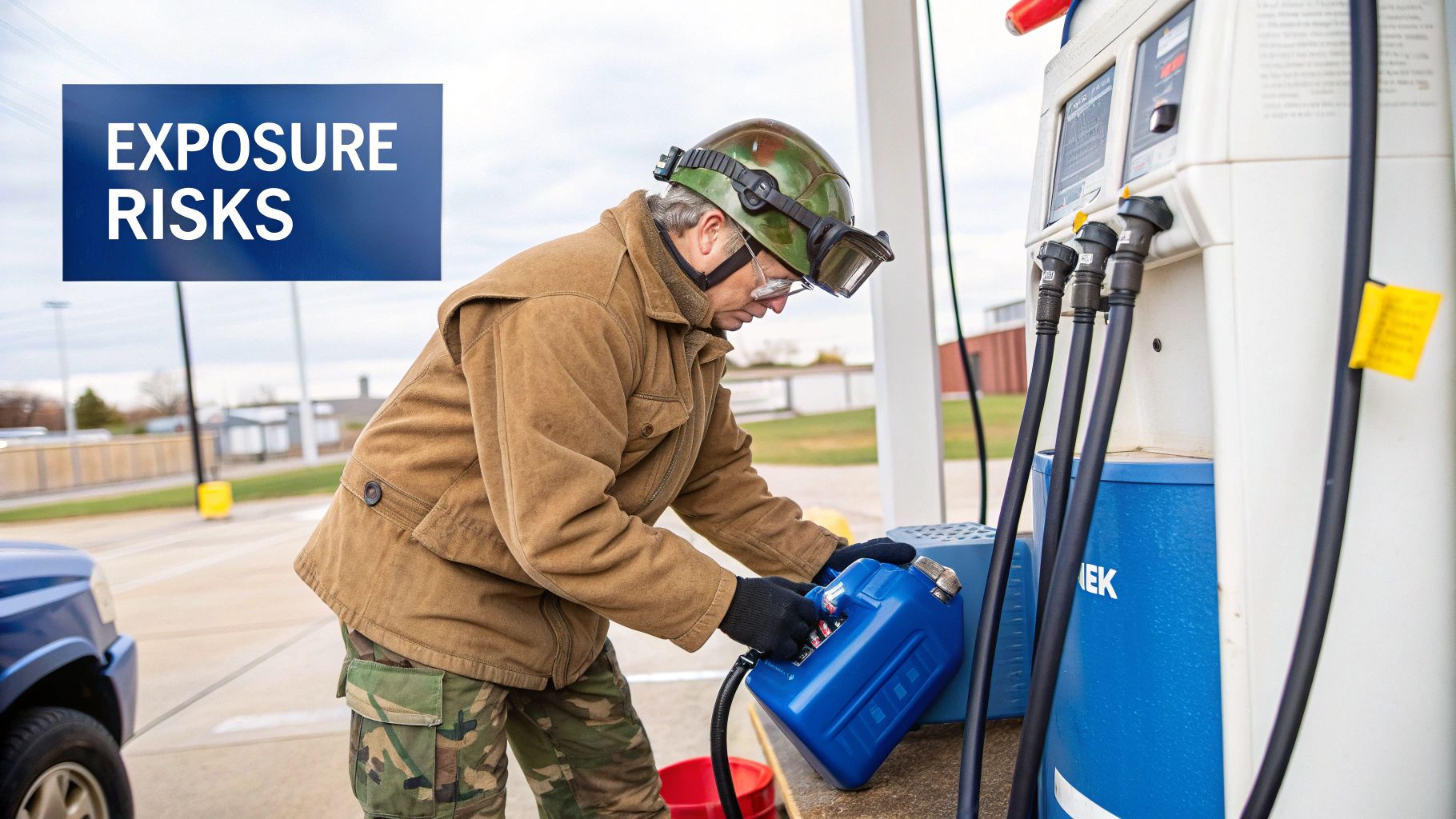
Figuring out if you qualify for VA disability due to jet fuel exposure can feel like a maze, but it really comes down to connecting the dots for the VA. You need to show them a clear line from your service history and job duties to a current, diagnosed health condition.
This isn't always as simple as it sounds. Unlike an injury that happens in an instant, the damage from toxic exposure can surface years or even decades after you've hung up the uniform. That’s why understanding how the VA looks at these specific claims is so important.
The PACT Act's Impact on Toxic Exposure Claims
For veterans exposed to toxins, the PACT Act was a massive step forward. It created "presumptive conditions," which means the VA automatically assumes certain health issues are service-connected if you served in specific locations and timeframes. This can dramatically lower the burden of proof on your shoulders.
While jet fuel itself isn't a blanket presumptive for everyone, the PACT Act has officially recognized it as a toxic substance. This is a big deal. Since its passage in 2022, the path to getting disability compensation for conditions linked to jet fuel is much more direct. You still need to connect the dots, but the VA is now listening more closely than ever before. You can discover more about the requirements for a solid claim and how to build your case.
A presumptive condition basically means the VA agrees that if you were in a place where exposure was likely and you now have a known related illness, they'll concede the connection. This saves you the nearly impossible task of proving exactly which day and which specific exposure made you sick.
High-Risk Military Roles and Locations
One of the most powerful pieces of evidence you have is your Military Occupational Specialty (MOS) or Air Force Specialty Code (AFSC). The VA knows that some jobs meant you were breathing in, touching, and living with jet fuel day in and day out.
If your service records prove you worked in one of these high-risk roles, your claim immediately becomes stronger.
- Aircraft Mechanics & Maintenance Crews: Anyone who regularly worked on engines, fuel lines, and fuel systems.
- Fuel Handlers & Specialists (POL): The folks directly responsible for refueling aircraft and managing fuel farms.
- Flight Line & Ground Support Personnel: If you worked on the ramp, you were in the thick of it.
- Aircrew Members: Pilots, flight engineers, and loadmasters were often exposed to fumes inside the aircraft itself.
Where you served also plays a big part. It’s a known fact that certain bases, both in the U.S. and overseas, had significant issues with fuel spills, contaminated soil, and tainted water. If you were stationed at one of these locations, it adds a critical layer to your claim. Your DD-214 and other service records are your best tools for establishing this part of your history.
Many veterans wonder which health conditions the VA might link to jet fuel. While every case is unique, certain patterns have emerged over the years. Below is a table outlining some of the common health issues that have been associated with prolonged exposure.
Health Conditions Linked to Jet Fuel Exposure
This table outlines common health issues the VA may associate with jet fuel exposure, helping you identify potential service-connected disabilities for your claim.
| Health Category | Associated Conditions |
|---|---|
| Neurological Issues | Headaches, fatigue, memory loss, difficulty concentrating ("brain fog"), peripheral neuropathy (tingling/numbness in hands and feet), Parkinson's-like symptoms |
| Respiratory Problems | Chronic bronchitis, asthma, shortness of breath, lung damage |
| Cancers | Leukemia, lymphoma, kidney cancer, bladder cancer, testicular cancer, liver cancer |
| Skin Conditions | Dermatitis, rashes, skin irritation, and other chronic skin disorders |
| Liver & Kidney Damage | Impaired liver function, liver disease, chronic kidney disease, renal failure |
Keep in mind this list isn't exhaustive. If you're experiencing a health problem you believe is connected to your exposure, it's always worth exploring a claim, especially with the support of a strong medical opinion.
The Long-Term Health Effects of Jet Fuel

If you spent your service time on a flight line, you know the smell of jet fuel all too well. But it's far more than just a powerful odor; it's a toxic soup of chemicals. This mixture of hydrocarbons and additives, including known carcinogens like benzene, can cause serious health problems that may not surface for decades.
Understanding what this exposure can do to your body is the first, crucial step in building a successful VA claim. The harm depends on how you were exposed—whether you were breathing in fumes all day, getting it on your skin, or accidentally ingesting it. A single, high-dose accident is different from the slow, steady exposure most ground crew experienced, but both carry significant risks.
These aren't just abstract theories. They are documented medical conditions affecting countless veterans. When you talk to your doctor or a VA rater, being able to connect your symptoms to specific, scientifically recognized conditions gives you a powerful advantage. It shows you've done your homework and can draw a straight line from your military duties to your current health struggles.
Neurological and Cognitive Damage
One of the most damaging and often overlooked consequences of jet fuel exposure is the toll it takes on the brain and nervous system. These issues can start subtly, making them easy to dismiss, but they often progress into debilitating conditions. Many veterans I've spoken with describe a frustrating mix of symptoms that are hard to put a name to.
Maybe you're dealing with headaches that won't quit or a bone-deep fatigue that no amount of sleep can fix. Or perhaps you've noticed your memory slipping and find it hard to concentrate—that frustrating "brain fog." These are all classic signs that your nervous system has been impacted by toxic exposure.
In more serious cases, the damage can lead to well-defined neurological conditions:
- Peripheral Neuropathy: This is when you experience tingling, numbness, or burning in your hands and feet without a clear cause. It’s a direct result of damage to the nerves outside your brain and spine.
- Parkinson's-like Symptoms: While research is ongoing, studies suggest a connection between exposure and a higher risk of developing movement disorders. This can include tremors, stiffness, and problems with balance.
- Cognitive Decline: This goes beyond simple forgetfulness. We're talking about significant trouble with memory, problem-solving, and mental sharpness that can sometimes look like the early stages of dementia.
These neurological symptoms can devastate your quality of life and your ability to hold a job, making them a critical piece of any VA claim related to jet fuel.
Respiratory and Systemic Conditions
The damage doesn't stop with the nervous system. When you breathe in aerosolized jet fuel—a daily reality for anyone working near active aircraft—those toxins go straight into your lungs and from there, into your bloodstream.
A recent VA report to Congress confirmed a wide range of health problems, pointing specifically to respiratory issues like reduced lung function and chronic breathing trouble. The report also highlighted impacts on hearing and vision, as well as mental health conditions like depression. A key takeaway was the need for more research on how the length of exposure affects health, which is one reason these claims can be so tough. You can read more about the VA's findings on jet fuel exposure to understand the official perspective.
The constant irritation from inhaled chemicals can lead to chronic inflammation of the airways, resulting in conditions that the VA recognizes for disability compensation.
Here are some of the most common respiratory and systemic problems we see in these claims:
- Chronic Bronchitis and Asthma: If you developed a persistent cough or started having trouble breathing after your service, it could easily be tied to airway inflammation from fuel vapors.
- Hearing Problems: It’s not just about volume. Studies show the chemicals in jet fuel can disrupt how your brain processes sound, even if a basic hearing test shows your ears are fine.
- Kidney and Liver Damage: Your liver and kidneys act as the body's filters. Forcing them to process toxic chemicals year after year can cause permanent damage and lead to serious disease.
- Certain Cancers: The VA looks at cancer claims on a case-by-case basis. However, studies have pointed to potential links between jet fuel components and a higher risk for leukemia and cancers of the kidney and bladder.
Building a Strong Evidence File for Your Claim
A successful VA disability claim isn't just about telling your story—it's about proving it with a rock-solid file of compelling evidence. For veterans dealing with the aftermath of jet fuel exposure, this means building an undeniable bridge between your time in service and your current health problems.
Think of it like you're a detective building a case. Each document you gather is another piece of the puzzle, and your job is to assemble them so perfectly that the VA rater sees the whole picture, leaving no room for doubt. It's rarely one single "magic" document that wins a claim. It’s the combination of different types of proof, layered together, that makes your case impossible to ignore.
This infographic breaks down the evidence-gathering process into its three essential pillars.
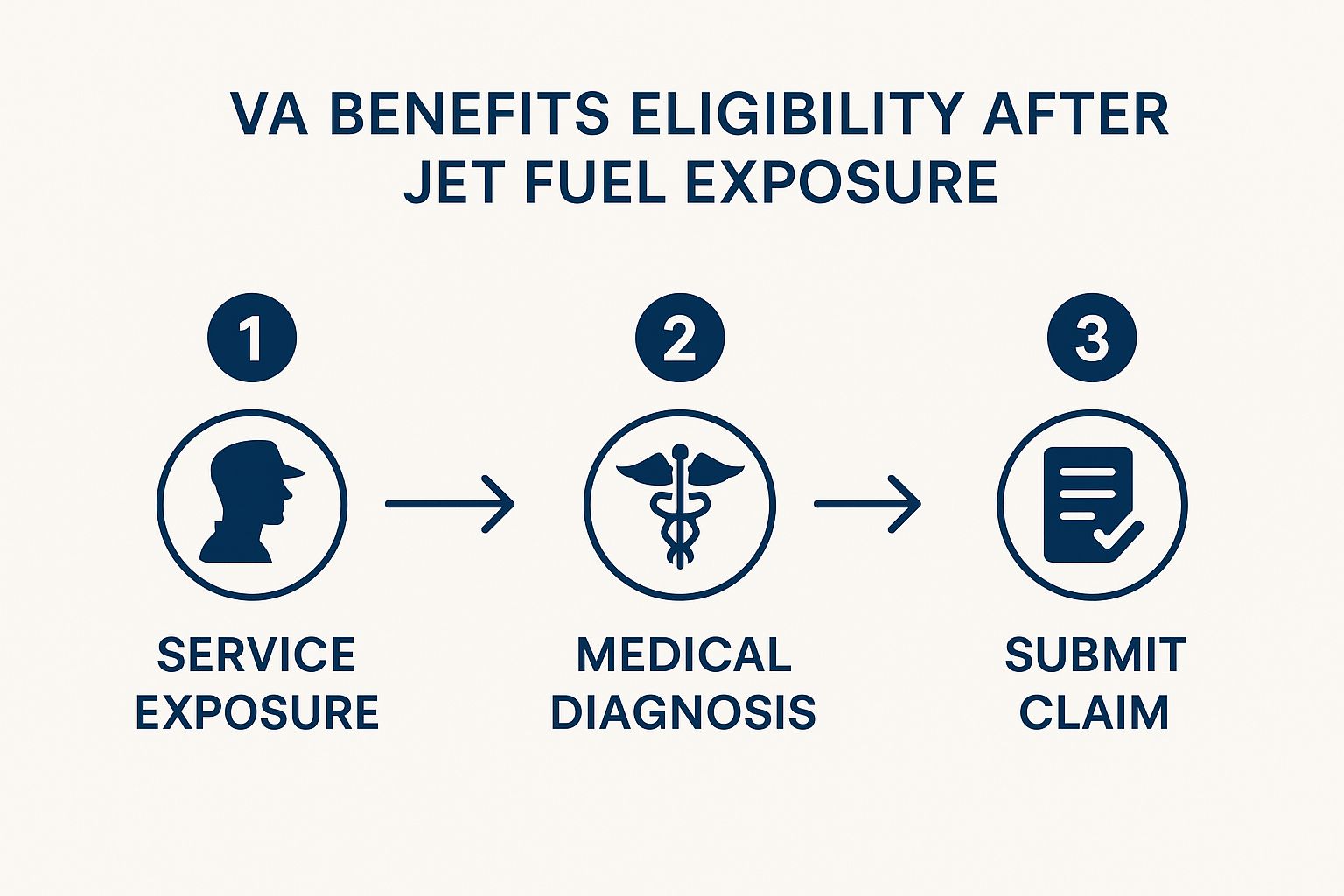
The logic here is exactly what the VA follows: they need proof you were exposed in service, proof you have a diagnosed medical condition now, and a claim to connect the two. Your evidence file is what makes each of those points a fact, not just a statement.
Proving Your Exposure to Jet Fuel
First things first, you have to prove you were there. The VA needs to see exactly how your specific job and duty station put you in direct contact with jet fuel. This is where details matter.
Your DD-214 is the obvious starting point because it lists your Military Occupational Specialty (MOS) or Air Force Specialty Code (AFSC). If you were an aircraft mechanic, a POL (petroleum, oils, and lubricants) specialist, or part of the flight line ground crew, your job title alone is powerful.
But you can and should go deeper. Request your complete Official Military Personnel File (OMPF). It might contain performance reviews or duty descriptions that paint a much clearer picture than just a job title. For example, a performance report that mentions your daily work on "fuel cell maintenance" or "flight line refueling operations" is gold.
Documenting Your Medical Condition
Next up is the medical proof. The VA can't award benefits for symptoms—they need a formal diagnosis from a qualified medical professional. This is a non-negotiable part of the process.
You need to gather all relevant medical records, including:
- Service Treatment Records (STRs): These are your military medical records. Don't discount them. Even if you only went to sick call for what seemed like minor issues at the time—headaches, skin rashes, breathing trouble—these records can establish an early pattern of symptoms.
- VA Medical Records: If the VA has been treating you, make sure every record related to your condition is part of your claim file.
- Private Medical Records: Records from your civilian doctors are just as critical. They often contain the most current diagnosis and a detailed history of your treatment.
Expert Tip: When you request your medical records, don't just ask for a summary. You need the whole story. Specifically request all doctor's notes, lab results, imaging reports (like X-rays or MRIs), and any notes from specialist consultations. The VA needs to see the complete history.
The Nexus Letter: The Critical Link
This is arguably the most important piece of paper in any toxic exposure claim: the nexus letter. This is a medical opinion from a doctor that directly connects your diagnosed condition to your jet fuel exposure during service. A weak or missing nexus is one of the top reasons claims get denied.
A strong nexus letter isn't just a simple note. It needs to contain specific phrasing the VA is trained to look for. Your doctor must state that your condition is "at least as likely as not" caused by or made worse by your military jet fuel exposure. That exact phrase meets the VA's 50% likelihood standard of proof.
The letter should also explain the doctor's medical reasoning, referencing your service records, your medical history, and even scientific studies if possible. Finding a doctor who understands this process can make all the difference.
The Power of Buddy Letters
Finally, never underestimate the impact of a good story from someone who was there. Buddy letters, officially known as Lay and Witness Statements, can fill in the gaps that official documents inevitably leave behind.
These are written statements from people you served with who can describe the conditions firsthand. Imagine a letter from a fellow service member from your unit describing the constant smell of JP-8 on the flight line, the lack of proper protective gear, or the fuel spills you all worked in. A statement from your old NCO confirming your daily duties involved hosing down aircraft with solvents and fuel can be incredibly persuasive.
These personal accounts provide a real-world context that paperwork just can't capture. They add a human element to your file, painting a vivid picture for the VA rater and powerfully reinforcing the other evidence you've gathered.
Filing Your Jet Fuel Exposure Claim the Right Way

You’ve done the hard work of gathering your evidence. Now it's time to put it all together and officially file your claim with the VA. This step can feel like the biggest hurdle, but thinking of it as a series of smaller, manageable actions makes it far less daunting.
The goal here is simple: submit what the VA calls a "fully developed claim." This just means you're providing everything they need upfront, which can significantly speed up the decision process and reduce the back-and-forth.
So, how do you actually get your claim in front of the VA? You have a few solid options, and the best one for you really depends on your own comfort level and whether you'd prefer a helping hand.
- Online at VA.gov: This is the VA's preferred route, and honestly, it's the fastest. You can upload all your documents, track your claim's status anytime you want, and get updates electronically.
- By Mail: The old-school paper route still works. You’ll need to mail the completed forms and copies of all your evidence to the VA's intake center. Just be absolutely sure to keep copies of every single page you send.
- With a Veterans Service Officer (VSO): I can't recommend this enough. A VSO is a trained, accredited professional who helps veterans navigate the VA system for free. They can review your paperwork, help you fill out the forms correctly, and even submit the claim for you.
Getting VA Form 21-526EZ Right
The heart and soul of your claim is VA Form 21-526EZ, Application for Disability Compensation and Related Compensation Benefits. This is your official request. It’s where you tell the VA what specific conditions you’re claiming and link them directly to your military service.
Precision is everything on this form. Under the section for disabilities, you have to be specific. Don't just write down "jet fuel exposure"—that's the cause, not the diagnosis.
Instead, list the actual medical conditions you've been diagnosed with. For instance:
- "Peripheral Neuropathy secondary to jet fuel exposure"
- "Parkinson's-like symptoms as a result of toxic exposure"
- "Chronic Bronchitis due to jet fuel exposure"
For every condition you list, you must clearly state that it was caused or made worse by your exposure to jet fuel during your service. This is how you draw a straight line from your disability back to a specific event or period in your military career.
The Power of Your Personal Statement
While it’s not technically required, a personal statement is your secret weapon. This is your chance to talk directly to the person deciding your claim. Officially, you can use VA Form 21-4138, Statement in Support of Claim, but any written statement will do.
Think of your personal statement as the narrative that ties all your evidence together. It turns a stack of papers into a human story, explaining the how and why behind your claim and detailing the real-world impact on your life.
This is where you paint a picture. Describe your duties and what daily exposure looked like. Talk about the constant smell of JP-8, getting it on your skin, or working in poorly ventilated hangars. Then, connect that experience to how your symptoms began and how they affect you today—your job, your sleep, your family life.
Legal experts who help veterans have seen that even with laws like the William Collins Jet Fuel Exposure Recognition Act, which aimed to make these claims easier, many veterans are still denied. This just highlights how critical your personal medical evidence is. You can read more on the challenges of these claims to better understand why your documentation is so vital.
Submitting Your Evidence for Success
Finally, how you submit your evidence matters almost as much as what you submit. If you're filing online, take the extra minute to make sure your scans are crystal clear. Give each file a descriptive name like "Nexus_Letter_Dr_Smith.pdf" or "Buddy_Letter_SGT_Doe.pdf". It makes a world of difference for the rater reviewing your file.
If you’re going the mail-in route, organize everything logically behind the main application form. I’ve seen veterans have success by including a simple cover sheet that acts as a table of contents, listing every document in the packet. It’s a small step that helps ensure nothing gets lost in the shuffle.
By presenting a clean, complete, and well-organized claim, you make the rater's job easier, and that can only help your chances of getting the benefits you've earned.
What to Expect at Your C&P Exam
The Compensation and Pension (C&P) exam is, without a doubt, one of the most pivotal moments in your jet fuel exposure claim. This isn't just another doctor's visit. It's a medical evaluation ordered by the VA, and its entire purpose is to gather the specific evidence they need to make a decision. Think of it as their on-the-ground fact-finding mission.
Your mindset walking into this appointment is everything. The examiner's final report carries immense weight and will heavily influence whether your claim is approved or denied. It’s absolutely essential to be prepared, completely honest, and thorough. This is not the time to be the tough, stoic service member who minimizes their pain. It’s the time to clearly communicate exactly how your conditions impact your day-to-day life.
Ultimately, the examiner has two main tasks: to confirm you have a diagnosed condition and to give a medical opinion on whether that condition is connected to your service. For a jet fuel claim, they'll be looking for specific links between your symptoms and the known health effects of these toxic chemicals.
Preparing for Your Appointment
Solid preparation is your best defense against anxiety and the surest way to guarantee the examiner gets the full picture. Don't just walk in cold. You need to spend some time beforehand organizing your thoughts and getting reacquainted with your own records.
A few days before the exam, set aside some time to review the documents you submitted with your claim. Refresh your memory on your service dates, your specific MOS or job duties, and the timeline of when your symptoms first started cropping up.
Here are a few practical steps I always recommend:
- Review Your Personal Statement: Reread the "buddy statement" you wrote for yourself. This helps keep your story consistent and brings those crucial details back to the front of your mind.
- Create a Symptom List: For each condition you've claimed, write down every symptom. Get specific. Note their frequency (how often they pop up), their duration (how long they last), and their severity (how badly they affect you).
- Organize Key Documents: While the examiner is supposed to have your file, it never hurts to bring a copy of your nexus letter and a simple summary of your medical diagnoses. You probably won't even pull them out, but having them with you can be a real confidence booster.
Crucial Tip: You must be ready to talk about your worst days. So many veterans make the mistake of describing an "average" day, but the VA needs to understand the full extent of your disability. If your peripheral neuropathy makes it impossible to stand for more than 10 minutes on a bad day, you have to say that, even if you can manage for 30 minutes on a good day.
During the Examination
Your C&P exam for jet fuel exposure will generally have two parts. First comes the interview, where the examiner will ask a series of questions about your military service, your exposure history, and your current health issues. Honesty and consistency here are non-negotiable.
When you describe your exposure, paint a clear picture. Don't just say, "I worked on the flight line." Go into detail. For instance: "For four years, my job was refueling F-16s. I worked 12-hour shifts on the flight line, constantly breathing JP-8 fumes. I frequently got fuel on my hands and arms because our gloves would tear."
The second part is the physical exam itself. The examiner will follow a standardized form called a Disability Benefits Questionnaire (DBQ), which is tailored to the specific condition they're evaluating. If you claimed peripheral neuropathy, for example, the exam will involve tests for your reflexes, sensation, and muscle strength. Be vocal during this part. If a certain movement causes pain or a particular test is uncomfortable, speak up right then and there.
After the C&P Exam
Once the appointment is over, the examiner completes their report and the DBQ, sending it straight to the VA. You won't get a copy from the examiner directly. However, you have every right to request a copy from the VA as soon as it's been added to your official claims file.
I always tell veterans to request this report. It lets you see exactly what the examiner told the VA. If you spot any errors or feel the report doesn't accurately capture your condition, you have a chance to respond. You can submit a statement or even new evidence to counter their findings. This becomes an absolutely critical piece of the puzzle if your claim is denied and you need to file an appeal. The C&P exam is a major milestone, and being an active, informed participant gives you the best possible shot at a successful outcome.
Got Questions About Your Jet Fuel Claim? We've Got Answers.
It's completely normal to have a ton of questions when you're wading into the VA claims process. For something as complex as toxic exposure, it’s easy to feel stuck or unsure about the right next step. Let's tackle some of the most common questions we hear from veterans dealing with VA benefits for exposure to jet fuel.
"What If I Can't Prove I Handled Jet Fuel?"
This is a big one, and it causes a lot of stress. But here's the good news: you don't need a photo of yourself with a fuel hose in your hand to build a solid claim. The VA is required to look at the whole picture of your service.
Your job title alone—your MOS or AFSC—is a huge piece of the puzzle. If you were an aircraft mechanic, part of the flight line crew, or a POL (Petroleum, Oils, and Lubricants) specialist, the VA knows exposure was just part of the job. It was an unavoidable reality of your day-to-day duties. When you combine that with your duty station and the era you served, you're already painting a clear picture. Your own personal statement, where you describe your daily routine, is the final touch.
This is where buddy letters become pure gold. A statement from a fellow service member who remembers the constant smell of JP-8 on the flight line, the fuel spills you all cleaned up, or the poor ventilation in the maintenance bays can be incredibly persuasive. It adds a human element that substantiates your claim beyond what's in your official records.
"My Jet Fuel Claim Was Denied. Now What?"
Getting that denial letter in the mail is a gut punch. I get it. But it is absolutely not the end of the road. You have clear options for fighting back, and the first step is to understand exactly why they said "no."
Read that decision letter from top to bottom. It will spell out their reasoning. Did they say you didn't have enough medical evidence? Or maybe they decided the "nexus"—the link between your condition and your service—wasn't strong enough. Once you know the 'why,' you can plan your 'what's next.'
You have a few paths forward:
- Supplemental Claim: This is your go-to if you have new, relevant evidence to submit. This is the perfect time to add that new nexus letter from your doctor, updated medical records, or more buddy letters.
- Higher-Level Review: Think the VA just got it wrong? If you believe there was a legal or procedural mistake in the original decision, you can have a more senior reviewer look at the exact same evidence. You can't add anything new here.
- Board Appeal: This is the most formal route. Your case will go before a Veterans Law Judge at the Board of Veterans' Appeals for a full review.
At this point, I strongly recommend talking with a Veterans Service Officer (VSO) or an accredited attorney. They live and breathe this stuff and can help you pick the best strategy for your specific situation.
"Can I Claim Mental Health Issues from Jet Fuel Exposure?"
Yes, you can, but you have to be strategic about it. While things like breathing problems and nerve damage are the more obvious physical results of jet fuel's toxic chemistry, the VA does recognize the mental health impact in a couple of ways.
First, you could file for a condition like depression or anxiety on a primary basis. This is the tougher path. It requires a very strong medical opinion from a professional stating that your mental health condition is "at least as likely as not" a direct physiological result of the toxic exposure itself.
What's far more common—and often more successful—is claiming a mental health issue as a secondary condition. For example, maybe the chronic pain from your service-connected peripheral neuropathy has left you unable to work or enjoy life, leading to severe depression. In that case, the service connection flows from the jet fuel exposure to the physical illness, and then from the physical illness to the secondary mental health condition. This is often a much clearer link for the VA to follow and approve.
Trying to navigate the VA's bureaucracy can feel like a full-time job, but you shouldn't have to do it alone. The Homefront Group team is made up of veterans and legal experts who focus specifically on toxic exposure claims. We're here to make sure you get the justice and benefits you earned with your service. Take our quick, 3-minute quiz to see how we can help strengthen your case. Find out more at Homefront Group.