

Waiting for a VA disability decision can feel like you're stuck in limbo. You've done the hard part—submitting your claim—and now the waiting game begins. The good news is you aren't completely in the dark. Knowing how to track your claim is the key to managing the process and reducing some of that stress.
Your primary mission hub for all things related to your claim is the official VA.gov portal. It's designed to give you a real-time look at where your claim stands, what's been done, and what might be needed from you.
Your 4 Essential Tools for Tracking VA Claims
Think of the VA benefits system like any military operation—you need the right tools and intelligence to navigate it successfully. When it comes to your disability claim, you have a few options, but one stands head and shoulders above the rest.
1. The VA.gov Claim Status Tool
This is your go-to resource, plain and simple. While some old-timers might still talk about the eBenefits site, everything has now migrated over to the more modern and user-friendly VA.gov. This is now the single, authoritative source for tracking your claim.
Once you log in, the system gives you an immediate, clear picture of your claim's progress. You can see which of the 8 stages your claim is in and, more importantly, if the VA needs anything else from you. This is critical. A missed request for more evidence is one of the quickest ways to stall your claim.
Here’s a glimpse of what the claim status page looks like. It’s a clean dashboard that cuts right to the chase.
As you can see, it clearly lays out your active claims and where they are in the process, which helps you set realistic expectations.
The VA is handling a massive number of claims. In fiscal year 2023 alone, they processed a staggering 2 million disability claims and delivered over $150 billion in earned benefits to veterans and their families. With that kind of volume, using the online tools isn't just a convenience—it's a necessity. You can read more about these record-breaking numbers in the VA's official announcement.
Think of VA.gov as your personal command center for your entire claim lifecycle. It provides the essential intelligence you need to stay informed, take action when required, and confidently monitor your claim from submission to decision.
2. The VA Benefits Hotline
Sometimes, you just need to talk to a person. If you're not comfortable with the website or have a specific question the online status tracker doesn't answer, you can call the VA's main benefits hotline.
- Phone Number: 1-800-827-1000
- Hours: Monday through Friday, 8:00 a.m. to 9:00 p.m. Eastern Time.
A quick tip from experience: try calling during off-peak hours, like mid-morning or mid-afternoon on a Tuesday or Wednesday. Calling right at 8 a.m. or on a Monday often means you'll face longer wait times. Have your claim number or Social Security number handy when you call.
3. Your VSO or Accredited Representative
If you worked with a Veterans Service Organization (VSO) like the DAV, VFW, or American Legion, or hired an accredited attorney or claims agent, they are your strongest advocate. They often have their own systems for tracking claims and can sometimes get more detailed information than what's available to you online.
Don't hesitate to reach out to your representative for an update. That's what they're there for. They can help interpret the VA's jargon and explain what's really happening behind the scenes.
4. Ask VA (AVA) Online Inquiry System
For non-urgent questions that don't require an immediate phone call, the Ask VA (AVA) system is a solid option. It’s a secure online messaging portal where you can submit a written question about your claim status.
The response isn't instant—it can take a few business days to get a reply—but it's a great way to get a documented answer to your questions without waiting on hold.
Comparing Your VA Claim Tracking Options
Every veteran has a preferred way of getting information. To help you decide which method works best for your situation, here's a quick breakdown of your main options.
| Tracking Method | Best For | Key Advantage |
|---|---|---|
| VA.gov Website | Routine, 24/7 status checks and document uploads. | Instant access to the same information the VA call center sees. |
| VA Benefits Hotline | Specific questions or clarification on a status update. | The ability to speak directly with a VA representative. |
| VSO/Accredited Rep | In-depth updates, help with evidence, and advocacy. | Expert insight and someone fighting in your corner. |
| Ask VA (AVA) | Non-urgent, documented questions. | Provides a written record of your communication with the VA. |
Ultimately, using a combination of these tools will give you the most comprehensive view of your claim's journey. Start with VA.gov for daily or weekly checks, and lean on the other resources when you need more support.
How to Use VA.gov for Real-Time Claim Updates

When you're waiting on a VA disability claim, the VA.gov portal is easily your best friend. It’s the most dependable way to see what's happening with your claim in real-time. Think of it as your personal dashboard, giving you 24/7 access without having to spend time on hold with the call center. Learning your way around this site is the single best thing you can do to stay on top of the process.
To get started, you'll need to sign in. The VA has a few secure ways to verify you are who you say you are, which is crucial for protecting your information. Your options are:
- Login.gov: This is a great, secure account you can use for a bunch of different government websites.
- ID.me: A trusted identity verification partner that many veterans already use.
- DS Logon: Some veterans still have and use this older login method, and it's still an option.
After logging in, you'll want to find the page labeled “Check your claim or appeal status.” This is where you’ll see a list of every claim you have, both open and closed. This is your command center.
Understanding What You're Seeing on the Site
Once you click on an open claim, you’ll get a detailed view of its current status, any files that have been uploaded, and a general timeline. This is so much more than a simple progress bar—it’s your inside look at the VA's workflow. For instance, you might see a request for a "DBQ" (Disability Benefits Questionnaire). That's your cue that the VA needs more specific medical details from a doctor.
Don’t just glance at the claim stage. Spend a minute in the Files tab. This is where you can verify the VA actually got the documents you mailed in and, more importantly, see if they’ve requested anything new. Missing a file request can stall your claim for months.
Let’s say your claim status is "Evidence gathering, review, and decision." Within that phase, you might see a new update that a C&P (Compensation and Pension) exam has been ordered. That’s a critical piece of information. It tells you to be on high alert for a phone call or a letter from a VA contractor like VES or QTC to get that exam scheduled.
Knowing what these updates mean is the key to avoiding frustrating delays. While VA.gov is your primary resource, getting comfortable with other federal portals like Grants.gov can help you get a better feel for how these government systems generally work. That familiarity can make navigating the digital red tape a little less intimidating. Checking VA.gov regularly gives you the power to see what the VA sees, so you can act fast and keep your claim from getting stuck in the mud.
What the 8 Stages of a VA Claim Really Mean
So, you've checked your claim status online. Great. But knowing where your claim is and understanding what's actually happening are two different things. When you track a VA disability claim, you'll see it move through an official, 8-stage process.
It's important to know this journey isn't always a straight line. Don't panic if you see your claim move backward from, say, stage 5 to stage 4. That’s not necessarily bad news. It usually just means the VA received a new piece of evidence—like your C&P exam results or records from a private doctor—and they need to take another look.
Decoding the Most Important Stages
While the VA has eight formal steps, a few of them are quick administrative checkpoints. The real waiting game, where all the heavy lifting happens, is concentrated in just a handful of key stages.
-
Claim Received: This one is simple. It's the VA’s way of saying, "Got it." Your application is officially in their system and has been placed in the national queue. From here, it waits to be assigned to a representative at a VA Regional Office.
-
Initial Review: Think of this as a quick once-over. A VA employee checks to make sure you've submitted the basic required forms. If something is glaringly absent, this is often when they’ll send an initial request for more information.
-
Evidence Gathering, Review, and Decision: Settle in, because this is the longest and most critical phase of the entire process. Here, the VA is actively working on your file. They'll be requesting your service records, VA medical files, and any private treatment records you told them about. This is also when they'll schedule your Compensation and Pension (C&P) exam.
My Advice: The single most important thing you can do during this phase is to promptly schedule and attend your C&P exam. Putting it off will bring your entire claim to a screeching halt.
This infographic gives a solid visual overview of the timeline, showing just how much of the process is dedicated to the review phase.
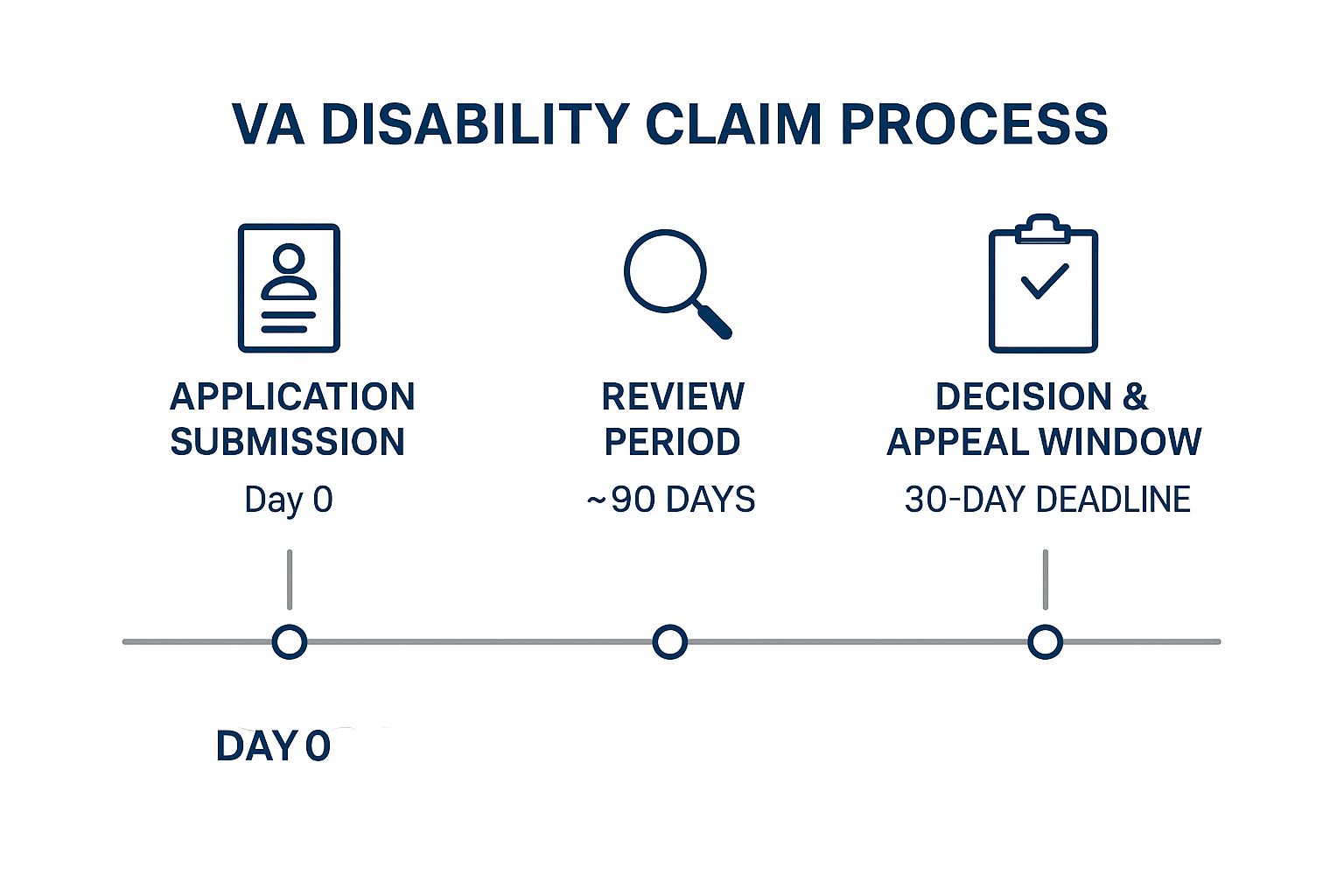
As you can see, that middle section is where the magic happens. That’s why being proactive and responsive during the evidence-gathering stage is so crucial to keeping your claim moving forward.
From Decision to Completion
Once all the evidence is collected, your claim shifts to Preparation for Decision. At this point, the VA employee assigned to your case—officially called a Rating Veteran Service Representative (RVSR)—has everything they need. They'll review all the records, C&P exam results, and other evidence to formulate a recommended decision.
The final steps, like Pending Decision Approval and Preparation for Notification, are mostly internal quality control. A senior representative double-checks and signs off on the RVSR's decision before the official rating letter is put together and sent out.
Once the status flips to Complete, that means your decision packet is in the mail. The VA has gotten much faster at this; they once processed over a million claims ahead of schedule, even finalizing over 12,000 claims in a single day. You can read more about the VA's recent processing performance on their news site.
Alternative Ways to Check Your Claim Status
While the online trackers are fantastic tools, they aren't your only option. Sometimes, the digital status just doesn't give you the full picture, or you simply need to talk through a question with a real person. Knowing who else to call or work with can make all the difference, especially when the waiting game gets tough.
If you hit a wall online, picking up the phone is a solid next move. The main VA benefits hotline is 1-800-827-1000. You can reach someone Monday through Friday, from 8:00 a.m. to 9:00 p.m. Eastern Time.
A quick pro-tip from experience: have your VA file number or Social Security number handy before you dial. This saves you and the representative a lot of time. I've also found that calling mid-week, like on a Wednesday or Thursday afternoon, often means less time on hold compared to the Monday morning rush.
Your Most Valuable Ally: A Veteran Service Officer
Beyond calling the VA yourself, one of the most powerful resources you have is a Veteran Service Officer, or VSO. These are accredited professionals—often veterans themselves—who know the VA system inside and out. Their services are completely free, and they work for organizations like the VFW, DAV, or your local county veterans affairs office.
Think of a VSO as your personal advocate and guide through the bureaucratic maze.
A good VSO can do more than just check a status. They can interpret complex VA notices, identify potential issues with your evidence before the VA does, and communicate directly with VA regional office staff on your behalf. This inside access is invaluable.
For instance, let's say your claim status shows a request for more evidence, but the description is vague. Instead of guessing, your VSO can get clarification on exactly what the VA needs. They can even review your documents before you submit them to prevent simple mistakes that cause major delays.
If you haven't connected with a VSO yet, I can't recommend it enough. It's one of the smartest moves you can make for your claim.
Insider Tips for a Less Stressful Claim Journey
After you’ve filed your VA claim, the waiting game begins. But waiting doesn't have to mean sitting on your hands. There's a lot you can do to keep things moving smoothly and avoid the common pitfalls that can derail a claim. Think of this as the "unwritten manual" based on the real-world experience of countless veterans who've been in your shoes.
Keep Your Contact Info Current—No Excuses
This might sound obvious, but you’d be surprised how often it trips people up. If the VA needs to schedule your C&P exam or clarify a detail and they can't reach you, your claim hits a wall. A missed letter or phone call because of an old address or disconnected number is one of the easiest ways to add months to your wait time. Make updating your info with the VA the very first thing you do if you move or change your number.
Master the Art of "Proactive Patience"
Patience is key, but I'm talking about proactive patience. The VA has actually gotten much faster lately, cutting its disability claims backlog by nearly 30%—a significant improvement. You can read more about these updates directly from the VA's news site.
So, what does proactive patience look like?
- Check your status weekly, not daily. Checking multiple times a day won't make the VA move faster, but it will skyrocket your stress levels.
- A weekly check-in is the sweet spot. It’s frequent enough to catch any new requests or updates without making you obsessed.
A Quick Tip: Set a recurring calendar reminder for every Tuesday morning to check your claim status. This turns an anxious habit into a simple, routine task.
Always, Always Keep Copies
Here’s a rule to live by: Never give the VA your only copy of anything. Whether it's a doctor's note, a buddy letter, or an official form, make a physical or digital copy before you send it off. Documents can and do get lost. Having your own file means you can resubmit something instantly without having to track it down all over again.
Following these simple tips puts you back in the driver's seat. You’re no longer just a passive applicant waiting for a decision; you become an active manager of your own claim, ready to handle whatever comes your way.
Answering Your Top Questions About Tracking a VA Claim
When you're navigating the VA claims process, a lot of questions pop up. It's completely normal. Let's tackle some of the most common ones we hear from fellow veterans to clear up the confusion and give you a bit more control over the situation.
How Often Should I Really Be Checking My Claim Status?
This is a classic dilemma: you want to stay on top of things, but you don't want the process to drive you crazy. Checking your claim status multiple times a day won't make the VA move any faster, but it will definitely increase your stress levels.
I always tell veterans to find a healthy middle ground. A good rhythm is to check your status on VA.gov about once a week. That’s frequent enough to catch important updates—like a request for more documents or a notification for a C&P exam—without letting the waiting game take over your life. A pro-tip? Set a recurring reminder on your phone, maybe for every Tuesday morning. This turns an anxious habit into a simple, routine to-do item.
Help! Why Did My Claim Go Backward?
It can be really disheartening to see your claim go from a later stage, like "Preparation for Decision," back to an earlier one, such as "Evidence Gathering." Your first instinct might be to panic, but take a deep breath. This is usually a normal part of the process and doesn't automatically mean something is wrong.
More often than not, it just means a new piece of information has been added to your file and a rater needs to review it.
- Maybe the results from your C&P exam just came in.
- Perhaps the VA finally received those private medical records you mentioned.
- It could be that a buddy letter you submitted was just uploaded.
Think of it this way: the system is actually working. The claim moved back so that this new evidence could be properly considered.
The Bottom Line: A backward jump in the claim tracker usually means your file is active and that new, potentially helpful evidence is being reviewed. It's a sign that they're trying to get the decision right based on all the available information.
What if My Claim Hasn't Moved in Over a Month?
Staring at the same status for over 30 days can be frustrating, especially if you're stuck in the "Evidence Gathering" phase. If you're seeing no movement at all, it's time to take some gentle action. First, poke around the "Files" tab on VA.gov again. Sometimes a request for information gets buried and is easy to miss.
If the coast is clear online, your best move is to reach out to your Veteran Service Officer (VSO) or accredited agent. They have a different level of access and can often get more specific details on what's causing the hold-up. If you filed on your own, calling the VA benefits hotline at 1-800-827-1000 is your next best option to ask for an update directly.
Wrestling with the VA claims and appeals system is tough, but you shouldn't have to go it alone. The team at Homefront Group is made up of legal professionals and fellow veterans who have been in your shoes and know this process inside and out. If your claim was denied or you believe you were underrated, we're here to help you build a solid appeal. Take our free 3-minute quiz to see how we can support your case.