
When you hear the term "TBI VA rating," it might sound like just another piece of government jargon. But for a veteran, it's much more than that. It’s the VA’s way of acknowledging how a Traumatic Brain Injury (TBI) has changed your life, from your ability to think clearly to your emotional well-being and physical coordination.
This rating, which ranges from 0% to 100%, is the key that unlocks your monthly disability compensation and other vital support services.
What a TBI VA Rating Really Means for You
Let's break it down. Think of the VA rating less as a simple score and more as a detailed story of your injury's aftermath. It translates the very real, often invisible, challenges you face every day—like memory lapses, sudden mood shifts, or balance issues—into a clear, official percentage.
The VA's goal here is to create a consistent framework that turns your personal experience with TBI into an objective measure. This process ensures that every veteran's claim is evaluated against the same standard, recognizing the profound impact these injuries can have.
How the VA Evaluates TBI Claims
The VA doesn't just pull a number out of thin air. The entire process is guided by a specific rulebook, 38 CFR § 4.124a, which covers neurological conditions. Instead of giving you a single, generalized score, the VA looks at ten distinct areas of brain function, often called "facets." These cover everything from memory and concentration to motor skills and social interaction.
Here’s the most important part: your overall rating is determined by the highest level of impairment found in just one of those ten areas. This is a critical detail. If you are totally impaired in even a single facet, you could qualify for a 100% disability rating, even if other areas are less affected.
The cornerstone of this whole process is a thorough medical evaluation. As technology evolves, it's also helpful to understand how enhancing patient consultations with video conferencing is changing how veterans connect with specialists for these crucial assessments.
The table below gives a quick overview of how the VA connects symptoms to specific rating levels.
TBI VA Rating Levels at a Glance
| Disability Rating | Level of Impairment | Common Symptoms |
|---|---|---|
| 0% | No Impairment | Symptoms are documented but don't affect daily functioning. |
| 10% | Mild Impairment | Symptoms are present but are generally manageable with minimal effort. |
| 40% | Moderate Impairment | Symptoms clearly interfere with work, social life, or daily tasks. |
| 70% | Severe Impairment | Symptoms cause major disruptions in most areas of life. |
| 100% | Total Impairment | Veteran is unable to function independently due to the effects of the TBI. |
As you can see, the system is designed to directly link the severity of your condition to the compensation you receive, providing a clear path from diagnosis to support.
The 10 TBI Facets the VA Actually Measures
When the VA looks at a Traumatic Brain Injury claim, they aren't just looking at the initial injury itself. What they really dig into are the lasting effects—what they officially call residuals—that mess with your day-to-day life. To get a clear picture, they break down brain function into ten distinct categories, which they call facets.
I like to use an orchestra analogy here. Think of your brain as a complex orchestra. After a TBI, maybe the string section is still playing beautifully, but the percussion is completely out of rhythm. The VA’s job is to listen to each individual section to pinpoint exactly where the performance is breaking down. A high tbi va rating isn’t based on an average of all ten facets; it's determined by the single most impacted one.
This is a great visual that shows how the different levels of severity for these facets line up with the VA's rating percentages.
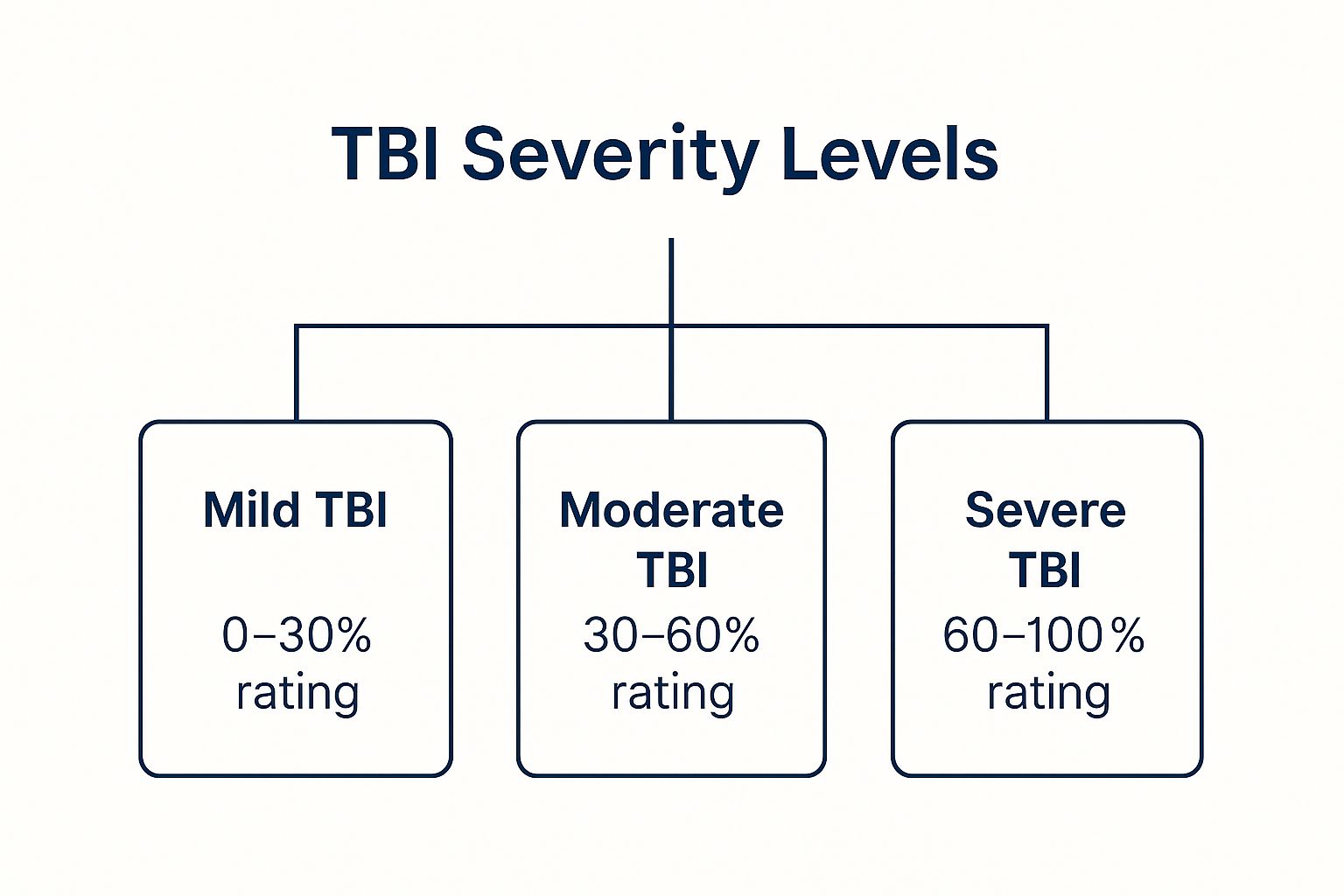
As you can see, the VA directly ties mild, moderate, and severe TBI symptoms to specific disability percentages.
Cognitive and Judgmental Facets
The first set of facets covers how you think and process information. These are often the toughest symptoms for veterans to explain because they’re completely invisible to an outside observer.
-
Memory, Attention, Concentration, and Executive Functions: This is a big one, and it's absolutely critical. Executive functions are like your brain's CEO—the part that handles planning, organizing, solving problems, and making decisions. A deficit here could mean you suddenly can't follow a simple recipe, struggle to keep track of your finances, or can't adapt when something unexpected disrupts your routine.
-
Judgment: This is all about your ability to make sound, safe decisions. The VA rater wants to know if you can look at a situation, weigh the pros and cons, and truly understand the potential consequences of your actions.
-
Orientation: Think of this as your brain's internal GPS. It's what keeps you grounded in knowing who you are, where you are, what the date and time is, and the situation you're in. Feeling disoriented can be a deeply unsettling and significant residual of a TBI.
Social and Behavioral Facets
A TBI can fundamentally alter how you interact with other people and regulate your own emotions. The VA measures these changes with two specific facets.
-
Social Interaction: This is about more than just being outgoing or shy. It’s your ability to behave appropriately in different social environments. For instance, a TBI might make it hard to pick up on social cues, which can lead to awkward encounters or friction with loved ones and colleagues.
-
Neurobehavioral Effects: This facet zeroes in on shifts in your personality and mood. We're talking about things like sudden irritability, acting on impulse, verbal aggression, or a general lack of cooperation that simply wasn't a part of who you were before the injury.
This is where personal statements and buddy letters become your most powerful tool. A letter from a spouse, a close friend, or a former supervisor describing how your personality has changed can provide the compelling, real-world evidence your claim needs.
Physical and Communication Facets
Finally, the VA evaluates the facets related to your physical control, your perception of the world around you, and your ability to communicate.
-
Motor Activity: This looks at your brain's ability to control your voluntary movements. It isn't about pure muscle weakness but rather the brain's capacity to send the right signals to get your body to do what you want it to do.
-
Visual-Spatial Orientation: This is how you perceive yourself in relation to the objects and space around you. If you're struggling here, you might find yourself getting lost in familiar neighborhoods or having a tough time with tasks like parking a car.
-
Communication: This facet is twofold. It assesses both your ability to express yourself clearly (whether speaking or writing) and your capacity to understand what others are trying to communicate to you.
-
Subjective Symptoms: This category is a catch-all for symptoms that a doctor can't objectively measure with a test. This includes things like chronic, debilitating headaches, persistent dizziness, and overwhelming fatigue that rest doesn't fix.
-
Consciousness: This final facet is reserved for the most severe TBI cases. It's used to evaluate whether a veteran is in a coma or a persistent vegetative state.
What TBI Rating Percentages Mean for Your Daily Life

When the VA assigns a percentage to your TBI rating, those numbers can feel cold and abstract. What's the real difference between a 10% rating and a 70% one in the real world? It's all about translating percentages into the real challenges you face every day.
Think of it like this: a lower rating is the VA’s way of saying, “We see you have symptoms,” while a higher rating says, “We see these symptoms are fundamentally disrupting your ability to work, connect with others, and take care of yourself.” Understanding this connection is the first step in painting an accurate picture for your claim.
From Minor Annoyances to Moderate Struggles
At the low end of the spectrum, a 10% TBI VA rating points to mild impairment. You're definitely experiencing symptoms, but you can generally manage them without your whole life grinding to a halt. Maybe you get more headaches than you used to or find your focus drifts sometimes, but you’re still able to hold down a job and handle your daily life.
A 40% rating is where things get more serious. This isn't just a minor inconvenience anymore; the effects of your TBI are actively interfering with your life. You might find yourself struggling to keep up at work, feeling too drained or overwhelmed for social events, or needing help with complex tasks like managing your bills. The challenges are persistent and undeniable.
When TBI Becomes Severely or Totally Disabling
Reaching a 70% TBI VA rating is a significant jump. This means the VA recognizes that your TBI’s residuals are a severe obstacle in almost everything you do. For a veteran at this level, daily life could involve:
- Serious social withdrawal, making it a struggle to even talk with family.
- Getting disoriented and confused, even in places you know well.
- Difficulty with basic self-care and living on your own.
Finally, a 100% rating represents total impairment. This is the highest schedular rating for a reason—it’s reserved for veterans whose TBI symptoms are so profound they can no longer function independently.
The VA’s compensation is designed to mirror this reality. The financial support you receive is directly tied to the level of functional loss you're experiencing because of your service-connected TBI.
The actual dollar amounts reflect this scale of severity. A veteran with a 10% rating gets a certain amount of monthly compensation, while someone rated at 40% receives a substantially larger payment. A 70% rating provides even more support, and the 100% rating offers the maximum schedular benefit. It's also worth noting that once you hit a 30% rating, you may be eligible for additional compensation for dependents. To see how these percentages translate to monthly payments, you can learn more about how the VA calculates TBI compensation rates.
Why the 70 Percent TBI Rating Is a Critical Milestone
Reaching a 70 percent TBI VA rating isn't just about getting a higher number on a piece of paper. It represents a fundamental shift in how the VA acknowledges the severity of your condition. It’s the point where the VA officially recognizes that the effects of your brain injury are causing severe functional impairment.
Think of it this way: lower ratings acknowledge challenges, but the 70% rating confirms that your TBI has profoundly impacted your ability to hold a job, maintain relationships, and simply manage your daily life. It’s a validation that the struggles you're enduring aren't just minor inconveniences—they are major, life-altering obstacles.
What Severe Impairment Actually Looks Like
It’s easy to get lost in the VA's clinical language. So, what does "severe impairment" really mean in day-to-day life? For a veteran at the 70% level, the challenges are persistent and often overwhelming. These aren't things you can just "power through" anymore.
This level of impairment often shows up in very real ways, such as:
- Significant Social Withdrawal: You might find it almost impossible to be around people, even family and friends you love. The mental energy it takes to follow a conversation or just be in a group setting feels completely draining.
- Disorientation and Confusion: Getting lost on a route you've driven a hundred times or suddenly feeling unsure what day it is can become a frighteningly common experience. Your brain's internal compass feels broken.
- Difficulty with Basic Self-Care: Simple routines that were once automatic, like remembering to shower or putting together a simple meal, can now feel like monumental tasks that require significant effort or assistance.
Historically and clinically, the VA’s 70% rating for TBI is significant as it denotes these severe functional impairments. At this level, veterans often show pronounced difficulty with memory, judgment, and social interactions.
For example, a veteran at this level might struggle with frequent disorientation, make poor decisions that could put them or others at risk, or deal with severe behavioral symptoms like intense panic attacks or unpredictable mood swings. You can discover more insights about how the VA evaluates these severe TBI symptoms on hillandponton.com.
The Impact on Your Future and Your Claim
Securing a 70% tbi va rating is the VA’s formal recognition that you need a substantial amount of support. It’s an acknowledgment that your ability to earn a living has likely been shattered and your overall quality of life has taken a massive hit.
This rating is so important because it validates your personal experience. It provides objective confirmation that the immense daily battles you fight are real, service-connected, and deserving of significant compensation and care. Understanding what this rating truly signifies helps you see that your struggles are being seen, measured, and taken seriously within the VA's system.
How to Build and File a Strong TBI Claim

Filing a VA claim for a Traumatic Brain Injury can feel like a mountain to climb, but you can absolutely get through it by taking it one step at a time. Think of yourself as building a case. Your mission is to give the VA a clear, undeniable picture of what happened, how you were injured, and how that injury continues to affect your daily life.
The entire foundation of a winning claim is built on solid evidence. Without it, the VA simply can't connect your current symptoms to your time in the military or figure out the right disability rating. This is where you take charge, providing the proof they need to grant you a fair tbi va rating.
Assembling Your Evidence
Your first order of business is to gather every single piece of paper that tells your story. This documentation is the backbone of your claim, offering the objective proof needed to back up your personal experience. To get started, focus on the three must-haves for any successful VA claim.
To prove a service connection for TBI, the VA needs to see:
- A Current Medical Diagnosis: You must have an official TBI diagnosis from a doctor or other qualified medical professional.
- An In-Service Event: You need to point to a specific event during your service that caused the injury—an IED blast, a fall during training, a vehicle accident, anything that caused the trauma.
- A Medical Nexus: This is the critical bridge connecting the first two points. It's typically a letter from your doctor stating that your current TBI is more likely than not a result of that specific in-service event.
Beyond these official documents, don't underestimate the power of "lay evidence." These are personal statements from people who know you and can speak to the changes they've seen in you since your injury.
Buddy Letters: A statement from a service member who witnessed your TBI event is priceless. They can provide a firsthand account of what happened and describe any immediate changes they noticed in your behavior or health.
Personal letters from family, close friends, or even a former boss can also paint a powerful "before and after" picture that a dry medical record just can't convey. They can describe shifts in your memory, mood, or ability to socialize. When you're ready to submit all your documents, you might need to send them securely; you can find information on how to send a fax to the US Veterans Administration if that's a method you choose to use.
This checklist can help you stay organized as you collect your evidence.
Your Essential TBI Claim Evidence Checklist
Use this checklist to gather the critical documents and statements needed to build a strong VA disability claim for TBI.
| Evidence Type | Description and Purpose | Where to Find It |
|---|---|---|
| Service Treatment Records (STRs) | Contains initial reports of the injury, headaches, dizziness, or concussion-like symptoms. Establishes the in-service event. | Your personal military records, National Archives, or request from the VA. |
| VA or Private Medical Records | Shows ongoing treatment for TBI symptoms, current diagnosis, and prescribed medications or therapies. | Your VA patient portal (My HealtheVet) or your private doctor's office. |
| Medical Nexus Letter | A professional medical opinion directly linking your current TBI diagnosis to your service. This is a crucial connector. | Your treating physician, a neurologist, or a private medical professional specializing in VA claims. |
| Buddy Letters | Firsthand accounts from fellow service members who witnessed the TBI event or the immediate aftermath. | Reach out to members of your old unit or anyone who served with you at the time. |
| Personal & Family Statements | Your own statement detailing the injury and its effects. Statements from family/friends describing changes in your personality, memory, and daily function. | Written by you, your spouse, parents, siblings, or close friends. |
| Employment Records | Documentation showing decreased work performance, disciplinary actions for behavioral issues, or termination due to TBI symptoms. | Human Resources departments from current or past employers. |
Having these documents in hand before you file will make the entire process much smoother and significantly strengthen your case from the very beginning.
Preparing for Your C&P Exam
The Compensation & Pension (C&P) exam is a major milestone in your claim. This is when a VA-contracted doctor will evaluate your condition in person. It is absolutely essential that you show up for this appointment and are ready to talk openly about your symptoms.
Before you go, make a list of every symptom you experience, no matter how small it seems. Think about how your TBI impacts each of the 10 different areas the VA evaluates, from your memory and judgment to your mood and social interactions.
Be completely honest and don't try to tough it out—this is not the time to be stoic. The examiner needs to understand the full scope of your struggles. Tell them what your worst days are like and give them real-world examples of how your symptoms mess with your job, your relationships, and your ability to get through a normal day.
Common Questions on the TBI VA Rating Process
Trying to make sense of the VA claims system can feel overwhelming, and that’s especially true when you’re dealing with something as complex as a Traumatic Brain Injury. Many veterans run into the same roadblocks and have the same questions. Let's tackle some of the most common ones head-on so you can move forward with your tbi va rating claim with a lot more confidence.
Think of this as a quick-reference guide for those nagging "what if" scenarios that pop up along the way.
What Happens If My TBI Symptoms Get Worse?
A TBI isn't a static injury; its effects can change, and unfortunately, they often get worse over time. If you find that your TBI symptoms have intensified since you got your initial rating, you have every right to file for an increase. This isn't a brand-new claim, but a formal request for the VA to re-evaluate your condition based on how it impacts you today.
To be successful, you'll need to back it up with new medical evidence that clearly shows this decline. This could be anything from recent reports from your neurologist and therapist's notes to results from new diagnostic tests. The VA will almost certainly schedule a new Compensation & Pension (C&P) exam to see the changes for themselves. It's absolutely crucial that you can clearly explain how the worsening symptoms have made it harder for you to work and handle daily life.
Can I Get Separate Ratings for TBI and PTSD?
Yes, you can, but it's tricky. The biggest hurdle is the VA’s policy against pyramiding, which is their term for preventing a veteran from being paid twice for the same symptom. Because TBI and PTSD share so many symptoms—like irritability, memory loss, and anxiety—the VA often lumps them together under one rating to avoid this issue.
However, if you can draw a clear line in the sand between the symptoms, you have a strong case for separate ratings. For example, maybe your TBI is the source of debilitating headaches and balance problems (distinctly physical symptoms), while your PTSD is what causes flashbacks and hypervigilance (classic mental health symptoms). Getting a medical opinion from a specialist who can expertly differentiate the root cause of each symptom is incredibly powerful here.
A denial is not the end of the road. You have multiple options to appeal the decision. First, carefully read the denial letter to understand the VA's reasoning. Most often, a denial is due to a lack of sufficient evidence connecting your symptoms to your service.
What Is a Presumptive Service Connection for TBI?
A presumptive service connection is a rule that can make the claims process much simpler. Essentially, it means that if you develop certain conditions after sustaining a moderate or severe TBI in service, the VA automatically assumes your military TBI is the cause.
This is a huge advantage. It lifts the burden of having to provide a "medical nexus" letter linking the new condition to your TBI. Conditions that can be granted a presumptive connection include:
- Parkinsonism that appears after a moderate or severe TBI.
- Unprovoked seizures following a moderate or severe TBI.
- Dementia diagnosed within 15 years of a moderate or severe TBI.
- Depression if it's diagnosed within three years of a moderate or severe TBI.
This presumption is a powerful tool for veterans who unfortunately develop these serious secondary conditions down the line.
What Should I Do If My TBI Claim Is Denied?
Getting a denial letter in the mail is crushing, but it is not the final word. You absolutely have the right to appeal. The key is to first understand why your claim was denied and then choose the right path forward. You can file a Supplemental Claim with new and relevant evidence, request a Higher-Level Review by a senior VA rater, or take your case directly to the Board of Veterans' Appeals.
Given how complicated the appeals process can be, getting help from an accredited attorney or a Veterans Service Officer (VSO) is something I always recommend. They've been down this road before and can help you build a much stronger case and guide you through the next steps.
Navigating the complexities of a VA claim, especially an appeal, can be overwhelming. The team at Homefront Group is composed of legal professionals and fellow veterans who understand what you're going through. If your TBI claim has been denied or you believe your rating is too low, take our 3-minute quiz to see how we can help you get the compensation you've earned. Visit us at https://homefrontgroup.com/ to get started.