

When you're ready to file a ptsd va claim, your success hinges on proving three key things to the VA: you have a current PTSD diagnosis, a specific event in your service caused it, and there's a clear medical link connecting the two. These aren't just suggestions; they're the absolute foundation of any approved claim.
Do You Qualify for a PTSD VA Claim?

Before diving into the mountain of paperwork, it’s crucial to understand what the VA is actually looking for. A winning claim isn't just about telling your story—it's about presenting a rock-solid case built on specific evidence that meets their legal and medical standards. Without this, even the most valid claims can get denied.
The entire process boils down to proving what the VA calls a "service connection." I always tell veterans to think of it like a three-legged stool. If any one of those legs is missing or wobbly, the whole thing topples over. This isn't just bureaucratic red tape; it's the exact framework the VA rater will use to decide your future.
The sheer number of veterans dealing with this shows how important it is to get it right. PTSD is one of the most common disabilities the VA compensates. Right now, about 1,664,170 veterans are receiving benefits for it. That means nearly 27% of all veterans on disability are being compensated for PTSD, which really underscores the mental health toll of military service. The Center for Deployment Psychology offers more insight into these statistics and what they mean for the veteran community.
To help you get started, here's a quick look at the essential components you'll need to prove service connection for your PTSD.
The Three Pillars of a Successful PTSD Claim
| Requirement | What It Really Means | Evidence That Works |
|---|---|---|
| Current Diagnosis | You must have a recent, formal PTSD diagnosis from a qualified professional (like a psychiatrist) that meets the criteria in the DSM-5. An old diagnosis won't cut it. | Medical records from a VA hospital, private doctor, or psychologist; a completed DBQ (Disability Benefits Questionnaire) for PTSD. |
| In-Service Stressor | You have to point to a specific, traumatic event that happened during your service. This is the incident the VA will try to verify. | Service records, performance reports, award citations (e.g., CIB, CAB), incident reports, or "buddy letters" from those who served with you. |
| Medical Nexus | A doctor needs to connect the dots, stating that your PTSD is at least as likely as not caused by that in-service event. This is the critical link. | A "nexus letter" from a medical expert that explicitly links your diagnosis to your specific stressor using VA-required language. |
Understanding these pillars is the first step in assessing the strengths and weaknesses of your own case before you even think about filling out a form. Let's dig a little deeper into what they mean in the real world.
Understanding the In-Service Stressor
The word "stressor" can be a bit confusing. It's not about the general stress of being in the military. It refers to a specific traumatic event that the VA can look up and confirm happened.
-
Combat Stressors: These are often the most straightforward to prove. If you were in direct combat, the VA usually concedes the stressor occurred, especially if you earned an award like the Combat Infantryman Badge (CIB) or Combat Action Badge (CAB).
-
Non-Combat Stressors: Many veterans I've worked with developed PTSD from events completely separate from combat. This could be a horrific training accident, a serious vehicle crash, or being a first responder to a mass casualty situation on base.
-
Military Sexual Trauma (MST): This refers to personal assault or repeated, threatening sexual harassment during service. The VA treats MST as a specific type of stressor and has special rules for these claims, knowing that these events were often never officially reported.
My Key Takeaway: The VA’s job is to verify your stressor. The more proof you provide to back up your story—service records, official reports, or letters from buddies who witnessed the event—the stronger your claim will be.
The Power of the Medical Nexus
The nexus is the bridge. It’s what connects your current diagnosis all the way back to your time in uniform. Without a strong nexus, the VA will likely assume your PTSD could have been caused by something else after you got out, and they will deny your claim.
A nexus letter from a psychologist or psychiatrist is an incredibly powerful piece of evidence. It needs to clearly state, in their professional opinion, that your PTSD is "at least as likely as not" related to your specific in-service stressor. That exact phrasing is VA legal-speak, and it's what satisfies their standard of proof. A well-written nexus letter can be the single most important document you submit, especially in a complicated PTSD claim.
Building Your Evidence File for a Winning Claim

Think of your PTSD VA claim like you're building a legal case. You're the lead attorney, and the strength of your case rests entirely on the evidence you present. A claim is nothing more than a story backed by solid proof, and your goal is to build a case file that leaves no doubt in the VA rater's mind.
The person reviewing your claim wasn't there with you. They don't know what you experience daily. Your evidence needs to paint a vivid picture for them, connecting the dots between your life before, during, and after the traumatic event that changed everything.
Locating Your Core Documents
The bedrock of any strong claim is your official paperwork. It's on you to track down every relevant document from your military career and medical history. Never assume the VA will find it all for you—take charge of this process from the start.
First, you'll want to request your Official Military Personnel File (OMPF) through the National Archives. This file is a goldmine, containing your full service history, awards, performance reviews, and training records. At the same time, request your complete Service Treatment Records (STRs) and any medical records from VA hospitals or private doctors you’ve seen since leaving the service.
These documents are absolutely critical. Here’s why:
- They can verify your in-service stressor. An award citation for combat action, an incident report, or even performance reviews showing a sudden decline can back up your account of what happened.
- They create a medical timeline. Records showing you sought help for things like anxiety, insomnia, or anger—even if PTSD wasn't the diagnosis then—are powerful pieces of the puzzle.
The Power of Personal Statements
Official records tell part of the story, but it’s the personal statements that bring your claim to life. Two types of statements can truly make or break a PTSD claim: buddy letters and your own personal statement.
A buddy letter, which is officially a Statement in Support of Claim, is a firsthand account from someone who knows your story. This could be a fellow service member who was there and witnessed the event, or it could be a spouse, parent, or close friend who has seen the profound changes in you since.
A truly effective buddy letter goes beyond simply stating, "He has PTSD." It gives concrete examples. A spouse might write, "Before his deployment, he was the life of the party. Now, he dreads family gatherings and I see sheer panic on his face when we're in a crowded store."
This kind of specific, observational detail is incredibly convincing to a VA rater. It gives them a real-world look at the "social impairment" the VA rating criteria talks about.
Crafting Your Personal Statement
Your personal statement, typically written on VA Form 21-4138, is hands-down the most important piece of evidence you will create. This is your opportunity to speak directly to the rater, in your own words. It’s what turns a stack of cold documents into a compelling human story.
A winning personal statement accomplishes three key things:
- It vividly describes the stressor event. You need to detail what happened, conveying the genuine fear, helplessness, or horror you felt.
- It links the event to your symptoms. Explain how your life began to unravel after the event. When did the nightmares start? When did you begin to withdraw from others or feel constantly on edge?
- It details your current life with PTSD. This is where you explain how your symptoms impact you today. Be honest about your worst days, not your best. Describe how PTSD affects your job, your relationships, and even simple daily tasks. It helps to use the VA's own terminology, explaining the impact on your "occupational and social functioning."
This is not the time to be stoic. If you have memory blackouts, say so. If you experience panic attacks, describe what they feel like and how often they occur. The more raw and detailed you are, the more credible your account becomes, providing the narrative that ties every other piece of evidence together into a claim they can't deny.
How the VA Assigns PTSD Ratings
Trying to figure out how the VA assigns a disability rating for a ptsd va claim can feel like you're trying to solve a puzzle with half the pieces missing. But here’s the secret: it all boils down to one simple concept. The VA is focused on how much your PTSD symptoms get in the way of you living your life—specifically, your ability to work and maintain social relationships.
It's not enough to just have a diagnosis. The entire rating system, which runs from a 10% rating all the way up to 100%, is built to measure the real-world impact of your condition. That final percentage directly translates into your monthly tax-free compensation, so getting it right is crucial. A low rating suggests minor issues, while a high rating acknowledges that your life has been severely disrupted. The difference between a 30% and a 70% rating often comes down to the frequency, severity, and duration of your symptoms, as shown in your medical records, personal statements, and, most importantly, your C&P exam.
This visual gives you a quick snapshot of the evidence you'll need to pull together.
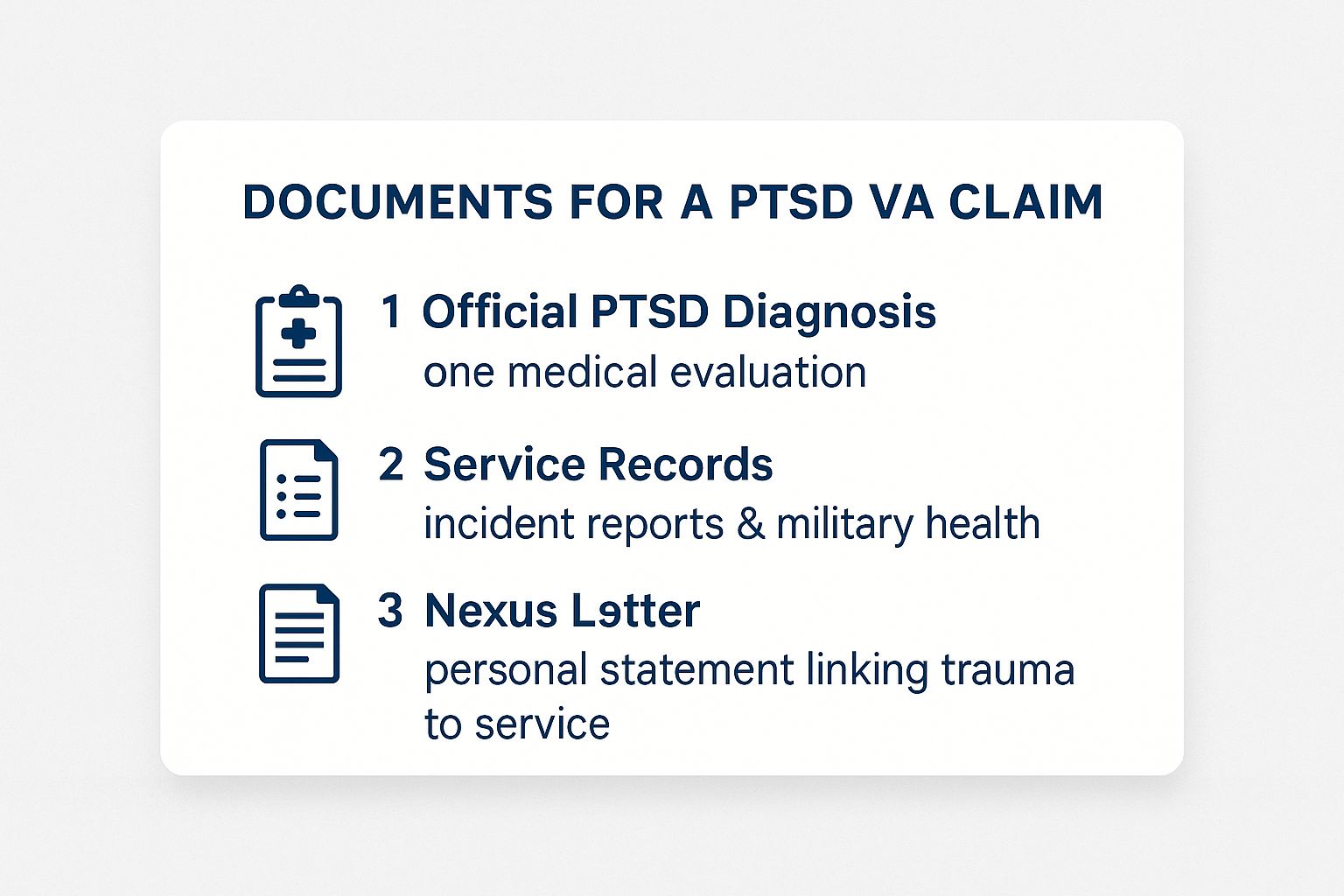
As you can see, a strong claim really stands on three legs: the official diagnosis from a professional, the evidence of your in-service stressor, and your own personal statement that ties everything together.
What Do the VA Rating Percentages Actually Mean?
The official language the VA uses in its rating schedule can be pretty dense and clinical. It helps to translate those percentages into what they actually look like in day-to-day life.
To make this clearer, here’s a breakdown of the VA’s PTSD rating levels and what kind of real-world impairment they correspond to.
Understanding VA PTSD Ratings and Impairment Levels
| Rating % | Level of Impairment | Common Real-World Examples |
|---|---|---|
| 10% | Mild | You have symptoms, but they don't significantly interfere with work or relationships. Maybe you have occasional nightmares but can generally handle your job and social situations. |
| 30% | Occasional Impairment | Your symptoms cause noticeable, but manageable, problems. This could be chronic trouble sleeping, mild memory issues (like forgetting names), or periods of irritability that sometimes affect your work efficiency. |
| 50% | Significant Impairment | This is a very common rating. It reflects more serious issues like frequent panic attacks, trouble concentrating at work, or clear mood swings that strain relationships. Your reliability and productivity are noticeably reduced. |
| 70% | Severe Impairment | You are struggling in most areas of your life—work, family, and even basic self-care. This could mean near-constant panic or depression, suicidal thoughts, or an inability to manage stress. Holding down a job is extremely difficult, if not impossible. |
| 100% | Total Impairment | Your symptoms are so severe that you are totally impaired occupationally and socially. This might involve gross impairment in your thought process, persistent danger of hurting yourself or others, disorientation, or profound memory loss. |
Ultimately, the goal is to paint a clear picture for the VA Rater, showing them exactly how your PTSD impacts your ability to function.
Key Takeaway: The difference between a 30% and 70% rating isn't about having a totally different set of symptoms. It's about how often they happen and how severely they impact you. Being able to clearly explain this during your C&P exam is absolutely critical to getting an accurate rating.
Big Changes Are Coming to Mental Health Ratings
It's also really important to know that the VA is in the process of overhauling how it rates mental health conditions, including PTSD. They’ve proposed some major changes designed to make the system more objective and fair.
The new system is built around five core areas of function:
- Cognition
- Interpersonal Interactions and Relationships
- Task Completion and Life Activities
- Navigating Environments
- Self-Care
Each of these "domains" will be scored on a scale from 0 (no impairment) to 4 (total impairment). Your final disability rating—10%, 30%, 50%, 70%, or 100%—will be based on how many domains are impaired and to what degree. You can read up on the specifics of these upcoming VA rating changes to see how they might affect your claim.
This is a huge shift. Instead of just ticking boxes on a symptom list, the new framework forces the VA to look at how your condition actually affects different parts of your life. For many veterans, this could be a good thing, leading to a rating that more accurately reflects the daily battle they're fighting. It's smart to familiarize yourself with this new model, as it will almost certainly be the standard for all future PTSD claims.
Preparing for Your PTSD C&P Exam

Let's be blunt: the Compensation and Pension (C&P) exam is the make-or-break moment for your entire ptsd va claim. This is your one shot to sit down with a VA-appointed examiner who will evaluate your condition. The report they generate from this single meeting carries immense weight and will heavily influence, if not decide, your final disability rating.
You simply can’t afford to walk into this appointment unprepared. Over the years, I've seen countless veterans hurt their own claims by doing what they were trained to do: be stoic and downplay their pain. That instinct, while vital in service, is your worst enemy here. The examiner only has a brief window to understand your life, and they need the raw, unfiltered truth.
Think of it this way: the exam's purpose is to get a snapshot of your symptoms and, crucially, how those symptoms throw a wrench into your work and social life. The examiner uses what you tell them to fill out a Disability Benefits Questionnaire (DBQ) for PTSD, the official form that documents the severity of your condition for the VA rater.
How to Talk About Your Symptoms
This is not the time to "suck it up." You have to be uncomfortably honest. The examiner needs to understand what your worst days look like, not the days you manage to hold it all together.
When you describe your symptoms, nail down the specifics. I always tell veterans to focus on three things:
- Frequency: How often does this happen? Daily? Weekly? A few times a month?
- Severity: When it hits, how bad is it? Does a panic attack completely sideline you for the rest of the day?
- Duration: How long has this been your reality? Have these symptoms been a constant presence since your service?
Details are everything. "I have trouble sleeping" is vague and doesn't tell them much. Compare that to: "I have chronic sleep impairment. Nightmares wake me up every two hours, so I only get about three hours of broken sleep a night. I'm left feeling completely exhausted and on edge all day." See the difference? That second one paints a vivid, undeniable picture.
My Best Advice: Before you go, make a simple list of your most significant symptoms and real-life examples of how they affect you. Jot it down on a piece of paper and bring it with you. This isn't cheating; it's being prepared. When you're sitting there, anxious and under pressure, it's incredibly easy to forget the most important details. This list is your safety net.
What to Expect During the Exam
The C&P examiner will guide the conversation, asking a lot of questions that come straight from that PTSD DBQ form. Expect them to ask about your military service, your life before and after, your work history, and, of course, the specific traumatic event—the "stressor"—that is the root of your PTSD.
You need to be ready to open up about the full spectrum of your symptoms, even the ones that are hard or embarrassing to discuss. Be prepared to talk about:
- Constant anxiety, depression, or wild mood swings
- Panic attacks and feeling hyper-aware of your surroundings
- Memory gaps and an inability to focus
- Flashbacks or intrusive thoughts that pull you back to the event
- Avoiding things that might trigger you, like crowds, loud noises, or even news stories
- Irritability, sudden anger, or trouble controlling your impulses
- How all of this has impacted your relationships with family and friends
The examiner's job is to see if your condition meets the diagnostic criteria in the DSM-5 and to document how it limits you. When they ask, "How are you doing today?" the absolute worst answer is "I'm fine." A more honest and effective response would be, "To be honest, I'm not doing well. I had a panic attack this morning just thinking about coming to this appointment."
Remember, this is not a therapy session. The examiner isn’t there to treat you; their role is to gather the facts for the VA rater who will decide your claim. Your role is to give them those facts with brutal honesty and clarity. By preparing yourself and being open about your daily battles, you give the examiner everything they need to write a report that accurately reflects your reality and gives your claim the best possible chance of success.
Alright, you’ve done the hard work of gathering your evidence and getting your story straight. Now it's time to take that final, crucial step: actually filing your PTSD VA claim. This is where the rubber meets the road.
The main event here is the VA Form 21-526EZ, the Application for Disability Compensation and Related Compensation Benefits. Think of this form as the official start of your journey toward getting the financial stability you deserve.
Don't just rush through it. Treat this form with the seriousness it deserves. A single typo in your Social Security number or a mistaken service date can throw your entire claim into a bureaucratic holding pattern for months. I’ve seen it happen. Take your time, double-check every entry, and make sure every single piece of evidence you've collected is attached before you submit.
Playing the Waiting Game (and How to Keep Your Sanity)
Once you hit "submit," the wait begins. Let's be honest, this is often the toughest part. It can feel like you’ve sent your story out into the void.
Thankfully, the VA gives you a window into the process. You can—and absolutely should—track your claim's progress on the VA.gov portal. It's a lifesaver for managing your own expectations. You’ll see your claim move through eight different stages, from "Claim Received" all the way to "Preparation for Notification." Even seeing it inch from one stage to the next is a good sign that your file is active and not lost in a pile somewhere.
The VA's official target is a decision within 120-150 days, but complex PTSD claims can, and often do, take longer. It’s a marathon, not a sprint. Be patient, but stay engaged with the process.
Pro Tip from the Trenches: If you want to speed things up, file a Fully Developed Claim (FDC). This is you telling the VA, "Here is every single piece of evidence I have. You don't need to go looking for anything else." While you can add more evidence later if needed, claims filed under the FDC program often get a much faster review because the VA rater has a complete package from the very beginning.
What a Successful Claim Actually Means for Your Wallet
Getting that approval letter is a huge relief, but the real impact comes from the tax-free monthly compensation that follows. This money can be a game-changer, easing the financial strain that so often comes with PTSD.
The amount you receive is tied directly to your disability rating, which is the VA’s way of measuring how much your condition affects your daily life and ability to work. These compensation rates aren't set in stone; they usually get a Cost-of-Living Adjustment (COLA) each year to keep up with inflation.
For example, a 10% rating will give you a small but helpful monthly payment. But as the rating increases, the financial support grows substantially. A 100% rating provides a level of compensation that can essentially replace a full-time income, giving you and your family the breathing room you need. To get a better idea of the numbers, you can check out breakdowns of current and projected disability rates and what they mean for veterans.
Don't Forget Your Dependents—It's More Money You've Earned
Here’s something a lot of veterans miss: if you have a combined disability rating of 30% or higher, you are eligible for additional monthly payments for your dependents.
This includes:
- Your spouse
- Your children (typically under 18, but up to 23 if they are in school)
- Parents who depend on you for financial support
This isn't a handout; it's the VA acknowledging the real-world financial responsibilities you carry. Forgetting to list your dependents is leaving money on the table—money you are entitled to. You can add them when you first file your claim or anytime after you've been approved. The goal is to make sure you’re receiving every dollar of the benefits you have earned through your service.
Answering Your Top Questions About the PTSD VA Claim Process
Even with the best preparation, the VA system can be a maze of "what-ifs." Getting clear, honest answers to the big questions before you're in the thick of it can save you a ton of stress and help you keep your expectations realistic.
Let's cut through the noise. Here are the questions I hear most often from veterans just like you, along with the straight-up answers you need.
"What if the VA Denies My PTSD Claim?"
First, take a breath. A denial letter can feel like a final judgment, but I can tell you from experience, it’s often just the beginning of a different chapter. It is absolutely not the end of the road.
Your first move is to dissect that decision letter. Don't just skim it—read every word. The VA is required to tell you why they said no. Was the link to your service (the nexus) too weak? Did they have trouble verifying your stressor event? Understanding their reasoning is your key to unlocking the next step.
Once you know the "why," you have a few ways to fight back:
- File a Supplemental Claim: This is your best option if you have new evidence to add. If the VA said you lacked proof of a stressor, and you've since found buddy statements that confirm it, a Supplemental Claim is the way to go.
- Request a Higher-Level Review: Think the first rater just got it wrong? You can ask a more senior reviewer to look at the exact same evidence. You can't add anything new, but it's a great way to get a fresh set of eyes on a potential error.
- Appeal to the Board: This is the most formal path. You can take your case to the Board of Veterans' Appeals, which involves more legal process but can be necessary for complex disagreements.
A denial is a fork in the road. This is often the perfect time to team up with a qualified VSO or an accredited attorney. They’ve been down this path countless times and can help you map out the strongest strategy.
"Is a 100% PTSD Rating Even Possible?"
Yes, absolutely. A 100% schedular rating for PTSD alone is achievable, but it's reserved for the most severe cases.
To get a 100% rating, the VA is looking for evidence of total social and occupational impairment. This isn't just about having bad days; it's about symptoms so profound they prevent you from functioning in daily life. Think of symptoms like persistent danger of self-harm, major issues with thought processes or memory, or complete disorientation to time and place.
Expert Tip: There’s another path to the same destination. If your PTSD doesn’t meet the strict 100% criteria but it still keeps you from holding down a steady job, you may be eligible for Total Disability based on Individual Unemployability (TDIU). TDIU pays at the same rate as a 100% disability rating.
"Seriously, How Long Is This Going to Take?"
This is the million-dollar question, and anyone who gives you a firm date is guessing. The honest answer is: it depends.
The VA has a goal of making decisions in about 120 to 150 days, but that's just a target. The real timeline is dictated by the complexity of your case. A claim for a combat veteran with a Purple Heart and clear in-service medical records will almost always move faster than one for a non-combat stressor, like an accident during a training exercise, that requires more digging from the VA to verify.
Want to speed things up? The best thing you can do is file a Fully Developed Claim (FDC). This means you do the legwork upfront and submit all your evidence at once, leaving less for the VA to chase down. You can always check your claim's status on the VA.gov website to see where it stands.
"Do I Really Need to Spend Money on a Nexus Letter?"
A nexus letter is a medical opinion from a private doctor, psychologist, or psychiatrist that connects your current PTSD diagnosis directly to a specific event or your time in service. While not technically required, a powerful nexus letter can be the single most important document in your file.
Think of it this way: a good nexus letter does the VA rater's job for them. It lays out a clear, evidence-based, professional medical conclusion that’s very difficult for them to dispute.
It's an especially powerful tool if your diagnosis came years after you left the military, or if you've been denied before for a weak connection to service. In those scenarios, a well-written nexus letter isn't just "worth it"—it's often the investment that wins the claim.
At Homefront Group, we understand that navigating the complexities of a PTSD claim can be overwhelming. Our team of veterans and legal professionals is here to provide the expert guidance you need. Take our 3-minute quiz to see what benefits you qualify for and let us help you build a strategy for success. Find out more at https://homefrontgroup.com/.