
When it comes to your VA claim, the nexus letter is arguably the most powerful piece of evidence you can have. Think of it as the critical bridge the VA rater needs to connect your current health condition directly to your time in service. A solid nexus letter template isn't just a form to fill out; it's the blueprint for building that bridge so it’s strong enough to carry your claim to approval.
Why a Nexus Letter Can Make or Break Your Claim
Filing a VA disability claim is like building a legal case. To win, you need to prove three things:
- You have a current, diagnosed medical condition.
- Something happened during your military service (an injury, event, or exposure).
- There's a clear, undeniable link between the two.
That link is the "nexus," and the nexus letter is the expert medical opinion that establishes it.
Without one, you're asking the VA adjudicator to connect the dots using just your service records and current medical files. If that connection isn't crystal clear, it’s a gamble. A well-crafted letter from a qualified medical professional takes all the guesswork out of the equation. It’s an authoritative statement that tells the VA, "In my professional opinion, this veteran’s condition is a result of their service."
The Heart of a Successful VA Claim
In recent years, the nexus letter has become essential for the millions of veterans seeking disability benefits—a number that hit approximately 4.7 million in 2023. These letters, written by licensed medical experts, are designed to give the VA exactly what it needs: a definitive medical link. As you'll find in resources from experts like CarePatron.com, this document is your chance to present a compelling medical argument.
This graphic breaks down what a powerful nexus letter really does.
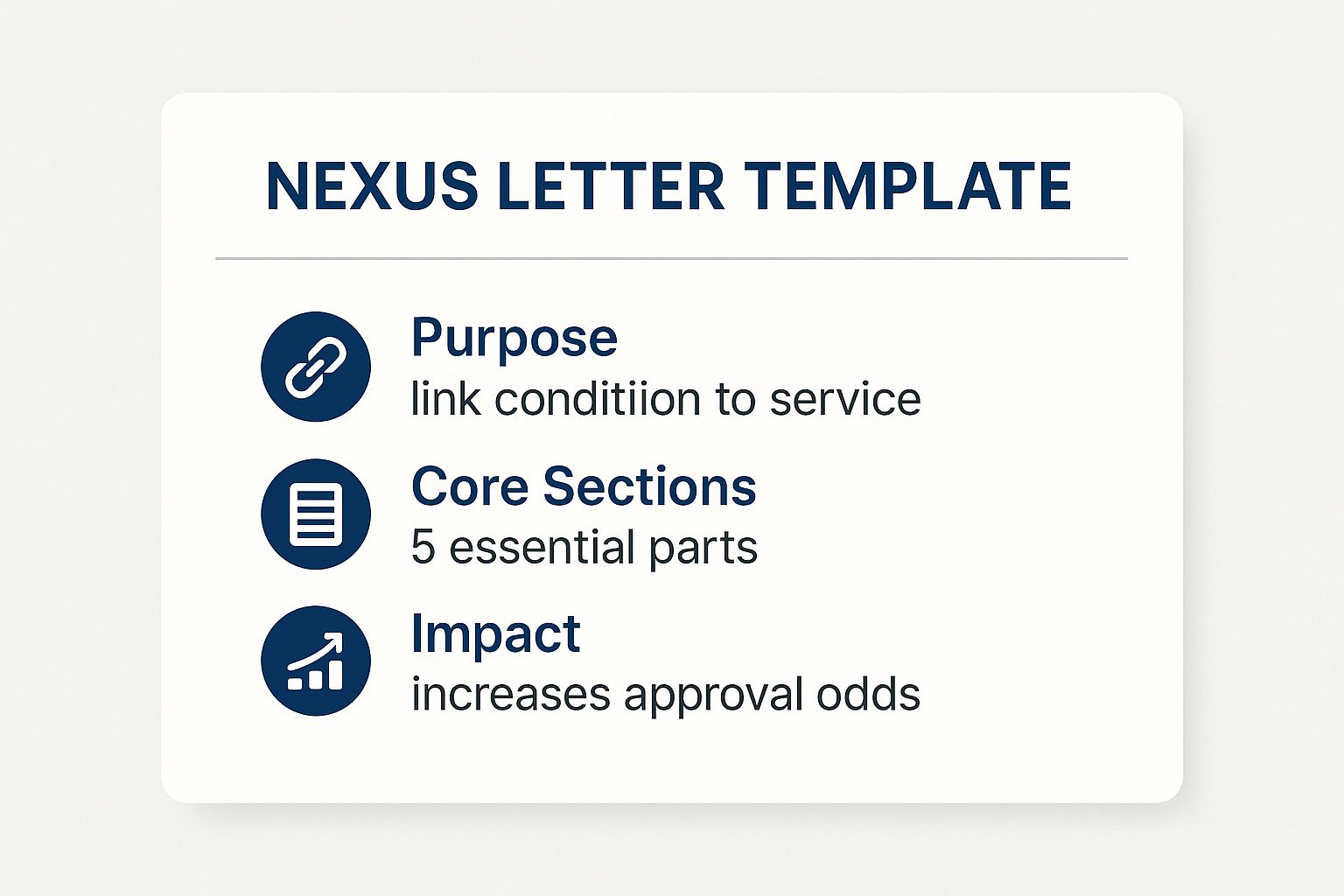
As you can see, it's all about linking your condition to your service with a structured, professional opinion that dramatically improves your odds of approval.
Strong vs. Weak Nexus Letter Components
It's important to understand that not all nexus letters are created equal. A vague, poorly written, or unsupported letter can actually hurt your claim, giving the VA an easy reason for denial. On the other hand, a strong, evidence-based letter is often the single document that tips the scales in your favor. Knowing the difference is crucial.
A strong nexus letter is far more than just a doctor's note. It's a detailed medical argument, citing evidence and using specific language the VA requires, such as stating your condition is 'at least as likely as not' related to your service.
The table below breaks down what makes a nexus letter compelling versus what makes it flimsy. Pay close attention to these details, as they can be the difference between getting the benefits you've earned and facing another denial.
| Component | Strong Nexus Letter (Effective) | Weak Nexus Letter (Ineffective) |
|---|---|---|
| Provider's Authority | Written by a qualified expert (MD, DO, PhD) who clearly states their credentials and specialty relevant to your condition. | Written by a provider with no relevant specialty or who fails to list credentials. |
| Evidence Review | Explicitly lists a thorough review of the veteran's complete file—service medical records, private medical records, and personal statements. | Makes a general statement without referencing any specific evidence that was reviewed. |
| Medical Rationale | Provides a clear, logical explanation of how the service event caused or aggravated the condition, often citing medical principles or studies. | Simply states a connection exists with no supporting rationale or scientific basis. |
| Concluding Language | Uses the VA's preferred legal terminology, such as "at least as likely as not" (a 50% or greater chance) or "more likely than not." | Uses vague, non-committal language like "could be related to" or "it's possible." |
Ultimately, a strong letter leaves no room for doubt. It presents a logical, evidence-based conclusion that is nearly impossible for a VA rater to ignore. A weak letter, however, raises more questions than it answers and won't get you very far.
How to Find and Brief the Right Medical Expert

A powerful nexus letter is only as good as the expert who writes it. It might seem like a no-brainer to ask your primary care doctor, but the best choice isn't always the most obvious one.
Your goal is to find a qualified professional who truly gets the specific requirements of the VA and is willing to put their name on a detailed, evidence-based opinion for your claim. This is more than just a quick chat during an appointment—it requires some strategic thinking and very clear communication.
You'll likely find yourself considering one of three main paths. Each has its pros and cons, so weighing them carefully will help you figure out what makes the most sense for you and your specific disability claim.
Comparing Your Medical Expert Options
Choosing the right person to author your letter is a huge decision. You need someone with the right credentials who can clearly and persuasively connect your military service to your current condition.
Your Private Physician or Specialist
This is usually the best place to start. A doctor who has been treating you for years already has a deep understanding of your medical history. They've built a rapport with you and can speak with real authority about how your condition has progressed.
The catch? Not all private doctors are familiar with the VA’s very specific requirements for a nexus letter or the precise language needed to make it stick.
A VA Doctor
Asking a VA doctor can be tricky. On the one hand, they know the VA system inside and out. On the other, there's a potential conflict of interest. While the VA has a "duty to assist"—which includes providing medical exams—their doctors are not required to write nexus letters for you. Some will, but many won't, often citing policy or a simple lack of time.
Independent Medical Opinion (IMO) Services
These are third-party services that do one thing very well: connect veterans with medical professionals who are experienced in writing nexus letters. They live and breathe the VA's legal standards and know exactly what raters are looking for.
While this option isn't free, it can be an invaluable investment if your own doctors are unable or unwilling to help. These independent experts are there to review your evidence and provide an unbiased, professional opinion.
How to Ask for a Nexus Letter
When you approach a doctor with this request, you need to be prepared and professional. You're asking for their expert opinion and their valuable time on something that carries significant legal and financial weight.
First, schedule a specific appointment just to discuss the letter. Don't try to tack this on to a routine check-up. Be incredibly clear and direct about what you're asking for. A vague request almost always gets a "no."
Key Takeaway: You aren't just asking for a note. You're asking the doctor to become a crucial partner in your VA claim. Frame your request that way—as a partnership where you’ll provide everything they need to make their job as easy as possible.
Here's a sample script you can adapt when you talk to your doctor:
"Dr. [Name], I'm in the process of filing a VA disability claim for my [condition], which I'm confident is connected to my time in the service. A key piece of evidence for this claim is a 'nexus letter' from a medical expert like you. It would involve reviewing my service records and medical files and then writing your professional opinion on that connection. I've already put together a complete packet with all the documents to make it as straightforward as possible for you. Would you be willing to consider helping me with this?"
Preparing Your Expert's Evidence Packet
If you want a strong, compelling letter, you have to make the expert’s job easier. Showing up with a disorganized stack of papers is a surefire way to get a weak, generic letter—or no letter at all. Instead, you need to hand them a well-organized evidence packet.
This packet should be their one-stop shop for everything they need to draw a clear conclusion.
- Cover Letter: A brief, one-page summary. State your request, identify your condition, and pinpoint the in-service event or injury you believe is the source.
- Relevant Service Medical Records (SMRs): Don't make them hunt. Highlight the exact pages that document the original injury, illness, or event.
- Post-Service Medical Records: Include everything from both VA and private doctors related to the diagnosis and ongoing treatment of your condition.
- Personal Statements: Your own written account, along with buddy letters from those you served with, can fill in critical gaps and provide context that medical records alone can't.
- The Nexus Letter Template: Give them a high-quality nexus letter template. This shows them the exact structure and language the VA is looking for.
When you provide this kind of comprehensive package, you empower the medical professional to write a detailed and persuasive letter that will stand up to the VA's scrutiny and give your claim the best possible chance of success.
Anatomy of a Powerful Nexus Letter Template
A truly effective nexus letter isn't just a doctor's note; it's a structured medical-legal argument built to convince a VA rater. When you hand your doctor a solid nexus letter template, you're not just making their life easier. You're strategically guiding the final document to include every single element the VA looks for.
Think of it like building a legal case, brick by brick. Each section serves a specific purpose, and when they all come together, they create a compelling, undeniable case for service connection. Let's walk through the essential components that make a letter a claim-winning piece of evidence.
Opening Statement and Provider Credentials
Right out of the gate, the letter has to establish the author's credibility. This is where the medical professional introduces themselves and, more importantly, their qualifications. It needs to be clear and concise, immediately signaling to the VA rater that this opinion comes from a legitimate expert.
A weak opening might just say, "I am Dr. Smith." That's not enough. A powerful opening provides authority and context.
For example, look at this sample phrasing:
"I, Dr. Jane Doe, am a board-certified orthopedic surgeon licensed to practice in the state of California. I have over 15 years of experience treating musculoskeletal injuries, including complex conditions resulting from physical trauma."
This kind of intro instantly tells the rater they’re reading an opinion from a specialist in the right field. It builds a foundation of trust from the very first sentence.
Statement of Evidence Reviewed
This is one of the most critical parts of the letter, and frankly, it's where many fall flat. The doctor has to explicitly state that they’ve reviewed your entire file. Just saying "I reviewed the records" is a red flag for the VA.
The letter must list the specific documents they examined. This proves the opinion isn't based on a single conversation but on a thorough analysis of all the evidence.
Your expert should list things like:
- Service Medical Records (SMRs): Mentioning the dates of relevant entries.
- Post-Service Medical Records: This includes records from both the VA and private doctors.
- Diagnostic Reports: Things like X-rays, MRIs, or sleep study results.
- Your Personal Statements: This includes your own lay statement and any buddy letters submitted.
- Relevant Medical Literature: Citing studies that support the connection can be a game-changer.
By itemizing the evidence, the doctor shows they've done their homework. It transforms their opinion from a simple observation into a well-researched conclusion, making it much harder for a VA rater to poke holes in it.
The Medical Diagnosis
After listing the evidence, the letter needs to clearly state your diagnosed condition using accepted medical terminology. Ambiguity is the enemy here; it creates confusion and weakens your entire claim.
The letter must be direct. Instead of saying "the veteran has back problems," it should be precise: "The veteran has a diagnosis of lumbar degenerative disc disease with sciatic nerve impingement." That level of precision is exactly what the VA needs.
The Core Medical Rationale
This is the heart and soul of the letter. The rationale is where the doctor connects all the dots for the VA. It explains how and why your in-service event or injury led directly to your current disability. This section must be logical, scientifically sound, and easy for a non-medical person to follow.
Here, the expert flexes their medical knowledge, explaining the physiological or biomechanical link.
A weak rationale is just an unsupported conclusion, like:
"The veteran’s back pain is from his military service."
A strong rationale, on the other hand, provides the "because":
"The veteran's service medical records document a fall from a vehicle in 2012, resulting in an acute lumbar strain. His current degenerative disc disease is a direct and logical progression of that initial trauma. The chronic instability and inflammation from the injury accelerated the degenerative process in his lumbar spine, leading to his current chronic pain and limited mobility."
See the difference? This explanation gives the rater a clear, step-by-step path from the event in service to the current diagnosis.
The Conclusive Nexus Statement
Finally, the letter must end with a definitive statement using the exact language the VA requires. This is non-negotiable. The power of a good nexus letter template is that it guides the doctor to use VA-approved phrasing. The magic words are "it is at least as likely as not" or "more likely than not," which means there's a 50% or greater probability. You can learn more about these crucial phrasing requirements to make sure your letter is perfect.
A doctor might be tempted to use vague language like "it's possible" or "could be related to," but those phrases are the kiss of death for a VA claim. They introduce doubt and give the VA an easy out for denial.
Here’s an example of a rock-solid concluding statement:
"After a thorough review of all available evidence, it is my professional medical opinion that it is at least as likely as not that Mr. Veteran’s diagnosed degenerative disc disease is proximately due to or the result of the lumbar strain injury he sustained during active-duty service."
This single sentence, coming at the end of a well-reasoned letter, is often the most important part of the entire document. It gives the VA adjudicator the clear, unambiguous medical link they need to grant service connection.
The Heart of the Letter: The Medical Rationale
A truly effective nexus letter is more than just a doctor's signature on a form—it's a compelling medical narrative. This is where we get into the core of the document: the medical rationale. Think of this section as the doctor connecting the dots for the VA, building a logical, evidence-based argument that’s easy for a claims rater to understand and accept.
Honestly, the strength of your entire claim can hinge on this one section. If the rationale is vague or weak, it leaves the door wide open for a denial. But when it's clear and persuasive, it can make your claim practically undeniable. The goal here is to turn a doctor's professional opinion into a powerful piece of evidence.
What Kind of Connection Are We Making?
First things first, we need to understand how the VA looks at service connection. It’s crucial because your doctor will frame their entire argument around one of three specific types. Giving your medical expert a high-quality nexus letter template can be a game-changer, helping them structure this part correctly.
Here are the three ways the VA recognizes a connection:
- Direct Service Connection: This is the most straightforward link. It argues that your disability started or was directly caused by an injury, illness, or event during your military service. A classic example is developing tinnitus after years of working on a loud flight line.
- Secondary Service Connection: This is a bit more complex. It argues that an existing service-connected condition either caused or significantly worsened a new, separate condition. The second disability didn't have to start in service, but it wouldn't exist—or at least wouldn't be as bad—without the first one.
- Service Connection by Aggravation: This one applies if you had a medical condition before you joined the military, and your service made it permanently worse. The key here is showing that your service aggravated the condition beyond how it would have naturally progressed over time.
The rationale has to be crystal clear about which type of connection is being argued. This focus eliminates confusion and aligns the medical opinion squarely with the VA's legal standards for granting benefits.
Building a Bulletproof Argument
The medical rationale needs to be a logical, step-by-step explanation. It should walk the VA rater from Point A (the event in service or the primary disability) to Point B (your current condition) without leaving any gaps or unanswered questions. It’s all about explaining the "how" and the "why."
Let’s imagine a veteran trying to connect sleep apnea as secondary to a service-connected back injury. The rationale can't just say, "The back injury caused the sleep apnea." That’s not enough. It has to build the case.
Real-World Scenario: Sleep Apnea Secondary to Back Pain
-
The Foundation: Start by stating the established fact. "The veteran has a service-connected lumbar spine condition, which results in chronic pain and severely limits their mobility."
-
The Link: Connect the first condition to the second. "As a direct result of this chronic pain, the veteran has gained a significant amount of weight because their ability to exercise or engage in physical activity is drastically reduced. This subsequent weight gain is a well-documented and primary risk factor for developing Obstructive Sleep Apnea (OSA)."
-
The Conclusion: Tie it all together with a professional medical opinion. "Therefore, it is my professional medical opinion that the veteran’s OSA was proximately caused by the weight gain resulting from their sedentary lifestyle, which is a direct consequence of their service-connected back condition."
See how that works? This logical progression is far more powerful than a simple declaration. It gives the VA a clear, medically sound path to follow.
Back It Up with Science
Want to take a good rationale and make it great? The medical expert can reference scientific studies, peer-reviewed articles, or established medical treatises. This adds a powerful layer of objective, third-party authority to their professional opinion. It demonstrates to the VA that the doctor's conclusion isn't just a personal belief but is firmly supported by the broader medical community.
For instance, when linking PTSD to combat exposure, the rationale can be made even stronger by citing research.
Real-World Scenario: PTSD and Combat Exposure
-
The Opinion: "The veteran's Post-Traumatic Stress Disorder is directly caused by their combat experiences in Afghanistan."
-
The Supporting Evidence: "This conclusion is supported by extensive research published in journals such as the Journal of Traumatic Stress, which have consistently established a strong causal link between exposure to high-intensity combat and the subsequent development of chronic PTSD. The veteran’s reported symptoms of hypervigilance, intrusive memories, and avoidance behaviors are classic manifestations described throughout this body of research."
This approach grounds the personal opinion in scientific fact, making it incredibly difficult for the VA to dispute. In fact, a survey of VA disability claims revealed that an astonishing 85% of successful claims included strong medical evidence like a well-prepared nexus letter. You can discover more insights about the impact of strong medical evidence on VA claims.
By clearly defining the connection type, building a logical argument, and reinforcing it with medical literature, the rationale becomes the powerhouse of your nexus letter, leaving no room for doubt.
Giving It One Last Look Before Sending to the VA

Getting that signed letter back from your doctor feels like a huge win. And it is. But hold off on uploading it just yet. Before this critical piece of evidence goes to the VA, it needs one final, careful review.
Think of this as your last line of defense. A small oversight now—a typo, a missing number—can create major headaches and delays down the road. You’ve come too far to let a simple mistake undermine your claim.
The Final Pre-Submission Checklist
This isn't just about catching spelling errors. You're confirming that every single element the VA rater looks for is present, clear, and correct. This is where you put on your "inspector" hat. For general advice on making any document sharper, you can check out these essential editing tips for writers.
Here’s what I always tell veterans to look for:
- Doctor’s Info and Signature: Is the doctor’s full name, medical title, specialty, and state license number all there? And, most importantly, is it signed? An unsigned letter is essentially just a worthless piece of paper to the VA.
- The "Magic Words": Scan the letter for the VA’s required phrasing. Does it explicitly state the condition is “at least as likely as not” or “more likely than not” related to service? Anything less, like "it's possible," just won't cut it.
- Referenced Records: Did the doctor mention your service medical records or a specific buddy letter? Double-check that you're including those exact documents in your claim submission. Mismatched evidence is a red flag.
- Simple and Clear: Read it from the perspective of a VA rater who isn't a medical expert. Is the doctor's reasoning easy to follow? A logical, straightforward argument is far more persuasive than a confusing one.
A Quick Word of Caution: Treat this final check with the same intensity as you did getting the letter in the first place. I've seen claims get sent back to the starting line over something as simple as a missing license number. It’s that serious.
Getting Your Letter into the Right Hands
Once you’re confident the letter is perfect, it’s time to submit it. But where and how you submit it matters. Uploading it to the wrong place can be like dropping it into a digital black hole at the VA.
Your nexus letter template becomes powerful evidence, whether you're filing for the first time or fighting a denial. This is especially true if your condition has gotten worse. In fact, these letters are a key part of over 25% of disability rating adjustments, which happen when a veteran's condition has deteriorated.
How to Upload Your Document
Follow these guidelines to make sure your letter gets seen by the right people at the right time.
- Filing a New Claim: If this is your first time filing for the condition, you'll upload the nexus letter as supporting evidence when you fill out the VA Form 21-526EZ on VA.gov.
- Filing a Supplemental Claim: If you’re trying to overcome a previous denial, this letter is your "new and relevant evidence." You'll file a Supplemental Claim (VA Form 20-0995) and upload the letter along with it.
- Appealing a Decision: The rules change here. You generally can’t submit a nexus letter with a Higher-Level Review, as no new evidence is allowed. However, it can be absolutely essential for a Board Appeal.
One last tip: Scan the signed letter as a high-quality PDF. Name the file something clear and easy to understand, like "Nexus Letter – J. Smith – Sleep Apnea.pdf". This small step makes a big difference for the person reviewing your file and helps prevent administrative slip-ups.
Your Top Nexus Letter Questions, Answered
Even with the best preparation, you’re bound to have questions when you get into the weeds of drafting a nexus letter. That’s perfectly normal. Getting this document right is a big deal for your claim, and some tricky situations can pop up along the way.
Let's walk through some of the most common questions and sticking points I see veterans run into. The goal here is to give you clear, practical answers so you can keep your claim moving forward without any guesswork.
What If My Doctor Refuses to Write My Letter?
This happens more often than you'd think, and it can feel like a punch to the gut. But don't let it derail your claim.
First, it’s important to understand why a doctor might say no. It's rarely personal. Many civilian doctors simply aren't familiar with the VA's unique requirements for these letters. Others might feel it's outside their normal duties or just don't have the time to dedicate to reviewing records and writing a detailed opinion.
If your primary doctor declines, you've still got great options:
- Turn to Your Specialist: If you're seeing a specialist—like a cardiologist for a heart condition or an orthopedist for your back—they are often your best bet. They have a deep, focused expertise on your specific disability, which adds a lot of weight to their medical opinion.
- Find an Independent Medical Opinion (IMO): There are reputable services out there that connect veterans with medical professionals who specialize in VA claims. Yes, this costs money, but it can be a phenomenal investment. These experts live and breathe the VA system; they know exactly what language to use and what evidence a rater needs to see.
A quick tip: No matter who you ask, make their job as easy as possible. Show up with your records neatly organized and a clear, one-page summary of your claim. A little prep work goes a long way.
How Much Should a Nexus Letter Cost?
The price for a nexus letter can really vary, so it’s good to know what to expect. You’re not paying for a specific outcome—you’re paying for a qualified medical expert's time and professional analysis of your file.
Costs can run anywhere from a few hundred dollars to over $2,000. The final price usually comes down to a few things:
- The complexity of your disability.
- The sheer volume of medical records that need to be reviewed.
- The doctor's credentials and experience level.
Be extremely cautious of any service that guarantees a "positive" nexus letter before they've even seen your file. A credible, ethical medical opinion is always based on an impartial review of the facts. You're investing in professional integrity, not a rubber stamp.
What’s the Difference Between a Nexus Letter and a DBQ?
This is a huge point of confusion for so many veterans, and mixing them up can create major problems for a claim. While both are medical documents, they do completely different jobs.
A Disability Benefits Questionnaire (DBQ) is a standardized, fillable form from the VA. Its whole purpose is to capture the facts: your diagnosis, your symptoms, and how severely they impact you. Think of it as answering "what is the condition and how bad is it?" in a format the VA rater can easily process.
A nexus letter, however, is a detailed medical narrative. It’s an argument. Its sole job is to connect the dots and answer why your condition is linked to your military service. It provides the medical rationale—the "because"—that a DBQ simply isn't designed to do. A solid nexus letter template is built to help a doctor construct this argument effectively.
| Document Type | Primary Purpose | Who Completes It |
|---|---|---|
| Nexus Letter | Establishes service connection (the "why") | Private Doctor or IMO Expert |
| DBQ | Documents diagnosis and severity (the "what") | VA or Private Doctor |
Can't I Just Use a Free Nexus Letter Template from the Internet?
Tempting, I know. But grabbing a random free nexus letter template online is a risky move. While it might seem like a good starting point, many of those freebies are way too basic, outdated, or just plain wrong. They often miss the critical legal phrases and detailed sections that VA raters are trained to look for.
A truly effective template does more than provide a simple outline. It should be a comprehensive guide for your doctor, prompting them to include their credentials, cite the specific evidence they reviewed, and use the "at least as likely as not" language that the VA requires.
Using a flimsy template often results in a flimsy letter, and a weak letter can do more harm than good. Your best bet is to find a thorough template or guide from a trusted source that specializes in veteran advocacy.
Navigating the VA claims process is a challenge, but you don't have to do it alone. The team at Homefront Group is made up of veterans and legal experts who understand what you're going through. We are dedicated to helping you get the benefits you've rightfully earned. Take our 3-minute quiz today to see how we can help you build a winning strategy. Find out more at Homefront Group.