
Living with Irritable Bowel Syndrome (IBS) is a daily struggle, and honestly, getting the VA disability rating you deserve for it shouldn't be another one. The VA does recognize IBS as a condition that warrants compensation, assigning ratings of 0%, 10%, or 30% depending on just how disruptive your symptoms are.
Your Roadmap to a Successful IBS VA Claim

This guide is designed to be your roadmap, helping you navigate the twists and turns of the VA claims process. Getting the right IBS VA rating is about much more than a percentage; it’s about getting the benefits that can make a real difference in your day-to-day life. A successful claim is the VA's acknowledgment of the genuine, daily challenges your condition presents.
Think of it like building a case. Every piece of evidence—your medical records, personal statements, letters from family—is a critical component. They all need to fit together to paint a clear, undeniable picture for the VA reviewer. We’re going to walk you through exactly how to assemble that case, step by step.
What You Will Learn
This is your playbook for putting together a solid claim. We'll break down all the essential pieces you need to get a handle on, including:
- VA Rating Criteria: We'll dig into the specific symptoms the VA is looking for when they assign a 0%, 10%, or 30% rating.
- Proving Service Connection: You'll learn the three main ways to connect your IBS to your military service—whether it's direct, secondary, or through a presumptive connection.
- Gathering Key Evidence: I'll give you a checklist of the must-have documents, like a strong Nexus Letter and buddy statements, that can make or break your claim.
- Handling Your C&P Exam: You'll go into this critical appointment feeling prepared and confident that your symptoms are being documented accurately.
Securing the correct VA rating for IBS is foundational. It validates your experience and unlocks the support necessary to manage a chronic condition that began with your service to the country.
Once you understand how the system works, you can present your case with clarity and strength. The whole point here is to take the guesswork out of the process and give you a plan you can actually follow. This approach helps ensure the VA rating you receive truly reflects how severely IBS impacts your life. Let's get started.
How IBS Affects Veterans
Anyone who thinks Irritable Bowel Syndrome is just an occasional stomachache has never lived with it. For a veteran, this condition is often a chronic, life-altering battle. The reality of IBS is dealing with severe cramping, painful bloating, and the unpredictable swings between diarrhea and constipation that can make holding a job or even just leaving the house a monumental challenge.

The first step toward building a successful VA claim is getting a clear, formal diagnosis from your doctor. This isn't optional; it's the bedrock of your entire case.
The Different Faces of IBS
When you're diagnosed, your doctor will likely classify your IBS into one of three main types based on what your symptoms look like most of the time. This detail is important because it helps the VA rater understand the specific way your disability affects you.
- IBS with Diarrhea (IBS-D): This is when your life is dictated by frequent, urgent trips to the bathroom, along with loose stools and abdominal pain.
- IBS with Constipation (IBS-C): This involves the opposite struggle—infrequent bowel movements, straining, hard stools, and often a frustrating feeling that you can't completely empty your bowels.
- IBS with Mixed Bowel Habits (IBS-M): Just as it sounds, this is an unpredictable mix of both worlds, where you alternate between periods of diarrhea and constipation.
Knowing your specific diagnosis is key. It helps you connect your personal experience directly to the VA's rating criteria for an IBS VA rating.
The Link Between Military Service and IBS
The most important part of your VA claim is drawing a clear line from your IBS back to your military service. For many veterans, this connection is obvious. Military life is full of known triggers that can either kickstart IBS or make an underlying sensitivity much, much worse.
Think about it: high-stress environments are a given, whether during deployment or intense training exercises. We also know that the psychological burden of service, including conditions like PTSD and anxiety, has a strong link to the development of IBS.
The gut-brain connection is very real. High-stress events directly disrupt digestive function. This can create a vicious cycle where your psychological stress feeds your physical symptoms, and the physical pain then worsens your stress.
On top of the stress, military life often means irregular schedules, a diet heavy on MREs (Meals, Ready-to-Eat), and exposure to foreign environments, all of which can wreak havoc on your digestive system. These aren't just minor inconveniences; they are the building blocks of a powerful argument that your condition is a direct result of your service.
While IBS is common worldwide, research confirms that people with IBS are far more likely to also deal with stress, anxiety, and depression—issues that are often at the core of a veteran's experience.
Of course, alongside the claims process, many veterans are looking for relief in their daily lives. Exploring things like natural remedies for bloating can be a helpful piece of a broader wellness plan. But for your claim, proving that service connection is everything. It's how you tell your story and secure the benefits you rightfully earned.
Breaking Down the VA Rating Formula for IBS
When it comes to getting the VA benefits you’ve earned, it's all about learning to speak the VA’s language. You need to be able to translate your daily struggles with IBS into the specific criteria they use to assign a disability rating.
The VA rates Irritable Bowel Syndrome under Diagnostic Code 7319, and it’s pretty straightforward. There are only three possible ratings: 0%, 10%, or 30%. The rating you end up with isn’t random; it’s directly tied to how severe and frequent your symptoms are, as documented in your medical records.
Think of it like a ladder. Each step up represents a worse set of symptoms, which in turn leads to a higher rating. A 0% rating is the VA’s way of saying, "Yes, your IBS is service-connected," but your symptoms aren't severe enough to qualify for payment. From there, a 10% rating is for milder cases, while the maximum 30% rating is for severe IBS that really impacts your ability to function.
This image gives you a quick visual of how the VA looks at the different severity levels.
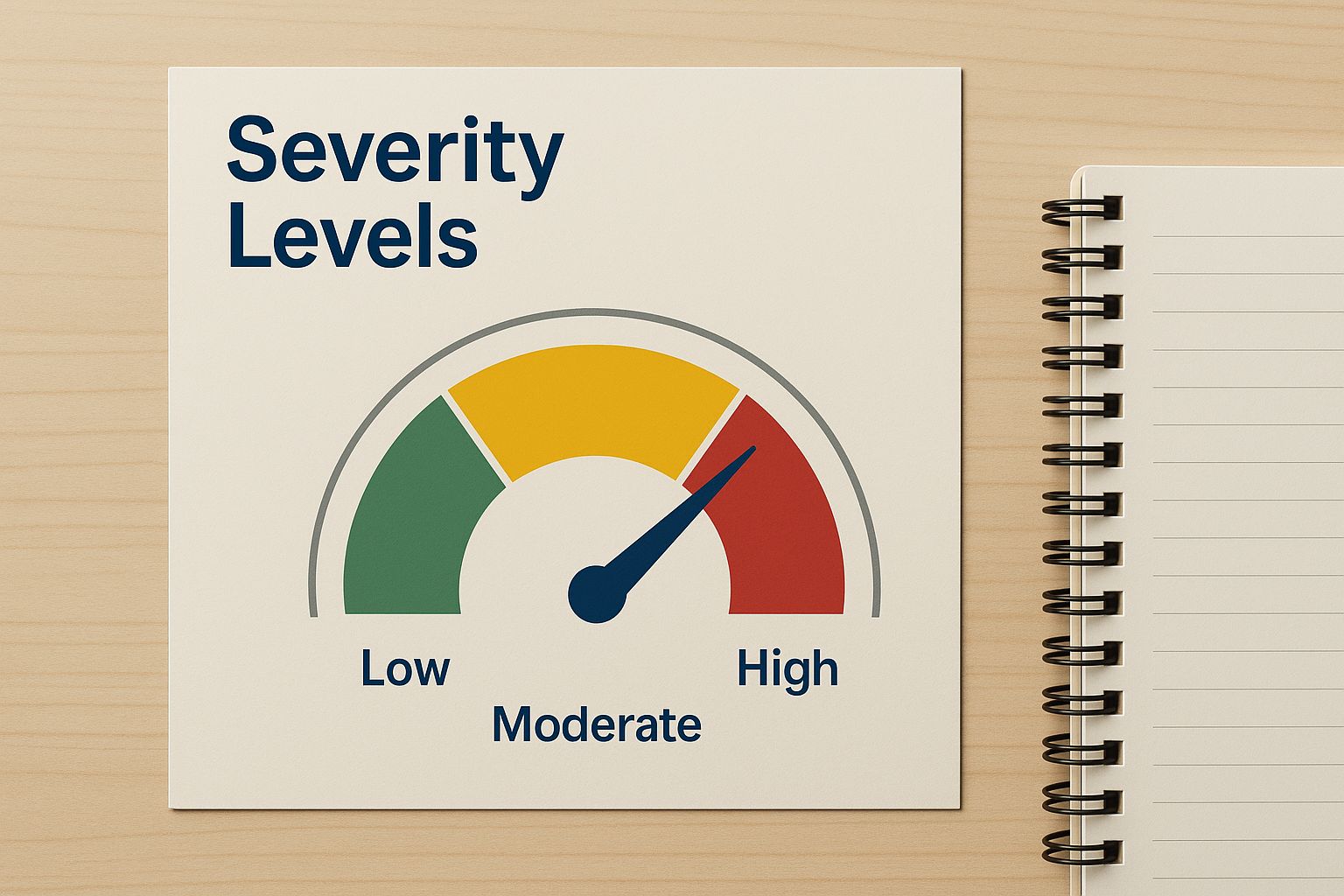
As you can see, where your symptoms land on that mild-to-severe spectrum is everything. This is why keeping detailed records is so incredibly important for your claim.
VA Disability Ratings for IBS (Diagnostic Code 7319)
Let's get into the specifics of what the VA is looking for. Understanding these benchmarks is the first step to building a claim that can’t be ignored. The table below breaks down the official criteria for each rating level and gives you an idea of what that looks like in the real world.
| Rating Percentage | VA Symptom Criteria | What This Looks Like in Daily Life |
|---|---|---|
| 0% | Formally diagnosed and service-connected, but symptoms are not active or severe enough to meet the 10% criteria. | You have an IBS diagnosis, but it rarely bothers you. You're not experiencing the consistent pain or bowel changes needed for a compensable rating. |
| 10% | Abdominal pain at least one day per month associated with changes in bowel habits (frequency or form). | This is a recurring, but not constant, problem. You might have a bad flare-up once or twice a month that disrupts your life for a day or so. |
| 30% | Abdominal pain at least one day per week associated with changes in bowel habits (frequency or form). | Your IBS is a constant battle. Bad days are a weekly event, significantly impacting your work, social life, and overall well-being. This is the maximum rating for IBS. |
At the end of the day, the VA is looking for a clear, documented pattern. The key difference between a 10% and a 30% rating often boils down to one simple question: Are your bad days a monthly problem or a weekly battle? Your medical evidence needs to answer that question clearly.
A Quick Word on the Anti-Pyramiding Rule
There’s a critical VA rule you need to know about called the anti-pyramiding rule. It sounds complicated, but the idea is simple: the VA won’t pay you twice for the same symptom, even if it’s caused by two different conditions.
For example, let’s say you have both service-connected IBS and GERD. Both can cause abdominal pain. The VA will not give you a separate rating for your IBS-related pain and another for your GERD-related pain.
This is a common snag for veterans with multiple digestive issues. The VA rater will look at all your symptoms and assign a single rating for the overlapping ones, usually based on the condition that provides the higher compensation. Knowing this upfront helps you set realistic expectations and focus your claim on showing how your different conditions cause unique and distinct problems.
How to Prove Service Connection for IBS
Getting an Irritable Bowel Syndrome diagnosis is a huge first step, but it’s only half the battle. To actually get the IBS VA rating you deserve, you have to prove a clear link—what the VA calls a "nexus"—between your condition and your time in the military. Think of it like building a solid bridge from your current diagnosis all the way back to your service.
The VA gives you three ways to build that bridge. Understanding each path helps you pick the strongest and most direct route for your claim. Honestly, your entire case hangs on getting this service connection right.
Direct Service Connection
The most straightforward approach is called direct service connection. This is exactly what it sounds like: you need to show hard evidence that your IBS symptoms started while you were on active duty.
Think of your service treatment records (STRs) as a day-by-day log of your health. To make a direct connection, you need to point to entries in that log where you went to sick call for things like stomach pain, chronic diarrhea, or constipation.
- Sick Call Records: Any visit for gut issues is gold. These are your strongest pieces of evidence.
- Buddy Letters: Statements from guys you served with who remember you constantly running to the latrine or complaining about stomach cramps can be incredibly powerful. They help fill in the gaps if your medical records are thin.
- Personal Statements: Don't underestimate your own story. A detailed account of when your symptoms began, how they felt, and how they affected you during service is critical.
It doesn’t even matter if you didn't get an official IBS diagnosis until years after you got out. What counts is proving the symptoms first showed up while you were wearing the uniform.
Secondary Service Connection
Another common and powerful way to win your claim is through secondary service connection. This is where you show that your IBS was caused or made worse by another condition you already have a service-connected rating for.
For many veterans, this is the key. The link between mental health and gut health—often called the gut-brain axis—is well-established, and the VA knows it.
For instance, a veteran with service-connected PTSD is under constant stress, which can wreak havoc on their digestive system and lead to IBS. In that scenario, the IBS is a secondary disability. To prove this, you’ll absolutely need a strong medical opinion from a doctor (a Nexus Letter) that clearly states your service-connected PTSD is the likely cause of your IBS.
Presumptive Service Connection
For some veterans, the VA makes this process a whole lot easier. It’s called presumptive service connection, and it’s a game-changer for Gulf War veterans who served in the Southwest Asia theater of operations.
If you’re a Gulf War veteran and you develop IBS that’s at least 10% disabling at any time after your service, the VA automatically assumes it’s related to your military duties. You don't have to provide the "nexus" evidence linking it to a specific event or illness in service.
This is the VA’s way of acknowledging the unique environmental exposures and unexplained illnesses from that era. Considering that IBS is a huge issue—affecting an estimated 25 to 45 million people in the U.S. alone—this presumptive status is a vital benefit. You can discover more facts about IBS and its prevalence on aboutibs.org. It's a crucial acknowledgment of the health challenges this specific group of veterans faces.
Building Your Case: The Evidence You Can't Afford to Miss
Think of your VA claim for IBS like building a legal case. You're the prosecutor, and your job is to present a mountain of evidence so compelling that the VA has no choice but to rule in your favor. Each document is a piece of that evidence, telling the story of your condition from its origins in service to its impact on your life today.
This isn't just about dumping a stack of papers on the VA's desk. It's about strategically assembling the right documents that prove three things: you have IBS, it started or got worse in the military, and it affects you now.
Your Medical Paper Trail: The Foundation of Your Claim
Your medical records are the absolute bedrock of your claim. Without a solid paper trail, your case is on shaky ground from the start. You'll need to gather three specific types of records to give the VA rater the full picture.
-
The Official Diagnosis: First things first, you need a formal diagnosis of Irritable Bowel Syndrome from a doctor. This is non-negotiable. It's the official document that establishes the condition you're claiming.
-
Service Treatment Records (STRs): Go through your military medical records with a fine-tooth comb. Look for any mention of stomach issues, no matter how small it seemed at the time. Every sick call visit for cramping, diarrhea, or constipation is a golden nugget of evidence showing your symptoms began while you were wearing the uniform.
-
Post-Service Medical Records: What you do after you get out matters. Consistent records from your civilian primary care doctor or a gastroenterologist prove that your IBS is a chronic, ongoing problem. This shows the VA it wasn't just a temporary issue that went away after service.
These records create the factual timeline for your claim, proving your condition is real, chronic, and has a history that points straight back to your time in service.
Your medical records lay out the "what" and "when" of your condition. But to truly win your claim, you need to explain the "how" and "why." That's where your most powerful tools come in.
The Game-Changers: Your Nexus Letter and Personal Statements
Beyond the basic medical files, two specific pieces of evidence can elevate your claim from a maybe to a definite yes. These are the documents that connect the dots for the VA and paint a vivid picture they can't ignore.
1. The Nexus Letter
For any claim that isn't presumptive, the Nexus Letter is arguably the single most important document you can submit. This is a medical opinion from a qualified professional that draws a clear line connecting your IBS to a specific event or condition from your military service. A powerful Nexus Letter will use the VA's preferred language, stating that it is “at least as likely as not” that your service caused or aggravated your IBS.
2. Personal and Buddy Statements
This is where you bring your claim to life. Medical records are cold and clinical; statements from you and those who know you provide the human story behind the diagnosis.
-
Your Personal Statement: This is your chance to tell the VA, in your own words, what it's really like to live with IBS. Don't hold back. Describe your worst days, explain how the constant pain and unpredictability limit your ability to work, go out with friends, or even just feel comfortable in your own home.
-
Buddy Letters: These are powerful. A statement from a fellow service member who remembers you running to the bathroom constantly during a field op can be incredibly persuasive. Likewise, a letter from your spouse or a close friend who sees your daily struggles provides a credible, third-party account of how severely IBS impacts your life now.
How to Approach Your C&P Exam with Confidence
The Compensation & Pension (C&P) exam is one of the most important moments in your VA claim for IBS. It’s best to think of it less like a regular doctor's appointment and more like a fact-finding mission. The examiner isn't there to treat you; their only job is to assess the severity of your IBS and write a medical opinion for the VA.
This is your chance to be an open book. It's not the time to be stoic or minimize how much you're struggling. The examiner only has two sources of information: your medical records and what you tell them during the exam. Be completely honest and get specific about how IBS impacts your day-to-day life.
Many of the same principles for clear communication in any important meeting apply here, so looking at general guides on preparing for an interview can be surprisingly helpful.
Key Strategies for a Successful C&P Exam
Coming prepared can make a world of difference. Your goal is to give the examiner a crystal-clear picture of your disability. Here are a few things to keep in mind.
- Describe Your Worst Days: The VA needs to rate your condition based on its full impact, not just how you feel on a good day. If your symptoms come and go, make sure you describe what a severe flare-up looks like and just how often you have them.
- Connect Symptoms to Your Life: Don't just list symptoms; explain their consequences. Tell the examiner how your IBS disrupts your work, forces you to cancel plans with family, or turns a simple trip to the grocery store into a nightmare.
- Bring a Symptom Journal: A written log is your best friend. Trying to remember details on the spot is tough. A journal that tracks the frequency and intensity of your abdominal pain, bloating, and bowel issues provides concrete, undeniable evidence.
The examiner will likely ask specific questions, such as, "How many days out of the last 30 did your abdominal pain keep you from leaving the house?" Having a clear answer, supported by your journal, is far more powerful than saying, "I'm not sure, it happens a lot."
While IBS is a very personal condition, it's also a widespread one. Research shows it's more common in urban areas, and factors like gender and age play a big role. You can discover more about these global trends in this research. Your C&P exam is the opportunity to put your personal story into that context and document exactly how it affects you.
Frequently Asked Questions About IBS VA Claims
When you're navigating the VA claims process, a lot of questions pop up. Let's tackle some of the most common ones I hear from veterans trying to get their IBS service-connected.
Can I Get a Rating Without an In-Service Diagnosis?
Yes, you absolutely can. It’s actually pretty common for veterans to only get a formal IBS diagnosis years after they’ve left the service.
The trick is proving the symptoms started while you were on active duty. Another, often more successful route, is to establish a secondary service connection. This means showing that your IBS was caused or made worse by another condition you already have a rating for, like PTSD or anxiety.
Is IBS Presumptive for All Veterans?
This is a critical point to understand: no, it's not. IBS is only considered a presumptive condition for a specific group—Gulf War veterans who served in the Southwest Asia theater of operations.
What does that mean? For these specific veterans, if their IBS is rated at 10% or higher, the VA automatically assumes it’s connected to their service. This makes the claim much more straightforward.
If you don't fall into that group, you'll need to prove the connection through direct evidence or by linking it to another service-connected disability.
What if My Claim Is Denied or My Rating Is Too Low?
First things first: don't give up. A denial or a low rating is just the beginning of the next step, not the end of the line.
You have a few solid options to fight the decision. You can file a Supplemental Claim with new and relevant evidence, ask for a Higher-Level Review where a more experienced adjudicator takes a fresh look, or appeal to the Board of Veterans' Appeals. I always suggest teaming up with an accredited professional to figure out which path makes the most sense for your specific situation.
Trying to figure out an appeal on your own can be overwhelming. The folks at Homefront Group are experts at helping veterans challenge incorrect VA decisions to get the benefits they deserve. See if you're eligible for their help by taking this quick 3-minute quiz.