Winning your VA appeal all comes down to one thing: picking the right fight. The decision you make right after getting that denial letter from the VA sets the entire tone for what comes next. It determines if you can add new evidence, who looks at your file, and frankly, how long you'll be waiting for an answer. Choose wrong, and you could be adding months, or even years, of frustrating delays to your case.
Choosing the Right VA Appeal Path
Getting a denial from the VA can feel like a gut punch. But that decision is not the final word. Thanks to the Appeals Modernization Act (AMA), you have clear, defined ways to challenge a ruling. The key is that you have to act, and you generally have one year from the date on your decision letter to do so.
Your entire strategy hinges on this first move. It’s like being a mechanic—you wouldn't grab a sledgehammer when you need a screwdriver. In the same way, you don't file for a Higher-Level Review if the whole reason you were denied is because you're missing a crucial medical report. You need to match the tool to the problem.
The Three Lanes of the VA Appeal System
The VA gives you three distinct routes to take. Your choice boils down to a simple question: Do you think the VA messed up with the evidence they already have, or do you have new proof to add to your file?
-
Supplemental Claim: This is your go-to option if you have new and relevant evidence. This isn't just any old paper; it has to be something the VA has never seen before that could change the outcome. Think new medical records, a powerful nexus letter from your doctor, or compelling statements from friends or family who have seen your struggles firsthand.
-
Higher-Level Review (HLR): Pick this lane if you're confident the VA already has everything it needs but simply made a mistake. Maybe they overlooked a key piece of evidence or misinterpreted a rule. With an HLR, you're asking a more experienced adjudicator to take a fresh look at the exact same file. You cannot submit new evidence here.
-
Board of Veterans’ Appeals (BVA): This is the most formal and complex route. You’re taking your case directly to a Veterans Law Judge at the Board. Even within this lane, you have more choices to make, like whether to submit new evidence, request a hearing, or just have the judge review your existing file.
This chart can help you visualize which path makes the most sense right from the start.
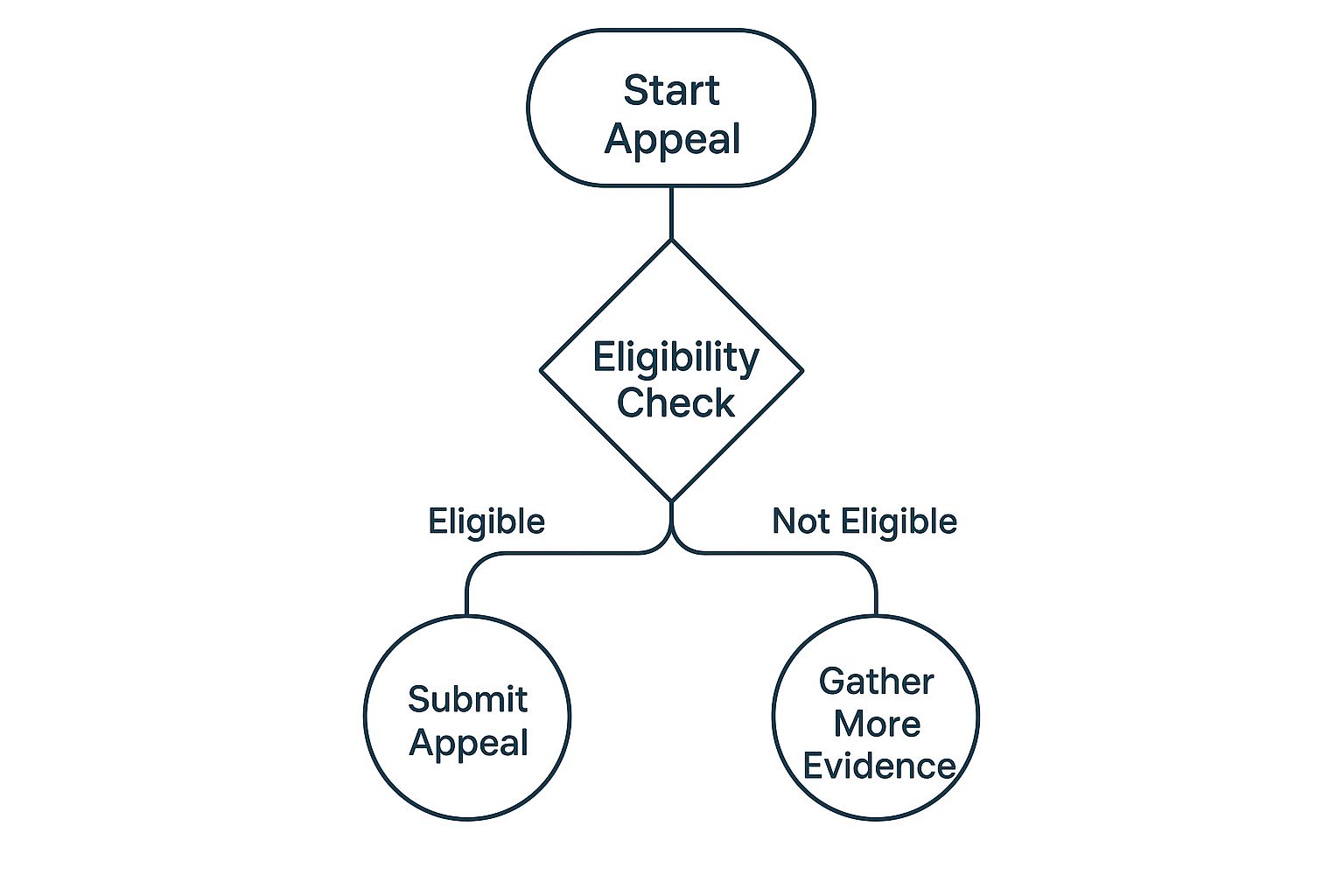
As you can see, the first question you must answer is whether you have new evidence. That single answer points you in the right direction.
To help you compare your options side-by-side, here’s a quick breakdown of the three appeal lanes.
VA Appeal Lanes at a Glance
| Appeal Option | Can You Add New Evidence? | Who Reviews the Appeal? | Best For… |
|---|---|---|---|
| Supplemental Claim | Yes | A VA claims adjudicator (rater) | Cases where the original denial was due to missing proof, like a medical opinion or service record. |
| Higher-Level Review | No | A senior VA claims adjudicator | Cases where you believe the VA made a factual or legal error based on the evidence they already had. |
| Board of Veterans' Appeals | Yes (in some sub-lanes) | A Veterans Law Judge (VLJ) | Complex cases, disagreements on points of law, or when other options have failed. |
Looking at this table should make it clearer which path aligns with the specifics of your denial and the evidence you have (or don't have) in hand.
Understanding the Odds and Making a Strategic Choice
Your chances of success are not the same across the board. The numbers show that the lane you pick has a real impact. For both Higher-Level Reviews and Supplemental Claims, the success rates often hover around 50%. They are designed to be faster and more direct fixes.
Board appeals, on the other hand, have a lower success rate of around 38% and typically take much longer. This is often because the cases that reach a judge are the most difficult and legally complex. For a deeper dive into these numbers, you can check out this helpful video on VA appeal statistics.
A common mistake I see veterans make is immediately jumping to a Board appeal. They think it's the "strongest" option, but they often could have resolved the issue much faster with a Supplemental Claim or HLR, avoiding the long wait times the Board is known for.
Let's look at a real-world scenario. Say a veteran was denied for a knee condition because the VA said there was no link to his time in service. He could file a Supplemental Claim and include a new nexus letter from his private doctor that clearly connects his knee problems to an injury he suffered on active duty. This directly provides the missing piece of the puzzle.
Now, imagine a different veteran was denied, but his service records clearly show a medic treated him for that same knee injury. If the VA rater just missed it, an HLR would be the perfect—and much faster—choice.
Picking the right lane from the get-go is the first, most important step in learning how to win a VA appeal. It’s about working smarter, not just harder, to get the benefits you've earned.
Building Your Case with Compelling Evidence
If choosing the right appeal lane is your strategy, then gathering the right evidence is the fuel that powers your case. A successful appeal isn't won by drowning the VA in paperwork. It's won with probative evidence—proof so clear and direct that it leaves no other reasonable conclusion. You have to show them, not just tell them.
This means looking far beyond your service treatment records. Many veterans get that first denial because their official records are frustratingly incomplete or miss crucial details. Your job is to fill those gaps with powerful, targeted evidence that closes the door on any doubt.
The Three Pillars of Evidence
To get a VA decision overturned, your evidence really needs to do three things: prove you have a current, diagnosed disability; show that a specific event, injury, or illness happened during your service; and then, critically, connect the two. This connection is what we call the "nexus."
Let's break down the types of evidence that build this foundation:
- Medical Evidence: This is more than just VA hospital printouts. It includes records from every private doctor, specialist, and clinic you've seen. These documents establish your current diagnosis and create a paper trail showing the continuity of your condition over years.
- Lay Evidence: This is testimony from non-experts, and it's incredibly powerful. It includes your own personal statements and "buddy letters" from people who know you best. They provide the real-world, human story of your condition and its impact.
- Service Records: This is your official military file—your service treatment records (STRs), personnel files, and any documentation of specific incidents or injuries that support your claim.
Focusing on these three pillars is the key to understanding how to win a VA appeal. A weak pillar can often be propped up by a strong one.
Securing a Powerful Nexus Letter
For many veterans, the single most critical piece of evidence you can get is a nexus letter. This is a formal medical opinion from a qualified professional—a doctor, psychologist, etc.—that explicitly connects your current disability to your military service. It’s the "missing link" the VA so often points to when issuing a denial.
A generic note from your family doctor saying "his back pain is from the Army" won't move the needle. A strong nexus letter has to be much more specific.
- It must state a clear opinion. The doctor needs to use the VA's language, stating something like, "it is at least as likely as not" that your condition is related to your service. This phrasing is the legal standard the VA must follow.
- It needs to explain the why. The letter must provide a detailed rationale, showing that the doctor reviewed your medical history, service records, and lay statements to build a logical, evidence-based argument.
- It should reference specific evidence. A top-tier letter will point directly to events in your service records or details from a buddy letter to back up its conclusion.
A classic scenario is a veteran denied for sleep apnea because it wasn't diagnosed on active duty. A strong nexus letter from a sleep specialist could link the condition to significant weight gain caused by a service-connected knee injury, which prevents him from exercising. This creates the necessary secondary connection the VA can approve.
The Untapped Power of Lay Statements
Never, ever underestimate the power of your own story or the firsthand accounts of those who served alongside you. Lay evidence, which includes your personal statements and "buddy letters," can be incredibly persuasive. It adds the human element and can fill in gaps where official records are completely silent.
For instance, your service records might not mention the daily mortar attacks you endured, but a detailed buddy letter from a fellow soldier describing those events can absolutely validate the source of your PTSD.
Here’s what makes a buddy letter truly effective:
- Be Specific: Instead of, "He was always in pain," a friend should write, "I remember seeing him unable to get out of his bunk for two days straight after that 10-mile forced march in 2008 because his back seized up."
- Establish Credibility: The writer needs to state their relationship to you, including the unit you served in together and the specific timeframe.
- Focus on Facts: They are witnesses, not doctors. The statement should detail observable facts and events, not offer medical opinions or diagnoses. They are testifying to what they saw, heard, and experienced with you.
Gathering strong evidence is the most time-consuming part of the appeals process, but it's also where you have the most control. The data backs this up. According to an analysis of the Board of Veterans Appeals' annual report, the approval rates for appeals under the Appeals Modernization Act (AMA) hovered around 28%, while older legacy appeals had a much lower rate of just 19%.
The ability to submit new and compelling evidence—a key feature of the AMA—is a huge reason for these better outcomes. You can learn more about these statistics from in-depth reports on VA appeal success rates. Building a well-supported case from the ground up gives you the best possible shot at getting the benefits you've earned.
Mastering Critical Deadlines and VA Forms
When you’re dealing with the VA, you have to play by their rules. The system is rigid, the paperwork is precise, and a single misstep can send your entire appeal back to the starting line. Think of it less like a conversation and more like a legal proceeding—every detail matters.
The most unforgiving rule is the one-year window you have to file an appeal. That clock starts ticking the day the VA mails your decision letter, not when you receive it. If you miss that deadline, you’ve lost your right to appeal that specific decision. It's a hard stop that can cost you thousands in back pay and force you to start the whole claim over again.
Navigating the Essential VA Appeal Forms
Once you decide to appeal, you'll need to choose the right form for the job. This is one of the first places veterans trip up. Picking the wrong form for your chosen appeal "lane" creates instant administrative headaches and delays. For most initial appeals, you'll be looking at one of two forms.
Let's break them down.
- Supplemental Claim: Use VA Form 20-0995. This is your go-to form when you have new and relevant evidence to add to your case. The most important section here is where you list that new evidence. Don't be lazy about it.
- Higher-Level Review: Use VA Form 20-0996. Choose this path when you believe the VA made a mistake with the evidence they already had. A crucial point: you cannot submit new evidence with this form. You can, however, request an informal phone call with the senior reviewer, which is an opportunity you shouldn't waste.
Getting these forms in on time is non-negotiable. It’s worth looking into general strategies for meeting deadlines effectively, because the principles of good time management are just as critical for your VA appeal as they are for any other major life project.
Common Mistakes on VA Forms and How to Avoid Them
I've seen so many appeals get bogged down by simple, avoidable errors on the paperwork. If you're serious about figuring out how to win a VA appeal, you have to treat these forms with the respect they deserve. A small mistake can cause big delays.
Here are some of the most common blunders I see time and time again:
- Vague Evidence Descriptions: On Form 20-0995, simply writing "Medical Records" is a huge red flag. It tells the rater nothing. Instead, get specific: "Nexus Letter from Dr. Jane Smith, dated May 15, 2024," or "Buddy Letter from John Doe detailing the April 2010 incident in Iraq."
- Forgetting to Sign: It sounds almost too basic to mention, but you'd be surprised how often it happens. An unsigned form is an invalid form. The VA won't process it; they'll just mail it back to you, and the clock keeps ticking. Always double-check for your signature and the date.
- Mishandling the Conference Request: On Form 20-0996 for a Higher-Level Review, there's a box to request an informal conference. If you want one, you must check that box when you file. I’ve seen veterans assume they can just ask for one later—you can't.
An informal conference is your one chance to speak directly with the person who will decide your appeal. You can literally guide them, saying something like, "Please look at page 3 of my service medical records, where it clearly documents my back injury on this specific date." Passing up this opportunity is a massive strategic mistake.
Before you send anything to the VA, run through this simple checklist. It’s a five-minute habit that can save you months of frustration.
Pre-Submission Checklist
| Check Item | Verified? |
|---|---|
| Correct Form Used? (0995 for new evidence, 0996 for HLR) | ☐ |
| All Personal Information Accurate? (Name, file number, etc.) | ☐ |
| Specific Issues Clearly Identified? | ☐ |
| All New Evidence Listed on Form 20-0995? | ☐ |
| Informal Conference Box Checked on Form 20-0996? (If desired) | ☐ |
| Form Signed and Dated? | ☐ |
Taking a few extra minutes to get the paperwork right is one of the most powerful things you can do to keep your appeal on track. Mastering these administrative details isn't just busywork—it's a core part of a winning strategy.
How to Prepare for a BVA Hearing
If your appeal has reached the Board of Veterans’ Appeals (BVA), you’re now in the most formal part of the entire process. When you request a hearing, you get a rare opportunity to speak directly with a Veterans Law Judge (VLJ)—the very person who holds the final say on your case.
This can feel incredibly daunting, but it's also your single greatest advantage. This is your chance to breathe life into the cold, hard paper of your claim file. Proper preparation is what separates a clear, persuasive story from a rambling, ineffective one. It’s what turns the hearing from a stressful formality into a powerful tool for winning your appeal.
Understanding the Different Hearing Formats
First things first, you need to know which type of hearing you’ll be attending. The BVA offers a few different formats, and your choice will shape how you prepare.
- Virtual Tele-Hearing: This has become the go-to option for most veterans. You'll join the hearing from your home using a computer or even a smartphone, offering incredible convenience and saving you a trip.
- Videoconference Hearing: This is a bit of a hybrid. You travel to a local VA regional office and connect with the judge, who is in Washington, D.C., via a secure video link.
- In-Person Hearing: The old-school, traditional format. You travel all the way to Washington, D.C., to sit in the same room as the judge. These are much less common now due to the significant travel and scheduling hurdles involved.
No matter the format, the goal is identical. A BVA hearing is an official legal proceeding. You will be under oath, and your testimony becomes part of the official record. The judge is there to listen, ask questions, and get the full story.
Organizing Your Testimony for Maximum Impact
Walking into a BVA hearing without a plan is a recipe for disaster. You can't just "wing it." Remember, the judge has likely already reviewed your entire file. Your job isn't to re-read documents to them; it's to connect the dots, fill in the blanks, and clarify anything that might be confusing.
I always tell veterans to start with a simple outline of the key points they absolutely must make. Zero in on the specific reason your claim was denied.
For example, if the VA denial letter states there’s no nexus (link) between your condition and your service, your testimony needs to revolve around the in-service injury, event, or exposure that started it all. If they’re questioning the severity of your symptoms, you have to paint a vivid picture of your daily struggles.
Don't just say, "My back hurts." Describe the functional impact. Try something like, "I can no longer lift a simple bag of groceries without a shooting pain down my leg. I have to stop and sit down after just five minutes of washing dishes." Details like these give the judge a real-world understanding of your limitations.
Your testimony is your chance to be the guide. You can literally say, "Ma'am, if you look at page 14 of my service medical records, you'll see the entry where I was treated for that fall. I want to explain how that one injury has stopped me from being able to work for the last ten years." This directs the judge's attention exactly where you need it.
Confidently Answering the Judge’s Questions
The judge is going to ask questions. This isn't an interrogation; it’s a fact-finding mission. They are trying to gather the specific evidence they need to rule in your favor. The best way to navigate this is to listen intently, take a breath, and give a truthful, concise answer.
Here are a few tips I've seen work time and time again:
- Stick to the Facts: Don't ramble or volunteer extra information. Just answer the question that was asked.
- "I Don't Know" Is a Good Answer: If you don't know something or can't recall a specific date or detail, it is perfectly fine—and much better—to say so. Guessing can instantly damage your credibility.
- Stay Calm and Respectful: It's easy to get frustrated, but your demeanor matters. Maintaining a calm, professional attitude can genuinely influence how the judge perceives you and your testimony.
This direct interaction is a crucial part of learning how to win a VA appeal. The system, while complex, is getting better. The Department of Veterans Affairs has made huge strides, recently processing over a million disability claims faster than ever while boosting its claims accuracy rate to over 92%.
This push for efficiency means a well-prepared case stands a much better chance of a thorough and timely review. You can read more about the VA's progress in claims processing and see how these improvements could directly benefit your appeal. Your hearing is your moment to make your case undeniable.
When Should You Get Professional Help for Your Appeal?
You can absolutely go through the VA appeals process by yourself. Plenty of veterans do it. But you don’t have to, and frankly, knowing when to call in a professional is often the single most important decision you can make. The VA is a massive bureaucracy with its own set of rules, its own language, and its own procedures. Fighting that system alone can be utterly exhausting.
Think of it as a strategic move. Recognizing when you need backup isn't a sign of weakness; it's a sign that you're serious about winning. If your case feels overly complicated, involves tricky legal issues, or you've already been denied more than once, it’s probably time to bring in an expert.
The Professionals in Your Corner
When you decide you need help, you've got three main options. Each one brings something different to the table.
- Veterans Service Officers (VSOs): These are accredited representatives from organizations like the VFW, DAV, or the American Legion. Their services are completely free. A good VSO can be a godsend, especially for filing initial claims or handling more straightforward appeals.
- Accredited Claims Agents: These are independent pros who've passed a VA-administered exam, certifying them to represent veterans. They often work on a contingency basis, just like an attorney.
- VA-Accredited Attorneys: This is the highest level of legal support you can get. An attorney is trained in legal strategy, evidence development, and crafting powerful arguments. They can represent you at every stage, and if things get really tough, they can even take your case outside the VA system to the U.S. Court of Appeals for Veterans Claims (CAVC).
For a simple appeal, a VSO might be all you need. But when you’re facing a case that’s been shot down repeatedly or involves complex medical evidence, the expertise of a claims agent or an attorney can be a game-changer.
What an Attorney Really Brings to the Fight
Hiring an attorney is about so much more than just having someone fill out forms. They become your personal advocate, a strategist whose entire job is to build a case that the VA simply can't deny. They’ve been in the trenches and know precisely what the Board is looking for.
A good VA benefits attorney will:
- Become an Evidence Detective: They know how to spot the missing piece of the puzzle, whether it's a specific medical record or a new C&P exam. Crucially, they can also hire independent medical experts to write the strong nexus opinions that so many cases hinge on.
- Craft Legal Arguments: They can pinpoint the exact legal or procedural errors the VA made in your denial and build sophisticated arguments that most of us would never see.
- Take on the Bureaucracy: They handle all the calls, file every brief, and track every deadline. This alone lifts an enormous weight off your shoulders, letting you focus on your health and family.
Think of it this way: The VA has its own lawyers and legal experts working for them. Going into a complex appeal without your own representation is like walking into a boxing ring with one hand tied behind your back. You’re putting yourself at a huge disadvantage.
"But What Does It Cost?"
This is the number one question on every veteran's mind, and the answer should put you at ease.
Almost every reputable VA-accredited attorney works on a contingency fee basis. This means you pay absolutely nothing upfront. Not a dime. They only get paid if they win your appeal and you get a retroactive payment of benefits, often called "back pay."
Their fee is a percentage of that back pay—that’s it. By law, this fee is usually capped between 20% and 33%. They never touch your future monthly benefit payments. Their success is tied directly to your success. If you don't get paid, they don't get paid. This system makes top-tier legal help accessible to every single veteran, no matter what their financial situation looks like. It’s a critical part of the process for getting the benefits you earned.
Common Questions About the VA Appeal Process
Even with the best strategy, hitting a snag or having a question pop up during a VA appeal is completely normal. It’s a complicated system. Getting straight answers to these common sticking points is key to keeping your appeal moving forward and avoiding simple, yet potentially costly, mistakes.
Let’s go through some of the questions I hear most often from veterans. Think of this as your quick-reference guide for navigating the process with a bit more confidence.
What Is the Most Common Reason VA Appeals Are Denied?
From what I’ve seen over the years, the number one reason an appeal fails is the lack of a clear medical "nexus." It’s a simple concept but a huge hurdle. This means the VA doesn’t see enough evidence directly connecting your current disability to your time in the service. You could have a stack of medical records a foot high, but if that link back to an in-service event or injury isn't rock-solid, the claim is almost certain to be denied.
Another major, and heartbreaking, reason is simply missing the deadline. You have one year from the date on your decision letter to file an appeal. If you miss that window, it’s a hard stop. You’re forced to start over with a brand-new claim and you could lose out on thousands of dollars in back pay.
Can I Add New Evidence to a Higher-Level Review?
No, you cannot, and this is a critical point to understand. A Higher-Level Review (HLR) is exactly what it sounds like: a senior reviewer takes a fresh look at the exact same evidence the VA had when it made the first decision. They are checking for errors, not looking at new information.
If you have new, relevant evidence that could change the outcome—like a new doctor's report or a buddy statement—you must choose the Supplemental Claim lane instead. Getting this right from the start is fundamental to learning how to win a VA appeal.
How Long Does a VA Appeal Take?
This is the big question everyone asks, and unfortunately, the honest answer is "it depends." The timeline is completely tied to which appeal lane you're in.
The VA has goals for its two faster options:
- Higher-Level Reviews: They aim for an average of 125 days.
- Supplemental Claims: The target is also about 125 days.
Taking your case to the Board of Veterans' Appeals (BVA) is a different story altogether. That’s a long-haul commitment. A direct review by a Board judge, with no new evidence or hearing, can easily take over a year. If you need to submit new evidence or request a hearing, you can expect that timeline to stretch out even longer, depending on the Board's backlog.
It's so important to set realistic expectations. The VA has improved, but a BVA appeal is a marathon, not a sprint. This long wait is precisely why you should always try to resolve your case with a Higher-Level Review or Supplemental Claim first if you can.
What Happens if My Appeal Is Denied Again?
Getting another denial letter is tough, but it's rarely the end of the line. The system is built with multiple chances to get it right. Your next step depends entirely on which type of appeal was just denied.
Here’s a look at the typical flow:
- If your Higher-Level Review is denied: Your next options are to file a Supplemental Claim (if you now have new evidence) or appeal directly to the BVA.
- If your Supplemental Claim is denied: You can request a Higher-Level Review of that specific denial, file another Supplemental Claim with even more evidence, or take your case to the BVA.
- If the Board of Veterans' Appeals denies your case: At this point, you have to leave the VA system. Your next option is to appeal to the U.S. Court of Appeals for Veterans Claims (CAVC). This is a federal court, and frankly, you should have professional legal representation if you reach this stage.
Navigating the VA appeal maze can be overwhelming, but you don’t have to go it alone. The team at Homefront Group is made up of veterans and legal experts who know what it takes to build a case that wins. If you're ready to get the justice and benefits you earned, take our free 3-minute quiz to see how we can help. Take the quiz now at Homefront Group.