

When you get hurt on the job, the first few moments are absolutely critical. Your first priority, always, is to get medical attention. After you've taken care of your immediate health and safety, you need to give your direct supervisor a quick, informal heads-up about what happened. This creates an immediate record of the event.
Your First Moves After a Workplace Injury

The moments after an injury at work can feel chaotic. For veterans and first responders, instincts from high-stress calls might take over, but it’s crucial to direct that focus toward protecting both your health and your rights. Before any formal paperwork gets filed, there are a couple of simple, non-negotiable things you must do.
Your primary duty is to yourself. Get the medical help you need right away. This could mean seeing an on-site medic, calling 911, or heading straight to an urgent care clinic. Your well-being trumps everything else.
The Power of Immediate Notification
Once you're safe, the next move is telling your supervisor. This isn't the official, written report yet—think of it more like a verbal alert. A simple, "Hey boss, I just tweaked my back lifting that crate," or "I slipped on a wet spot in the hall and rolled my ankle" is all it takes.
This immediate notice does something really important: it officially starts the clock and links the injury directly to your work. If you wait a few hours, or even until the next day, you open the door for an insurance company to question whether the injury actually happened at work. Don't give them that opening.
Reporting an injury kicks off a process that's vital for both your safety and legal compliance. In the U.S., the Occupational Safety and Health Administration (OSHA) distinguishes between injuries (like a cut or fracture) and illnesses (like a respiratory condition from exposure). A prompt heads-up to your supervisor is the first step in a chain that includes formal documentation and filing reports, often under strict deadlines. You can discover more about the different types of workplace incidents and why reporting them fast is so critical.
To help you remember the crucial first steps, here's a quick checklist.
Immediate Checklist After a Workplace Injury
| Action | Why It's Important | Key Detail |
|---|---|---|
| Get Medical Help | Your health is the top priority and it officially documents the injury. | Go to an ER, urgent care, or company-approved doctor. |
| Notify Your Supervisor | Establishes a direct link between the incident and your job. | This can be verbal initially, but do it as soon as possible. |
| Document the Scene | Your memory is sharpest right after the event. | Use your phone to take pictures of the location and what caused the injury. |
| Identify Witnesses | Their accounts can support your claim. | Get names and contact information from anyone who saw what happened. |
Following these actions lays a solid foundation for any claim you may need to file.
Capturing Critical Details on the Spot
Right after it happens is when your memory of the incident will be clearest. Even with adrenaline pumping, try to make a few mental or physical notes. You don't need a full-blown report, but locking down the basics is invaluable.
Take a second to ground yourself and just observe. The little details you notice right now—no matter how small they seem—can become the most critical pieces of evidence for your claim down the road. This is your initial evidence-gathering mission.
A quick note in your phone or scribbled on a piece of paper can make all the difference. Try to capture:
- Time and Date: Get as close to the exact time of the injury as you can.
- Location: Be specific. Not just "in the warehouse," but "aisle 7, next to the north wall loading bay."
- What Happened: A simple, factual sentence. "The ladder slipped out from under me while I was on the third rung."
- Witnesses: Who was there? Jot down their names.
This simple act of documenting the facts creates a strong foundation that will support you as you learn how to report a workplace injury. It guards against your memory getting fuzzy later and ensures your formal report is accurate and consistent. These first few moves set the stage for a much stronger, more defensible claim.
Making the Official Injury Report to Your Employer
Telling your supervisor you got hurt is the first, immediate thing you should do. But the formal, written report is what really covers you. This document isn't just a piece of paper; it’s the official record of what happened and your undeniable proof that you did your part according to company policy and state law. Getting this part right shuts down any "he said, she said" arguments later on.
Think of the written report as your first line of defense. Whether it's a standard company form or a detailed email, this is your chance to lay out the cold, hard facts. You're building a paper trail that leaves no doubt about when, where, and how you were injured.
This chart breaks down the critical first moves after an injury, which all lead directly to this crucial documentation step.
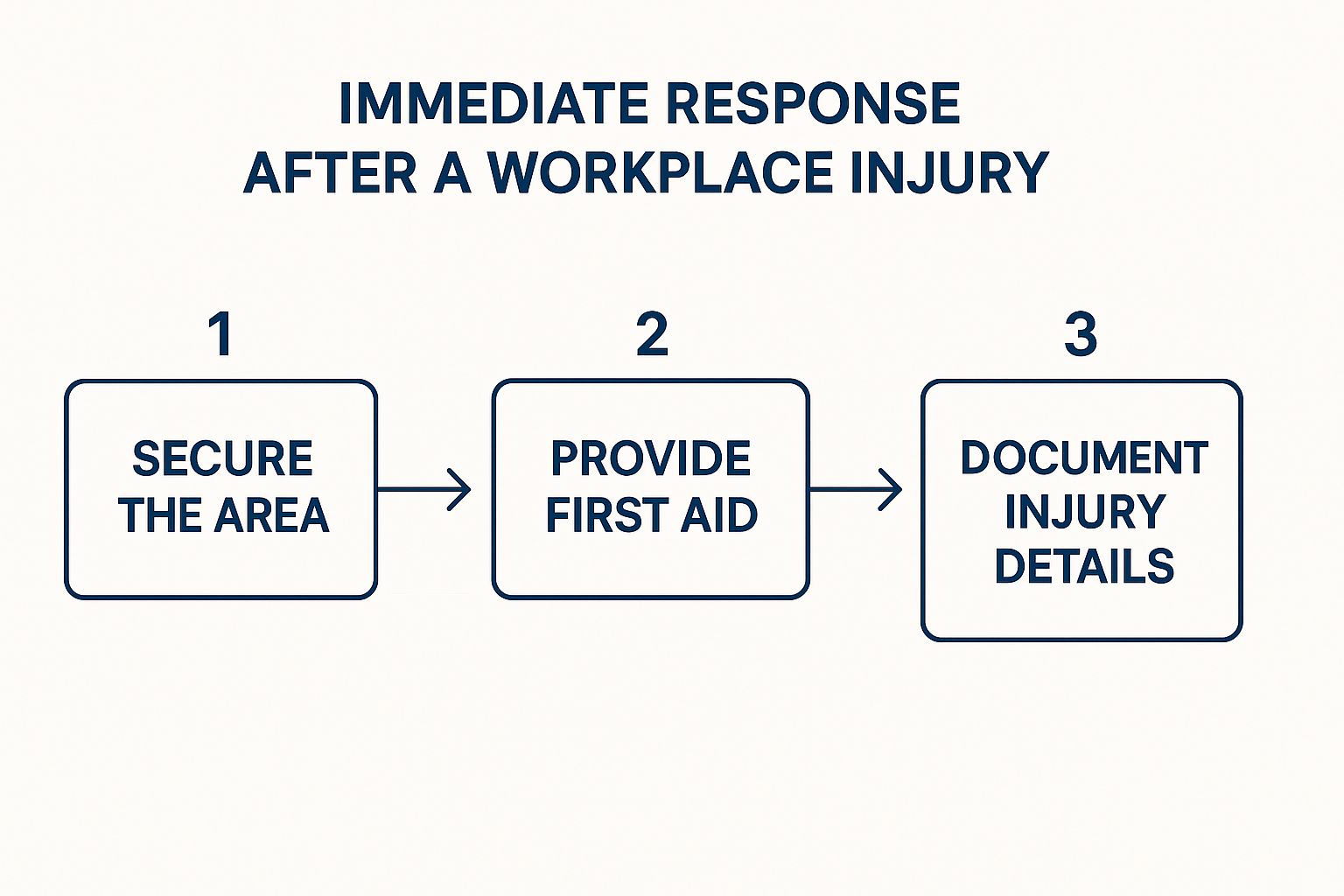
As you can see, securing the scene and getting first aid are immediate priorities. But putting the details down on paper is the essential bridge that moves you from the incident itself to the formal reporting process.
What to Include in Your Written Report
When you sit down to write, precision is everything. Your job is to be an objective reporter of the facts. Leave out emotion, speculation, or who you think is to blame. Just stick to what happened, providing a clear, step-by-step account of the event.
Your report absolutely must include these core details:
- Your Full Name and Job Title: Don't let them guess who it is.
- Date and Exact Time of Injury: Pull this from the notes you hopefully jotted down right after.
- Specific Location: Be precise. Instead of "the warehouse," write "Aisle 4, Bay 2, near the pallet wrapper."
- Detailed Description of the Incident: Lay out exactly how the injury occurred, step-by-step.
- List of Your Injuries: Clearly state which parts of your body were hurt.
- Names of Any Witnesses: If anyone saw it happen, get their names down.
Treat this like you're filing an incident report after a call—just the facts, presented clearly and in order. This detailed approach is your best defense against any future disputes.
Crafting a Clear and Factual Narrative
How you word this report really matters. An insurance adjuster looking for an excuse to deny a claim can twist vague language. Your description needs to be a simple, factual story.
Keep it concise and direct. Focus on the sequence of events without adding your opinions or assumptions. The whole point is to create a record that's impossible to argue with because it's grounded entirely in fact.
For example, which of these sounds more credible?
Vague Example: "I was working and my back started hurting really bad. The boxes were too heavy."
This is weak. It's subjective and doesn't connect the pain to a specific work task.
Factual Example: "On Tuesday, June 4th, at approximately 10:15 AM, I was lifting a 45-pound box from a pallet onto the conveyor belt. As I twisted to place the box, I felt a sharp, immediate pain in my lower back."
The second one is powerful. It’s specific, measurable, and directly ties the action to the injury. There’s no room for misinterpretation.
Who Receives the Report and Why You Need a Copy
Once you've written the report, you need to get it into the right hands. Every company is different, but it usually goes to your direct supervisor, the HR department, or a designated safety manager. If you’re not sure, just ask your supervisor. I often recommend sending it via email, even if you also hand in a paper form, because it creates an undeniable digital timestamp.
No matter who you give it to, always, always keep a copy for yourself. This is non-negotiable.
Email a copy to your personal account. Take a clear photo of the filled-out form on your phone. This copy is your proof that you reported the injury on time. In a state like Florida, where you typically have to report an injury within 30 days, having proof of when you submitted your report is absolutely essential if your claim is ever questioned.
Building Your Case with Smart Documentation

The initial report you file is just the opening chapter of your story. The real strength behind a workplace injury claim comes from building an undeniable mountain of evidence. Think of it as an ongoing mission where every receipt, note, and photo is a crucial piece of intel.
This process is about more than just telling your employer you got hurt. It's about creating a comprehensive file that validates every single aspect of your experience, from the moment of the injury to the long-term impact on your life. For veterans and first responders, this kind of meticulous record-keeping should feel familiar—it’s just applying that discipline to a new, very personal objective.
The Foundation: Your Personal Injury Journal
Your most powerful tool in this fight will be a dedicated injury journal. This isn't just a diary; it's a systematic log of your recovery. Grab a simple notebook or start a secure document on your computer and start tracking everything. The goal here is to paint a clear, day-by-day picture of how this injury is truly affecting you.
This daily log becomes irrefutable proof of your condition over time. It makes it much, much harder for an insurance adjuster to downplay your pain and suffering. Consistency is everything. A detailed entry every couple of days is far more powerful than a frantic, month-end summary you try to piece together from memory.
So, what should you track?
- Symptom and Pain Levels: Use a 1-10 scale to rate your pain. Describe it. Is it a dull ache or a sharp, stabbing feeling? Pinpoint its exact location.
- Daily Life Impact: Get specific about what you can't do anymore. Can you no longer lift your child, mow the lawn, or even sit through a movie without pain? Write it down.
- Medical Appointments: Note the date, the doctor's name, and a quick summary of your conversation. What was the diagnosis? What’s the new treatment plan?
- Emotional State: Be honest. Document the frustration, anxiety, or depression that often comes with a serious injury and a long recovery.
Collecting Physical Evidence
Beyond your personal notes, you need to gather tangible proof. This means collecting every physical item and digital file that backs up your story. Start a folder—a real one or a digital one on your desktop—and make it the central hub for every document related to your claim.
Organize things as they come in. A little effort now will save you from a massive headache later when you’re desperately searching for a specific receipt from three months ago.
Every piece of paper, every email, and every photo helps build a wall of facts around your claim. Your goal is to make your case so clear and well-supported that it becomes easier for the insurer to approve it than to fight it.
Your evidence file should include:
- Medical Records and Bills: Keep copies of every single bill, explanation of benefits (EOB), lab result, and doctor's note.
- Receipts for Out-of-Pocket Costs: This covers prescriptions, co-pays, mileage to and from appointments, and any medical gear you had to buy, like a brace or crutches.
- Photos and Videos: If it's safe, take clear pictures of the accident scene, any equipment involved, and the progression of your injury (bruising, swelling, etc.). Timestamps on digital photos are incredibly valuable.
- Witness Information: Get the full names, phone numbers, and email addresses of anyone who saw the incident or the immediate aftermath. Their statements can be vital.
- Correspondence: Save every single email, letter, or official note you get from your employer, their insurance company, or any medical provider about your injury.
Using Technology to Your Advantage
Don't forget that your smartphone is an essential documentation tool. Use it to snap photos on the fly, record quick voice memos about your symptoms when you're in pain, and keep your digital records organized.
To really make sure your documentation is airtight, you might even consider using field data collection apps. These can help you log crucial details with timestamps and GPS coordinates right at the scene, adding another layer of credibility.
Adopting simple tech can make this whole process more efficient and your final case file that much stronger. Remember, the more detailed and organized you are now, the more seriously your claim will be taken. Your diligence at this stage has a direct impact on the final outcome.
Navigating Workers' Comp and OSHA Requirements
When you get hurt on the job, it feels like you've been dropped into a world of confusing acronyms and legal systems. Two of the biggest you'll hear about are Workers' Compensation and OSHA. They might sound related, but they serve completely different functions. Getting them straight is the first step in protecting yourself and securing the support you're entitled to.
Simply put, Workers' Comp is about you and your recovery. It's the system that pays your medical bills and covers a part of your lost income. OSHA, on the other hand, is about your employer. It’s a federal agency that holds companies accountable for providing a safe place to work.
Workers' Comp: Your Direct Lifeline
Workers' Compensation is your most immediate path to getting help. It’s a “no-fault” system, which is good news for you. It means you don't need to prove your employer was careless or did something wrong—only that your injury happened at work while you were doing your job.
The rules and deadlines for this stuff are different in every state, which can make it feel like navigating a maze blindfolded. But this is the system that gets your doctor's visits, surgeries, and prescriptions paid for. It's also what provides a check when you can't work.
Think about a common scenario: a firefighter tears a rotator cuff during a training drill. The Workers' Comp claim is what pays for the MRI, the orthopedic specialist, the eventual physical therapy, and a percentage of their salary while they're on light duty or out of work entirely.
Your personal claim for benefits is entirely separate from your employer's legal duty to report serious incidents to government agencies. Focus on your part first: officially filing for the benefits you are owed. This is how you take direct control of your own recovery process.
Don't sleep on the deadlines. They are strict and non-negotiable. Some states give you just 30 days to officially report the injury to your employer. The clock to file the actual claim with the state board might run for a year or two. If you miss these windows, you could lose your right to any benefits at all.
Understanding OSHA's Role in All This
While you're focused on your own claim, your employer has a separate responsibility to OSHA. The goal of OSHA reporting isn't to get you paid; it's to track workplace injuries on a national scale to spot dangerous trends and hold employers accountable. This is a legal requirement on them, not on you.
Your employer doesn’t have to report every little cut or bruise to the feds. The law is very specific about what triggers an OSHA report:
- Any work-related death must be reported within 8 hours.
- Any in-patient hospitalization, amputation, or loss of an eye must be reported within 24 hours.
So, if a piece of equipment fails and causes an injury that lands you in the hospital, your employer has a legal duty to notify OSHA within a day. This happens whether you've even started your Workers' Comp paperwork or not. The two processes run on parallel tracks. This all falls under the much larger umbrella of complying with general employment laws, which every employer must follow.
These reports are a big deal for a reason. In the U.S., employers reported roughly 2.6 million nonfatal injuries and illnesses in 2023. Even with that number dropping, there were still 5,283 fatal work injuries that year—a rate of about 3.5 deaths per 100,000 workers. You can read the full report on national workplace safety data to see why this tracking matters so much for preventing future tragedies.
Knowing this distinction is a powerful piece of information. Learning how to report a workplace injury for your own benefit is one part of the puzzle. The other is understanding that your employer has a legal obligation that could trigger an official investigation—and that investigation might just help validate your own claim down the road.
Common Mistakes That Can Hurt Your Injury Claim

Knowing the right steps to take after a workplace injury is only half the battle. You also have to know which mistakes to avoid—the seemingly small errors that can completely torpedo an otherwise valid claim. For veterans and first responders, careers built on precision and following procedure, sidestepping these missteps is crucial for protecting your rights.
Think of it like a mission. The claims process has its own rules of engagement, and any deviation gives the insurance company an opening to challenge the benefits you’ve earned. Let's walk through the most common pitfalls I see and, more importantly, how you can steer clear of them.
Waiting Too Long to Report
This is, without a doubt, the single most damaging mistake you can make. Every minute that ticks by between your injury and your official report introduces doubt. It gives the insurance adjuster a reason to question whether your injury actually happened at work.
For instance, picture a paramedic who feels a sharp pop in her shoulder while lifting a patient. She decides to tough it out and finishes her shift without a word. It’s not until three days later, when the pain becomes unbearable, that she reports it. The adjuster can now argue she might have hurt it at the gym or doing yard work over the weekend. That simple delay just created a massive roadblock for her claim.
Don't wait. In Florida, for example, the law generally requires you to report a workplace injury to your employer within 30 days of the incident. If you miss that deadline, you could lose your right to any benefits at all.
Giving Vague or Inconsistent Details
When you finally do report the injury, clarity is everything. Vague statements like "my back started hurting sometime today" or "I think I hurt my arm" are major red flags for insurance carriers. They need a specific action tied directly to a specific injury.
Inconsistency is just as bad. If you tell your supervisor one thing and the ER doctor something slightly different, you can bet those discrepancies will be used against you. Your account of what happened needs to be factual and consistent across every report, form, and conversation.
- Vague: "My knee got hurt while I was working in the warehouse."
- Specific: "At 10:30 AM, I was stepping down from the forklift when my left foot slipped on an oil patch. My body twisted, and I felt a sharp, tearing pain in my right knee."
The second one is gold. It’s precise, connects a work activity directly to the injury, and leaves no room for interpretation.
Downplaying Your Pain
Veterans and first responders are conditioned to have a high pain tolerance and a "shake it off" mentality. That's an admirable trait on the job, but it can be absolutely devastating to an injury claim. When a doctor asks you to rate your pain, this is not the time to be a stoic hero.
If you tell the initial doctor, "It's not that bad, I can manage," but later claim you're in too much pain to perform your duties, you've created a huge contradiction. Insurance adjusters will grab onto those initial statements to argue that the injury isn't serious enough to warrant lost time or extensive treatment. Be honest and accurate about your pain levels and how the injury is truly impacting your life.
Mishandling Insurance Company Communications
Once your claim is filed, expect a call from the insurance adjuster. You need to be extremely careful here. Their job is not to be your friend; it's to minimize the insurance company's financial exposure.
- Giving a Recorded Statement: You are almost never required to give a recorded statement without legal counsel. Adjusters are masters at asking leading questions designed to get you to say something that hurts your case. It’s smart to politely decline until you’ve had a chance to speak with an expert.
- Signing Vague Forms: Never, ever sign a blank form or a medical release you don't fully understand. A broad medical release can grant the insurer access to your entire medical history. They will dig for anything—a pre-existing condition, an old sports injury—to argue that your current problem isn't work-related.
Imagine a police officer with a torn meniscus from a foot pursuit. He signs a broad release form, and the adjuster finds a doctor's note from five years ago about occasional knee soreness after jogging. That's all they need to try and deny the claim.
By understanding how to report a workplace injury and actively avoiding these common blunders, you build a much stronger, more defensible case. Every step you take from the moment of injury should be deliberate and documented. It’s how you protect your access to the care and benefits you are rightfully owed.
Common Questions About Reporting an Injury on the Job
When you get hurt at work, your head starts spinning with questions. It's a stressful, confusing time, and the last thing you need is more uncertainty. Let’s cut through the noise and get straight to the facts on some of the most common concerns I hear from veterans and first responders.
Getting these answers straight will give you the confidence to handle the process correctly.
How Long Do I Have to Report My Injury?
This is probably the most critical question, and it has a two-part answer. You're dealing with two separate clocks: your employer's and your state's.
First, tell your employer immediately. I can't stress this enough. While company policies vary, aim to get it on record within 24-48 hours. Doing so shuts down any argument about whether the injury actually happened at work.
Then there's the formal workers' compensation claim. Each state has its own strict statute of limitations. For example, here in Florida, you generally have 30 days to report the injury to your employer. But the deadline to file the actual claim with the state can be as long as two years.
Don't ever assume you have time. Missing a deadline can mean giving up your right to any benefits at all. Your first move should be to check your employee handbook and your state's workers' comp board website to confirm your specific time limits.
Can My Boss Fire Me for Reporting an Injury?
Absolutely not. It is illegal for your employer to retaliate against you for getting hurt on the job and filing a workers' comp claim. The law protects you.
So, what does retaliation look like? It's not always as obvious as a pink slip. It can be subtle.
- Sudden termination without a valid reason
- Getting demoted or having your pay cut
- A surprise negative performance review
- Being stuck on the worst shifts or given miserable tasks
- Any kind of harassment designed to make you want to quit
If you feel like you're being punished for filing a claim, start documenting everything. Every comment, every shift change, every email. This is a serious situation, and you should consider talking to your state's labor agency or an attorney who knows this area of law.
What if My Employer Says My Injury Didn't Happen at Work?
This is a tough spot to be in, and unfortunately, it happens more than you'd think. If your employer tries to dispute your claim, all that documentation we talked about becomes your best defense.
The immediate report you filed, the photos you took of the scene, the names and numbers of anyone who saw what happened—this is now your evidence. Don't let their denial stop you. Proceed with filing your formal workers' compensation claim with the state agency anyway.
The state agency acts as a neutral party. They will investigate, look at the evidence from both sides, and make a formal decision. In a situation like this, getting some legal advice is a very smart move.
Am I Stuck With the Company Doctor?
This one is a definite "it depends." The rules on this are set at the state level, so there's no one-size-fits-all answer.
Some states mandate that you have to see a doctor from an employer-approved list, at least for your first round of treatment. Other states give you the freedom to choose your own doctor right from the start. If you go to your own doctor when you were required to see one from their list, you could find yourself on the hook for the medical bills.
Before you make an appointment with anyone, double-check your state's rules. You can usually find this information on the state workers' compensation board website or by asking your HR department. Getting this right from the beginning ensures your medical care gets covered without a fight.
Navigating a work injury claim is a battle you shouldn't have to fight alone. The team at Homefront Group is made up of veterans and legal experts who specialize in helping first responders and fellow veterans secure the benefits they’ve earned. If you've been hurt on the job, let us help you build the strongest possible case.