

When you're reeling from a bad medical outcome, the idea of a lawsuit can feel both necessary and overwhelming. The first and most important step isn't rushing to a courthouse, but taking a hard, honest look at whether your situation actually constitutes medical malpractice in the eyes of the law.
It’s a common misconception that any negative result from medical care is grounds for a lawsuit. The reality is much more complex. The legal system has a very specific definition of malpractice, and it's a high bar to clear.
Do You Have a Valid Medical Malpractice Claim?
Before you can even think about legal filings, you have to answer one critical question: was it just an unfortunate outcome, or was it negligence? This distinction is everything. The law doesn't penalize doctors for bad results that happen despite competent care; it holds them accountable when their actions fall below an accepted professional standard and cause harm.
Think of it this way: your case needs to stand on four solid legs. If any one of them is weak or missing, the whole thing comes crashing down.
The Four Elements of a Malpractice Claim
To figure out if you have a viable case, you and your attorney will need to prove all four of the following elements. This is the bedrock of every single medical malpractice claim, without exception.
A quick way to understand these legal requirements is to see them side-by-side.
| Legal Element | What It Means | Example |
|---|---|---|
| Duty of Care | A formal doctor-patient relationship existed. The healthcare provider agreed to treat you, creating a professional obligation to provide competent care. | You made an appointment with a surgeon, they examined you, and you both agreed to move forward with a specific procedure. |
| Breach of Duty | The provider failed to meet the "medical standard of care"—the level of skill a reasonably competent professional would have provided in the same situation. | A radiologist reviews an X-ray but misses a very obvious fracture that a typical radiologist would have spotted immediately. |
| Causation | The provider's specific failure (the breach of duty) was the direct cause of your injury or made your condition worse. | Because the fracture was missed, it healed improperly, causing you chronic pain and requiring a second, more complex surgery to correct it. |
| Damages | You suffered tangible harm. This can be physical (disability), emotional (trauma), or financial (lost income, medical bills). | You have mounting medical bills from the corrective surgery, lost wages from being unable to work, and ongoing pain and suffering. |
Ultimately, a claim isn't just about being unhappy with a result. It’s about proving that a different, competent doctor would have achieved a better outcome by acting differently.
Crucial Insight: An undesirable result, like a scar after surgery or a cancer treatment that isn't successful, does not automatically equal malpractice. The core of your claim must be that another competent doctor in the same situation would have acted differently and prevented the harm.
Differentiating Bad Outcomes From Negligence
Let’s put this into a real-world context. Imagine a patient undergoes a high-risk heart surgery and, despite the surgeon’s best efforts, doesn't survive. It's a tragic outcome, but if the surgeon performed the procedure flawlessly and followed all established protocols, it’s likely not malpractice. It's a known risk of a dangerous procedure.
Now, let's change one fact. Imagine the patient dies because the surgeon accidentally nicked a major artery and didn't notice the internal bleeding until it was too late. An expert medical witness would almost certainly testify that a reasonably skilled surgeon would have identified and repaired that kind of error. That is a clear breach of duty that directly caused the patient's death—and it's the foundation of a strong malpractice claim.
While stories of medical errors can make it seem like these cases are common, the legal hurdles are incredibly high. The National Practitioner Data Bank reported around 11,440 malpractice claims in a recent year, a figure that’s often lower than public perception.
Those claims resulted in payouts totaling $4.8 billion, with an average payout of about $420,000. This shows that while successful claims can secure significant compensation, the system is built to weed out cases that don't meet the strict legal standard. You can learn more about what medical malpractice statistics mean for plaintiffs and how these numbers reflect the challenges involved.
Gathering the Evidence for Your Claim

If you believe you've been a victim of medical malpractice, the strength of your case won't rest on your feelings or suspicions. It will be built, piece by piece, on a mountain of solid proof. The moment you suspect something went wrong, your focus needs to shift to collecting the evidence that tells the whole story. This isn't just a step in the process; it's the foundation of your entire claim.
Your most important mission is to track down every single record related to your care. I’m not just talking about the documents from the specific incident. You need to create a complete timeline.
Gather everything from before the suspected negligence, the records during the treatment in question, and all follow-up care after the injury. This full picture allows your legal team to show what your health was like beforehand, pinpoint where the standard of care failed, and prove the full impact of the harm you suffered.
Securing Your Complete Medical History
You have a legal right to your medical records. You'll need to formally request them from every single provider you saw—hospitals, specialists, your family doctor, labs, and imaging centers. Be prepared; some offices may charge a small fee for copying and sending them over.
When you get the records, don't just put them in a folder. Scrutinize them. Look for notes that don't add up, inconsistencies between different providers' reports, or missing information you know should be there.
The documents you collect are the backbone of your claim, so leave no stone unturned. You absolutely need:
- Doctor’s notes and reports from every single visit.
- Hospital admission and discharge summaries that detail your stay.
- Surgical and operative reports if you had a procedure.
- All test results, including labs, X-rays, MRIs, and CT scans.
- Prescription records from your pharmacy.
- Billing statements from every provider—these can sometimes reveal codes for procedures or tests you didn't even know happened.
The Power of Non-Medical Evidence
Medical records tell the clinical story, but they don't show the human cost. How has this injury shattered your daily life? That's where non-medical evidence comes in, and it's incredibly powerful for showing the true scope of your damages.
Start a journal. Today. Every day, write down your pain level, what you can and can't do physically, your emotional state, and the activities you miss. It might seem simple, but this personal log can become one of the most persuasive pieces of evidence you have.
A daily journal is one of the most compelling pieces of evidence you can create. It translates clinical data into a human story of struggle and loss, making the "damages" portion of your claim tangible and real.
Beyond a journal, you also need to document the real-world impact:
- Photographs and Videos: Take photos of your injuries over time to show their progression (or lack of healing). A short video showing your struggle with a simple task like getting dressed or climbing stairs can be more impactful than a thousand words.
- Financial Records: Keep a meticulous file of every single related expense. This means co-pays, pharmacy receipts, gas mileage for driving to appointments, and the cost of things like walkers or braces.
- Witness Statements: The people who see you every day are powerful witnesses. Ask your spouse, friends, or even a trusted coworker to write down what they've observed about your health and limitations since the injury. Their perspective adds another layer of credibility to your story.
This whole process is a serious undertaking, and for good reason. A malpractice lawsuit isn't just a personal matter; it's a response to a major public health crisis. Some research has estimated that medical errors are a leading cause of death in the U.S., yet a tiny fraction—perhaps only 1%—of these incidents result in a formal claim. The cost to the country is staggering, estimated at $55 billion a year.
These aren't just numbers; they show why holding negligent providers accountable is so critical. You can learn more from the startling statistics behind medical malpractice to understand the full scope of the problem. By diligently gathering your evidence, you're taking the first, most important step on a difficult but necessary journey.
Finding the Right Malpractice Attorney

Thinking about filing a medical malpractice lawsuit without a seasoned attorney is a bit like trying to navigate a minefield blindfolded. The reality is, these cases are incredibly complex, and going it alone, or even with a general practice lawyer, is almost always a recipe for disaster.
The stakes are far too high for a jack-of-all-trades. You need a legal professional who lives and breathes medical malpractice. These cases demand a sophisticated understanding of both medicine and law, access to a network of credible medical experts, and firsthand experience countering the tactics of powerful insurance companies. A specialist knows the terrain and won't be easily intimidated.
Researching Potential Lawyers
Your search should start and end with attorneys who focus their practice almost exclusively on medical malpractice. Their website, biographies, and professional profiles should shout this specialization from the rooftops. A lawyer who dabbles in DUIs, divorces, and personal injury simply won't have the deep-seated knowledge you need.
Once you’ve put together a shortlist, it's time to dig in.
-
Look for a Proven Track Record: Any attorney worth their salt will be transparent about their case results. You're looking for successful verdicts and settlements in cases that mirror your own situation, whether it involves a surgical error, a delayed diagnosis, or a birth injury.
-
Check Their Credentials: See if they’ve earned recognition from legal organizations or have high ratings on professional platforms like Avvo and Martindale-Hubbell. This isn't just about ego; it’s a sign that their peers respect their work.
-
Read Client Reviews: While you know the firm has chosen the best ones to display, testimonials can give you a real sense of the attorney’s communication style and how they treat clients navigating one of the worst times of their lives.
This initial homework is vital. The landscape for these lawsuits is tough. An American Medical Association report found that about 31% of U.S. physicians have been sued at least once, and the insurance premiums they pay have skyrocketed. This means defense teams are more aggressive and better funded than ever. Your choice of attorney is single-handedly the most critical decision you will make. You can explore the research on medical liability trends to get a better sense of the environment your lawyer operates in.
Questions for Your Initial Consultation
Most malpractice attorneys offer a free consultation. Treat this as your interview—you are hiring them for a critical job. Don't walk in empty-handed. Come prepared with a list of specific, tough questions to gauge their expertise and see if they're the right fit.
Key Questions to Have on Your List:
- What percentage of your cases are strictly medical malpractice?
- Have you handled a case involving this exact type of medical error before? Can you talk about the outcomes?
- Do you work on a contingency fee basis? What is your percentage?
- What other costs could I be responsible for, like expert witness fees or court filing costs?
- What's your process for reviewing a potential case? Who are the medical experts you rely on?
- If I hire you, who will be my main point of contact? How often should I expect updates?
A Critical Point on Fees: Pay very close attention to how they explain their contingency fee structure. You need to know, without a doubt, what percentage they take and whether case expenses are deducted before or after their fee is calculated. This can make a huge difference in your final recovery.
Beyond their answers, trust your gut. This person will be your guide and your champion through an exhausting and deeply personal process. You must feel comfortable enough to be completely honest with them. If you feel rushed, dismissed, or talked down to, they aren't the right lawyer for you, no matter how impressive their resume is. A solid, trusting relationship is non-negotiable.
From Filing a Complaint to Finding a Resolution: Navigating the Legal System
Once you've found the right attorney, the real legal work begins. This is when your case officially enters the court system, and it's a journey with a lot of specific rules and procedures. It's less about your personal story at this point and more about navigating a structured, and often slow, legal process.
The First Major Hurdle: The Certificate of Merit
Before your lawyer can even file your lawsuit, most states have a gatekeeping requirement. It's often called a Certificate of Merit or an Affidavit of Merit.
Essentially, this is a sworn statement from a qualified medical professional who practices in the same specialty as the person you're suing. This expert has to review your case and officially state that, in their professional opinion, the standard of care was likely breached and your claim has a valid basis. It’s the system's way of filtering out unsubstantiated claims before they clog up the courts.
Your attorney will tap into their network to find a credible expert for this review. It's a non-negotiable first step; without this expert endorsement, a judge will almost certainly throw your case out.
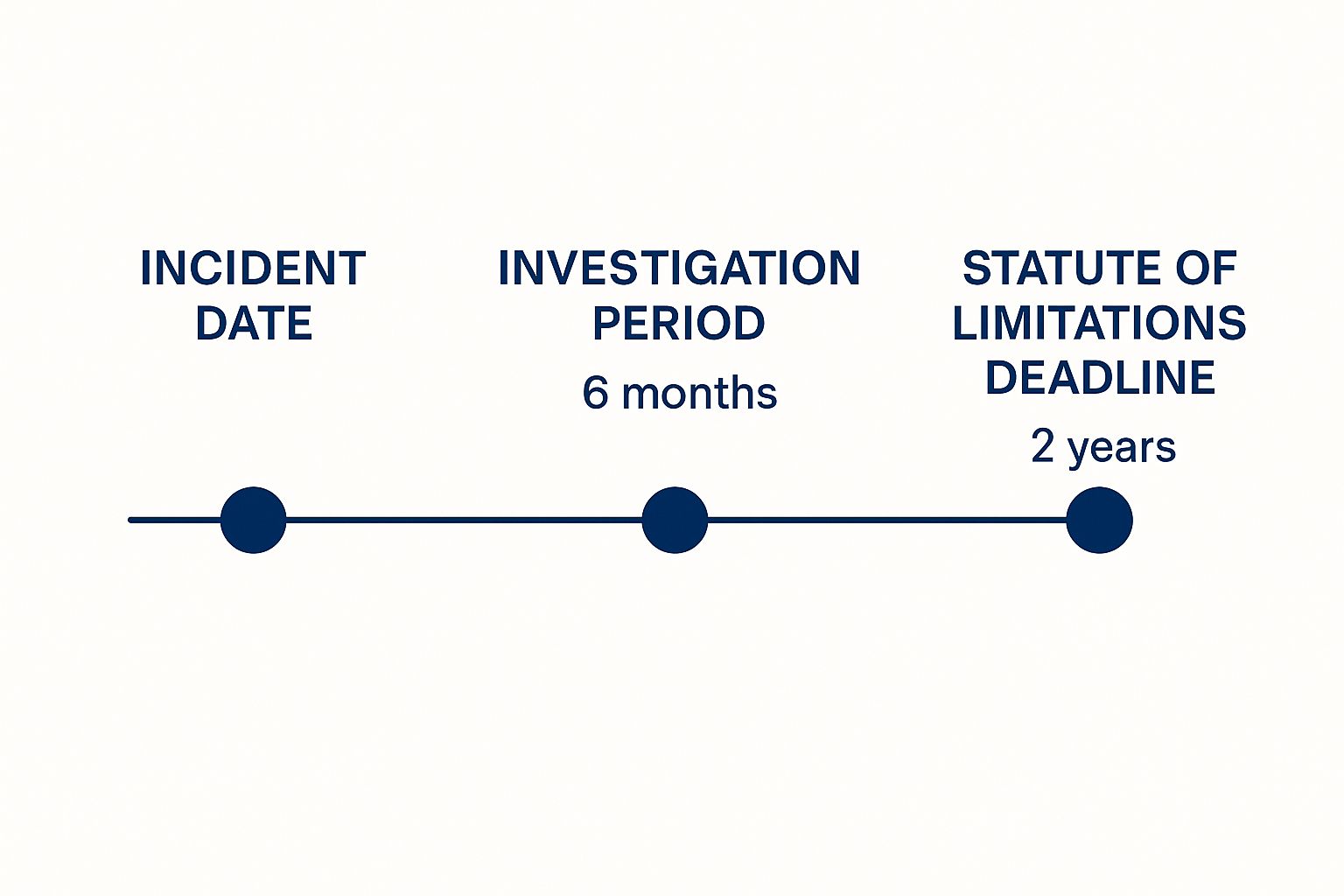
As you can see, time is of the essence from the very beginning. The clock on the statute of limitations is always ticking in the background.
Making it Official: The Complaint and Service of Process
With the expert's affidavit in hand, your lawyer will draft the formal Complaint. This is the document that kicks off the lawsuit. It's a detailed narrative that lays out the facts, names the defendants (the specific doctor, the hospital, etc.), explains the negligence, and specifies the damages you're seeking.
After filing the Complaint with the court, the defendants have to be officially notified. This isn't as simple as sending an email; it's a formal process called "service." It often involves hiring a process server to ensure the legal papers are delivered correctly and proof of delivery is documented.
Once served, the defendants have a set period—usually 20 to 30 days—to file their formal Answer. Don't be surprised when this document denies nearly everything. It’s standard practice for them to deny the allegations and outline their own defenses.
This back-and-forth of the Complaint and Answer officially puts both parties on the record. It defines the battle lines and moves the case into its next—and typically longest—phase.
The Heart of the Case: The Discovery Phase
Welcome to discovery. This is where both sides are legally required to share information and evidence. It's an exhaustive, methodical process where your attorney digs deep to build the strongest possible case. Be prepared, as this phase can easily last for a year or even longer.
Several key activities happen during discovery:
- Interrogatories: These are formal, written questions sent to the other side, which they must answer in writing and under oath. For instance, your lawyer might ask the defendant surgeon to list every continuing education course they took in the two years prior to your surgery.
- Requests for Production: This is exactly what it sounds like. Both sides request documents. We'll ask for things like the hospital's internal staffing policies, the doctor's training records, and any incident reports. In turn, the defense will ask for your complete medical history, employment records, and tax returns to verify lost wages.
- Depositions: Think of these as out-of-court, sworn testimony. The defense attorney will question you under oath—this is your deposition. They will ask about the incident, your injuries, and how they've affected your daily life. Your attorney will do the same to the defendant doctor, nurses, and any other key witnesses.
A Quick Word on Your Deposition
Your deposition is a make-or-break moment. The other side’s attorney is trying to find weak spots in your testimony and get a feel for how you’d present to a jury. Your lawyer will prepare you for this, but the golden rules are simple:
- Always tell the truth.
- Keep answers short and to the point.
- Don't guess or offer information you weren't asked for.
- "I don't know" or "I don't recall" are perfectly acceptable answers.
A medical malpractice lawsuit can feel like a marathon. The timeline below provides a general idea of how these cases typically unfold, though every case is unique.
Medical Malpractice Lawsuit Timeline
| Stage | Key Activities | Estimated Duration |
|---|---|---|
| Initial Investigation & Filing | Case review, evidence gathering, obtaining Certificate of Merit, filing the Complaint. | 2 – 6 Months |
| Discovery | Interrogatories, document requests, depositions of all parties and experts. | 12 – 18 Months |
| Negotiation & Mediation | Settlement discussions based on evidence from discovery. Formal mediation with a neutral party. | 3 – 6 Months |
| Trial Preparation | If no settlement, both sides prepare for court, file pre-trial motions, and finalize expert witnesses. | 3 – 6 Months |
| Trial | Presentation of evidence and arguments to a judge or jury. | 1 – 4 Weeks |
| Resolution | Verdict is reached, or a post-trial settlement is agreed upon. | Varies |
This table shows why patience is so crucial. The legal system moves deliberately, and the discovery phase alone can take well over a year.
The final stretch of this journey is about reaching a resolution. The reality is that over 90% of medical malpractice cases never see the inside of a courtroom. They end in a settlement. These negotiations can start at any point, but they usually gain momentum once discovery is complete and both sides know the strengths and weaknesses of their cases.
If a fair settlement can't be reached, the next step is often mediation. Here, a neutral mediator helps facilitate a conversation to see if a compromise is possible. Only when all other options have been exhausted will your case proceed to trial, where the final decision is left in the hands of a judge or jury.
Critical Deadlines and Common Mistakes to Avoid

When it comes to medical malpractice, the clock is your worst enemy. I’ve seen it happen too many times: a rock-solid case with clear evidence of negligence gets thrown out simply because the client waited too long to take action.
This unforgiving deadline is called the statute of limitations. It’s a state-specific law that puts a hard stop on how long you have to file a lawsuit. If you miss that window—even by a day—you lose your right to compensation forever. These timelines can differ wildly, but most states set the limit somewhere between one and three years from the date the medical error happened.
Understanding the Discovery Rule
So, what if the harm isn't obvious right away? This is a common situation, especially with a misdiagnosis or a surgical error whose effects don’t show up for months, or even years.
Fortunately, the law has a crucial exception for this: the discovery rule. This principle can effectively pause the statute of limitations clock. Instead of starting on the date of the incident, the clock begins ticking on the date you actually discovered—or reasonably should have discovered—that you were injured and that it was likely due to a medical mistake.
Think about a patient who has a sponge accidentally left inside them during surgery. They might suffer from non-specific abdominal pain for over a year before an imaging scan finally reveals the source of the problem. In this scenario, the discovery rule would likely start the clock on the date of that scan, not the date of the original operation.
My Advice: The statute of limitations is an absolute, non-negotiable deadline. Never assume you have more time than you do. The moment you suspect something went wrong with your medical care, your very first call should be to an experienced attorney. It’s the only way to be certain you know the deadline for your specific situation.
Common Pitfalls That Can Jeopardize Your Claim
Missing the filing deadline is the ultimate mistake, but it’s far from the only one. Many other pitfalls can seriously weaken or even destroy an otherwise valid claim. Remember, the hospital and its insurance company have a team of sharp lawyers ready to pounce on any misstep you make.
One of the biggest blunders I see is when clients talk to the insurance adjuster for the doctor or hospital. These are professional negotiators, and their only goal is to pay you as little as possible—or nothing at all. They might ask for a recorded statement, hoping you’ll say something they can later twist to hurt your case. Let your lawyer handle every single conversation with the other side. Period.
Damaging Your Own Case Without Realizing It
In our hyper-connected world, it's frighteningly easy to accidentally sabotage your own case. From the moment you even think about filing a lawsuit, you need to be incredibly careful about what you say and do.
Here are a few of the most common—and most damaging—mistakes I tell my clients to avoid at all costs:
- Posting on Social Media: You absolutely cannot post anything about your injury, your feelings about the doctor, or any detail of your case online. A simple photo of you smiling at a family BBQ can be used by the defense to argue your “pain and suffering” isn’t as bad as you claim. Go dark on social media until your case is over.
- Ignoring Medical Advice: You have a legal duty to "mitigate your damages," which means you must do everything you can to get better. If you start skipping physical therapy or ignoring your new doctor’s instructions, the defense will argue that your own actions are the reason you aren’t recovering.
- Exaggerating Your Injuries: Honesty is everything. If you’re caught overstating your symptoms during a deposition or an independent medical exam, your credibility will be shot. It’s often the single fastest way to lose a case.
Protecting your claim means being vigilant. The best approach is to let your attorney do the talking while you focus on one thing: meticulously following your doctor's orders and getting better.
Common Questions We Hear About Malpractice Lawsuits
Even when you understand the steps involved, the thought of filing a lawsuit can be overwhelming. It’s natural to have a lot of personal and practical questions swirling in your head. You might be worried about the cost, how long it will all take, and what you can realistically expect. Getting straight answers is the first step toward feeling in control of your decision.
Let's walk through some of the most common concerns people have when they first consider a medical malpractice claim. My goal here is to give you the clear, straightforward information you need to move forward with confidence.
"How Much Will This Cost Me?"
For most people, this is the number one question, and for good reason. Thankfully, the way legal fees are structured in these cases is designed to help patients, not burden them.
The vast majority of experienced medical malpractice attorneys work on a contingency fee basis. What does that mean for you? It means you pay nothing upfront to hire a lawyer. Their fee is simply a pre-agreed percentage of whatever compensation you receive at the end. This amount typically falls between 30% and 40%.
If your case isn't successful and you don't get a settlement or award, you owe your attorney zero fees. It's that simple.
Now, one crucial detail to clarify is how case expenses are handled. These are things like court filing fees, the cost of getting thousands of pages of medical records, and paying for expert witness testimony. Make sure your fee agreement clearly spells out whether you are responsible for these costs, regardless of the outcome. A good lawyer will be transparent about this from day one.
"How Long Is This Going to Take?"
I'll be direct: these cases require patience. The legal system moves at its own deliberate pace, and a malpractice lawsuit isn't a quick process. The timeline can stretch or shrink based on a few key things:
- The Complexity of Your Case: A lawsuit involving a single, obvious mistake will move much faster than a case with multiple doctors and hospitals involved.
- The Court's Calendar: Some court systems are simply more backlogged than others, which can add significant delays.
- The Other Side's Willingness to Settle: If the defendant's insurance company wants to resolve the case early, things can wrap up much sooner.
A relatively straightforward case that settles might take one to two years. On the other hand, a highly complex case that has to go all the way to a jury trial can easily take three to five years, sometimes even longer.
The discovery phase—where both sides gather evidence, review documents, and question witnesses under oath (depositions)—is almost always the longest part of the journey. This step alone can often last for over a year.
"What Kind of Compensation Could I Receive?"
The goal of compensation, or what the law calls "damages," is to help put you back in the position you were in before the injury occurred—as much as money possibly can. These damages fall into two main buckets.
1. Economic Damages
This is the easy-to-calculate stuff. It covers all the tangible financial losses you’ve suffered, including:
- Every medical bill from the past and what's anticipated for the future.
- Wages you lost from being out of work, plus any impact on your ability to earn in the future.
- Costs for physical therapy, rehabilitation, or necessary medical devices.
2. Non-Economic Damages
This category is for the profound, intangible harm that doesn't come with a receipt. It's compensation for:
- Physical pain and ongoing suffering.
- Emotional distress, anxiety, and mental anguish.
- Loss of enjoyment of life (not being able to play with your kids, do a hobby you loved, etc.) or loss of consortium, which addresses the impact on your marriage.
In very rare situations where a provider’s actions were especially reckless or malicious, a court might also award punitive damages. These aren't meant to compensate you but to punish the defendant and send a strong message to deter others from similar conduct.
"But I Signed a Consent Form. Can I Still Sue?"
Yes, absolutely. This is one of the biggest misconceptions I see, and it stops too many people from seeking the justice they deserve. Signing a consent form does not give a doctor a license to be negligent.
Think of it this way: a consent form is there to inform you of the known, accepted risks of a procedure. A form for surgery will probably list infection or bleeding as risks you agree to accept.
But that form does not give a surgeon permission to operate on the wrong knee or leave a sponge inside you. Your lawsuit isn't about the risks you agreed to; it’s about proving the care you received was substandard and negligent—something no patient ever consents to.