

When you hear the term "Gulf War illness presumptive conditions," what does that actually mean for you as a veteran? In short, it’s the VA’s way of acknowledging that if you served in certain locations and now have specific chronic health problems, they will automatically assume your illness is connected to your service.
This is a game-changer. It means you don’t have to fight an uphill battle to get the disability benefits you've earned.
What Are Gulf War Presumptive Conditions?
Typically, filing a VA disability claim means gathering a mountain of evidence to prove your health condition is a direct result of your military service. This link, known as a "medical nexus," can be incredibly difficult to establish, especially for illnesses that show up years after you’ve returned home.
That’s where the concept of a presumptive condition completely changes the dynamic.
Think of it like this: the VA has essentially built a bridge for you. Instead of forcing you to prove exactly how or why your deployment to Iraq led to your chronic fatigue, the VA looks at the extensive scientific and medical evidence and agrees there's a strong likelihood of a connection. It’s a powerful tool that gives you the benefit of the doubt.
A presumptive service connection means the VA concedes the link between your illness and your service. If you meet the service requirements and have a recognized condition, the most difficult part of the claim is already done.
This policy didn't just appear out of thin air. It came about because the VA recognized that veterans serving in the Southwest Asia theater of operations were exposed to a unique and complex mix of environmental hazards. These exposures resulted in a wide array of health issues that are often hard to trace back to a single, specific event.
The Foundation of Presumptive Benefits
It's really important to understand that "Gulf War Illness" isn't a single diagnosis. It's more of an umbrella term that covers a cluster of chronic, often medically unexplained symptoms affecting various systems in the body. To make claims more straightforward, the VA groups these into several official categories.
Thanks to laws like the PACT Act, the VA presumes a service connection for many of these illnesses for veterans who served in specified locations on or after August 2, 1990. This includes conditions like chronic fatigue syndrome, fibromyalgia, and functional gastrointestinal disorders (like irritable bowel syndrome).
As long as your condition has persisted for at least six months, you don't need to provide that tricky medical nexus. This dramatically lowers the burden of proof, helping you get the benefits you are rightfully owed. You can discover more about the specific conditions and qualifying locations to see how this applies to you.
To give you a clearer picture, here’s a quick breakdown of the major illness categories the VA recognizes as presumptive. This table can help you see at a glance where your condition might fit.
Quick Guide to VA Presumptive Condition Categories
| Category of Illness | Common Examples | Key Requirement |
|---|---|---|
| Medically Unexplained Chronic Multisymptom Illness (MUCMI) | Chronic Fatigue Syndrome, Fibromyalgia, Irritable Bowel Syndrome (IBS) | Must cause a cluster of symptoms and be chronic (6+ months). |
| Infectious Diseases | Brucellosis, West Nile Virus, Malaria, Coxiella Burnetii (Q Fever) | Must be diagnosed within a specific timeframe after service. |
| Cancers | Brain, Lymphoma (all types), Kidney, Pancreatic, and others | Must be diagnosed anytime after service in a qualifying location. |
This table is just a summary, but it illustrates how the VA has organized these conditions to streamline the claims process for veterans.
Key Aspects of Presumptive Conditions
So, how do you know if you qualify? Your situation generally needs to hit three main points. Getting familiar with these criteria from the start will save you a lot of time and frustration.
- Qualifying Service: You must have served on active duty in specific locations, primarily in the Southwest Asia theater of operations, from August 2, 1990, to the present.
- Recognized Condition: Your illness must be on the VA’s official list of presumptive conditions. This covers both formally diagnosed illnesses and certain undiagnosed chronic symptoms.
- Chronic Nature: The condition must have lasted for six months or more. In many cases, it also needs to be severe enough to warrant a disability rating of at least 10%.
By creating this framework, the VA acknowledges the very real health struggles and shared experiences of Gulf War-era veterans. It ensures you can get the support you need without facing an impossible evidentiary fight.
Confirming Your Eligibility for Presumptive Benefits
Before you even think about starting a claim, you need to make sure you tick the right boxes for Gulf War illness presumptive conditions. It's like doing a pre-flight check on an aircraft; getting these details right from the start saves a world of trouble later and sets your claim up for success.
It all really comes down to two things: your service history and your current health. Let's break down exactly what the VA is looking for in each of these areas.
Verifying Your Service Record
First things first, let's talk about your time in service. The foundation of any presumptive claim is proving you were in the right place at the right time, and your DD-214 is the key to unlocking that.
The service window is broad, covering any active duty from August 2, 1990, to the present. The critical part is where you served. The VA has a specific list of locations that qualify as the Southwest Asia theater of operations.
You must have served in one of these places:
- Iraq
- Kuwait
- Saudi Arabia
- The neutral zone between Iraq and Saudi Arabia
- Bahrain
- Qatar
- The United Arab Emirates (UAE)
- Oman
Don't forget the surrounding areas. Service in the airspace above these countries or in the nearby waters also counts. The VA includes:
- The Gulf of Aden
- The Gulf of Oman
- The waters of the Persian Gulf, the Arabian Sea, and the Red Sea
For certain infectious diseases, the VA's list of locations is even bigger, adding Afghanistan, Israel, Egypt, Turkey, and Syria. The bottom line is simple: pull out your service records and make sure the locations listed on them match the VA's official list.
Meeting the Health Condition Requirements
Once you've confirmed your service location and dates, the next piece of the puzzle is your health. The VA has a couple of clear-cut rules for what makes a condition presumptive.
To qualify, your condition must be chronic, which the VA defines as lasting for at least six months. It also needs to be severe enough to warrant at least a 10% disability rating.
This "chronic" part is non-negotiable. A bad flu that knocks you out for a few weeks, for example, wouldn't qualify. The VA is looking for health problems that have stuck around and have a real, lasting impact on your life.
These aren't just arbitrary rules. They’re designed to connect your deployment to the long-term health issues that so many Gulf War veterans are now facing. When you meet these criteria, the VA essentially agrees to connect the dots for you, presuming your condition is tied to your service without you having to prove a direct medical link.
This presumption is a huge advantage. Of course, dealing with a chronic illness often brings financial stress that goes beyond what disability benefits can cover. It's why some veterans also look into other financial tools; for instance, understanding how to qualify for VA personal loans for veterans can provide another layer of support when you need it most.
Making sure you're eligible on both fronts—your service and your health—is the most important first step you can take. With these pieces confirmed, you can proceed with your claim, knowing you’re starting from a position of strength.
The Official List of Gulf War Presumptive Illnesses
If you're a Gulf War veteran dealing with health issues, one of the most important things to know is which conditions the VA officially recognizes as "presumptive." This isn't just some long, confusing list; the VA has grouped these illnesses into specific categories to make it easier for everyone to understand.
Think of it as a framework built to address the unique health challenges that came out of service in that region. This structure mainly revolves around Chronic Multisymptom Illnesses (CMI), a handful of infectious diseases, and—thanks to recent major legislative changes—a whole new set of cancers and respiratory conditions. Getting a handle on these categories is your first step to figuring out where your own health condition fits.
Chronic Multisymptom Illnesses and Undiagnosed Illnesses
This is the big one. It's the broadest and most common category, and it covers a lot of ground for Gulf War veterans. It's designed to include both recognized medical conditions and situations where you have real, persistent symptoms that don't have a clear, official diagnosis.
Let's break that down. A Chronic Multisymptom Illness (CMI) is a diagnosed condition like Fibromyalgia or Chronic Fatigue Syndrome. It has a name, even if the medical community is still figuring out the exact cause.
An "Undiagnosed Illness," on the other hand, is the VA's way of acknowledging that your symptoms are real even without a formal label. Maybe you're struggling with a combination of fatigue, joint pain, and brain fog that doesn't fit neatly into a textbook definition. The VA recognizes these clusters of symptoms as disabling.
The most common conditions under this umbrella include:
- Fibromyalgia: This isn't just "being sore." It's widespread, chronic pain throughout your muscles and joints, often coupled with severe fatigue, sleep problems, and memory or mood issues.
- Chronic Fatigue Syndrome (CFS): Imagine a level of exhaustion so extreme that it doesn't get better with rest and actually gets worse after any physical or mental effort. That's CFS.
- Functional Gastrointestinal Disorders: This is a group of problems where your gut just doesn't work right. The most well-known example is Irritable Bowel Syndrome (IBS), which can cause a frustrating mix of cramping, abdominal pain, bloating, gas, and either diarrhea or constipation.
The VA’s recognition of "undiagnosed illnesses" is a game-changer. It means you can still get disability benefits for a persistent cluster of symptoms—like headaches, cognitive problems, and widespread pain—even if your doctor can't pin a specific name on what you're going through.
This infographic lays out the different categories of presumptive conditions in a clear, clinical way, making it easier to see how the VA organizes everything.
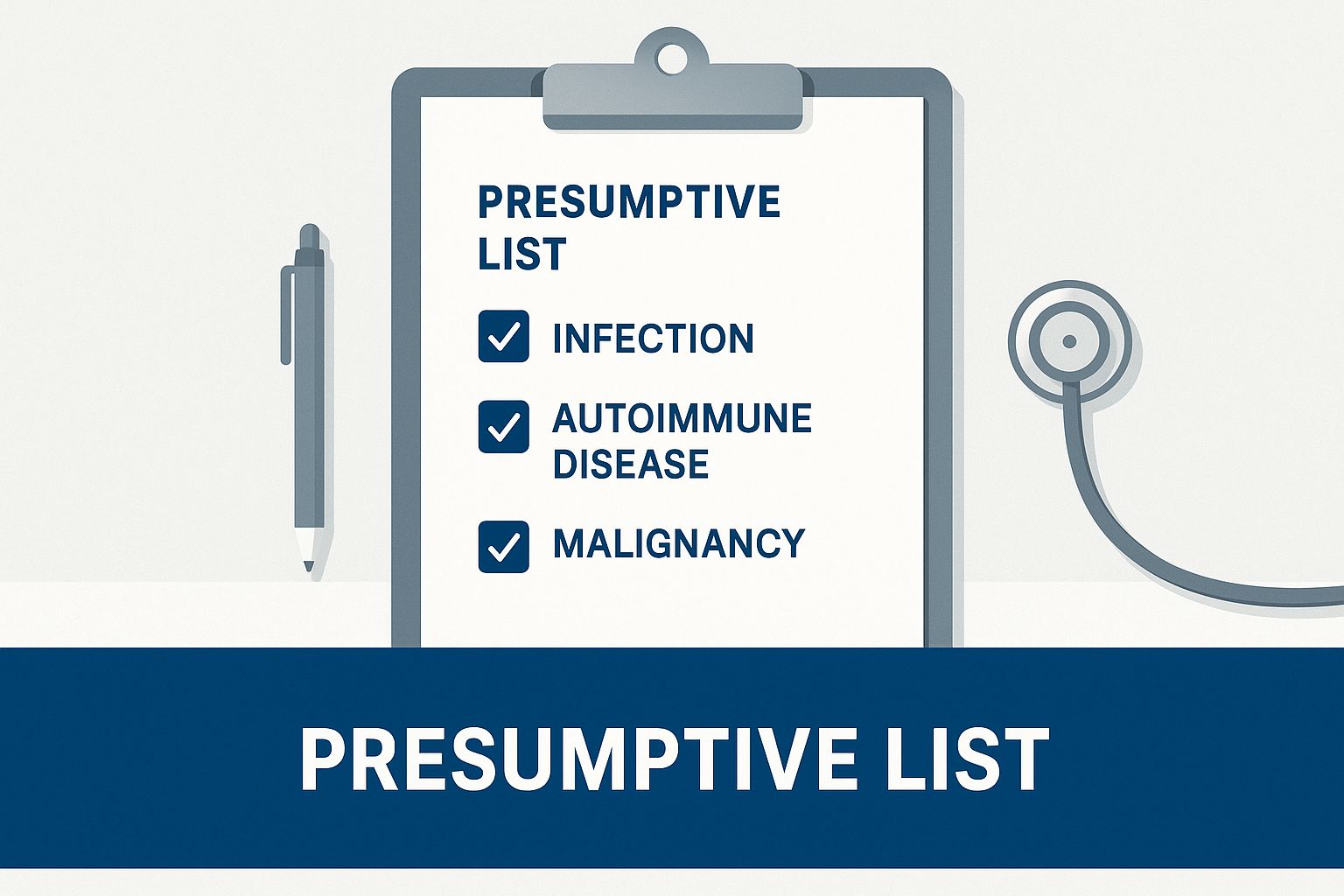
By breaking down the conditions visually, from multisymptom illnesses to specific diseases, it gives veterans a clearer map to follow when determining their eligibility.
Infectious Diseases
The VA also presumes that certain infectious diseases are connected to service in the Gulf War. Unlike the broader multisymptom illnesses, these have very specific diagnostic and timing rules you need to meet.
For most of these, there's a critical time window: you must have been diagnosed within one year of separating from active duty for the VA to presume a service connection.
The specific diseases on this list include:
- Brucellosis
- Campylobacter jejuni
- Coxiella burnetii (Q fever)
- Malaria
- Nontyphoid Salmonella
- Shigella
- West Nile Virus
There are two exceptions: Mycobacterium tuberculosis and Visceral leishmaniasis. These are also presumptive but, importantly, have no time limit for when they must be diagnosed after your service.
New Presumptive Conditions Under the PACT Act
The entire landscape of VA benefits changed dramatically with the passage of the PACT Act. This landmark law added over 20 new presumptive conditions linked to burn pit exposure and other toxic substances, directly impacting Gulf War and post-9/11 veterans.
This is huge. It means that many cancers and respiratory illnesses that veterans have been fighting to get recognized for years are now automatically presumed to be service-connected if you served in a qualifying location and time frame.
Some of the major cancers added to the list are:
- Brain cancer
- Kidney cancer
- Lymphoma (all types)
- Pancreatic cancer
- Melanoma
A host of respiratory illnesses also made the list, including conditions like Asthma (if diagnosed after service), chronic rhinitis, chronic sinusitis, and the more severe Constrictive or Obliterative Bronchiolitis.
From undiagnosed symptoms and neurological problems to specific cancers, the VA’s approach to Gulf War presumptives is designed to be comprehensive. The list covers service across the entire Southwest Asia theater of operations, from boots on the ground in Saudi Arabia to sailors on the waters of the Persian Gulf. With the PACT Act's expansion, the scope of benefits continues to grow as medical science catches up. You can discover more about the specifics of these presumptive illnesses to see how they might apply to your claim.
How to File a Strong VA Claim for Your Condition

Realizing you have one of the Gulf War illness presumptive conditions is a huge first step. But getting a claim approved takes more than just awareness—it requires a solid, organized approach. This isn't just about filling out paperwork; it's about building a compelling case that shows the VA exactly how your service-connected illness impacts your life today.
It helps to think of this process like you're building a legal case. You're the main witness, and every document you track down is a crucial piece of evidence. The objective is to present a complete and undeniable picture that leaves no room for doubt.
Let’s walk through the roadmap to a strong claim. We'll cover gathering your evidence, filling out the right forms, and getting ready for the all-important Compensation & Pension (C&P) exam. Following these steps can make the whole process less stressful and seriously boost your chances of success.
Gather Your Essential Evidence
Before you even touch a form, your first priority is to gather all your documentation. This evidence is the absolute backbone of your claim, so being thorough here is non-negotiable. Think of yourself as a detective building a case file—every single piece matters.
You'll need to pull together three core types of documents:
- Proof of Service: Your DD-214 (Certificate of Release or Discharge from Active Duty) is the place to start. It's the official record that proves your service dates and, crucially, the locations that make you eligible for a presumptive condition.
- Medical Records: Collect every single medical record related to your condition. This means diagnoses from both VA doctors and your private healthcare providers. These documents establish your current medical diagnosis, which is a must-have for any claim.
- Supporting Documents: This is where you can really make your application stand out. These documents help paint a vivid picture of how your condition affects your day-to-day life.
Lay statements, often called "buddy letters," can be incredibly powerful. These are written statements from friends, family, coworkers, or fellow veterans who have seen firsthand how your symptoms affect you. Their observations provide a real-world perspective that medical jargon in a report simply can't convey.
Your supporting evidence should tell a story. For instance, a letter from your spouse describing your chronic fatigue and how you can no longer participate in family outings provides powerful, humanizing context. A statement from a former boss about how your cognitive "brain fog" impacted your performance at work can be just as compelling.
Filling Out the Right VA Forms
Once your evidence is collected and organized, you're ready to tackle the paperwork. The main form for filing a disability claim is VA Form 21-526EZ, Application for Disability Compensation and Related Compensation Benefits.
You have a few options for submitting it:
- Online: This is the fastest and most recommended method. You can file directly through the VA's official website.
- By Mail: You can always download the form, fill it out by hand, and mail it to the VA's Claims Intake Center.
- In-Person: A Veterans Service Officer (VSO) at a VA regional office can provide invaluable help in preparing and submitting your claim.
When you're filling out the form, be meticulous. In the sections where you list your conditions, use the exact same terminology your doctor used in your diagnosis. If you're claiming Fibromyalgia, write "Fibromyalgia," not just "body pain." This kind of precision helps the VA rater directly connect your claim to your medical evidence without any guesswork.
Preparing for Your C&P Exam
After you submit your claim, the VA will most likely schedule you for a Compensation and Pension (C&P) exam. It's important to understand this isn't a treatment appointment. It's a medical evaluation designed to assess the severity of your condition. The report from this examiner will be one of the most critical factors in the VA's final decision.
Your goal during the exam is to be honest, open, and specific. Don't exaggerate your symptoms, but more importantly, don't downplay them. This is not the time to be a tough soldier; it's the time to be a clear communicator about your daily struggles.
Here are a few tips to help you prepare:
- Review Your Records: Before the exam, look over your medical records and buddy letters. This will refresh your memory on the specific details of your symptoms and how they've progressed.
- Describe Your Worst Days: The examiner needs to understand the full scope of your condition. When they ask how you are, describe what your worst days feel like, because that reflects the true extent of your disability.
- Use Concrete Examples: Don't just say, "I have headaches." Explain how your migraines force you to lie down in a dark, quiet room for hours, causing you to miss work or your kid's baseball game. Instead of saying, "I have fatigue," describe how you're completely wiped out after just a few hours of activity.
This exam is your chance to connect the dots between the medical diagnosis and your real-life experience. By preparing your evidence, carefully completing your forms, and communicating clearly at your C&P exam, you build a powerful case for the Gulf War illness presumptive conditions you're living with.
The Shared Struggle: Understanding Gulf War Illness's Widespread Impact
If you’re a Gulf War veteran dealing with chronic, baffling health problems, it's easy to feel like you're on an island. The exhaustion, the pain, the "brain fog"—it's all invisible to an outside observer, but for you, it's a constant, daily battle. The most important thing to know is that you are not fighting this alone. What you're experiencing is a widespread health crisis that has affected hundreds of thousands of your brothers and sisters in arms.
The scale of Gulf War Illness is truly staggering. For years, veterans reported the same strange clusters of symptoms, often only to be met with doubt. But the numbers don’t lie. The Department of Veterans Affairs now openly acknowledges the problem, and the statistics are undeniable: more than 44% of Gulf War veterans have reported suffering from these chronic, multi-symptom illnesses. Think about that—nearly half of everyone deployed is facing long-term health consequences tied directly to their service. This validates the silent struggle so many have endured, and you can learn more about how this recognition helps your claim on the Disability Law Group’s blog.
From Numbers to a Daily Reality
Percentages and data points are one thing, but they can feel cold and distant. They don't capture the real, human cost of these conditions. The true impact of Gulf War Illness is found in the day-to-day grind, in the things it takes away from a veteran’s quality of life. These aren't just vague complaints; they are very real obstacles that can steal your joy and opportunities.
This illness shows up in countless ways, but many veterans report the same frustrating challenges:
- Pervasive "Brain Fog": This isn't just about forgetting your keys. It's a debilitating cognitive haze that can make it incredibly hard to keep a job, manage your family's finances, or even just follow a simple conversation. The strain it puts on your professional and personal life is immense.
- Chronic, Widespread Pain: For so many, this is a constant companion. The persistent muscle and joint pain can make it impossible to enjoy the simple things, like tossing a ball with your kids, working in the garden, or getting any kind of exercise.
- Overwhelming Fatigue: This is so much more than just feeling tired. It's a deep, relentless exhaustion that sleep can't touch. It turns every single day into a fight against your own body and severely limits your ability to just live your life.
This shared experience is the very reason gulf war illness presumptive conditions were created. The VA's presumptive policies are a formal acknowledgment that your illness is a legitimate, service-connected injury—not something you have to prove from the ground up.
Why Presumptive Policies Are So Important
Understanding just how widespread this issue is helps reinforce that your condition is real and legitimate. For decades, too many veterans felt their symptoms were brushed aside or ignored. The creation of presumptive policies by the VA was a direct result of overwhelming scientific evidence and the collective voice of veterans who refused to stay silent.
These policies have a clear and vital purpose: to validate what you've been through and remove the unfair burden of proof that once stood in your way. They are an official admission that the hazards you were exposed to during your deployment led to real, lasting health problems. Your illness isn't just a personal struggle; it’s a shared sacrifice, and one that is finally being recognized by the country you served. This validation is a powerful tool, giving you the firm ground you need to seek and receive the benefits you rightfully earned.
Common Questions About Gulf War Presumptive Claims
It’s completely normal to have a lot of questions when you're staring down the VA claims process. When you add the complexities of Gulf War illness presumptive conditions into the mix, it's easy to feel overwhelmed.
Let's clear the air. This section is all about tackling the most common questions veterans have, head-on. No jargon, no runaround—just straight answers to help you understand your options and move forward with your claim.
What if My Condition Isn't on the Presumptive List?
This is a big one, and the answer is yes, you can absolutely still file. But you’ll need to take a different route. Instead of relying on a presumption, you have to prove a "direct service connection."
This puts the responsibility on you to connect the dots for the VA. You’ll need to show three things:
- You have a current, diagnosed medical condition.
- You can point to a specific event, injury, or exposure that happened during your service.
- You have a medical "nexus" opinion—a letter from a qualified doctor linking your current condition directly to that in-service event.
That nexus letter is the linchpin of your claim. It's an expert medical opinion stating it is “at least as likely as not” that your service caused your health problem. Without a strong nexus letter, winning a direct service-connected claim is incredibly difficult.
Can I Get Benefits for More Than One Presumptive Condition?
Yes, you can—and you absolutely should. You should file for every single health issue you believe stems from your Gulf War service. The VA will evaluate each condition on its own and assign a separate disability rating.
But here’s a common point of confusion: the ratings don't just add up.
The VA uses a unique calculation, often called "VA Math," to determine your combined rating. For example, a 30% rating for Fibromyalgia and a 20% for Irritable Bowel Syndrome don't simply equal a 50% rating.
The formula is complex, but the main takeaway is simple: every single condition you successfully connect to your service can raise your overall rating and your monthly compensation. It’s crucial to claim everything you're dealing with to get the full benefits you’ve earned.
What's the Difference Between a CMI and an Undiagnosed Illness?
This is a really important distinction that often trips people up. Though they sound similar, a Chronic Multisymptom Illness (CMI) and an "Undiagnosed Illness" are two different things in the VA's eyes.
A Chronic Multisymptom Illness (CMI) is a recognized medical diagnosis, like Fibromyalgia or Chronic Fatigue Syndrome. Doctors know what they are, they have diagnostic criteria, and they have a name—even if the root cause isn't fully understood.
An "Undiagnosed Illness", on the other hand, is the VA’s term for when a veteran has a collection of chronic symptoms (lasting six months or more) that don’t fit any single, known diagnosis. Maybe you suffer from debilitating headaches, widespread joint pain, and brain fog, but doctors can't pin it on one specific disease.
In this situation, the VA can actually grant benefits for the cluster of symptoms themselves, even without an official medical label. This is a vital pathway that acknowledges the very real, but hard-to-define, health issues many Gulf War veterans face.
Is There a Deadline to File for These Conditions?
Yes, timing can be very important, especially with the PACT Act in play. For many Gulf War illness presumptive conditions, you can file a claim at any time, but filing before certain deadlines can make a huge difference in getting back pay.
For instance, when a new condition gets added to the presumptive list, veterans often have a one-year window to file a claim and potentially get retroactive benefits going back to the date the law was passed.
While some major PACT Act deadlines have passed, new ones can emerge with new legislation. It's always smart to check the official VA website for the latest PACT Act information to make sure you don't miss a critical window of opportunity.
Does Service in Afghanistan Count for These Presumptives?
Yes, service in Afghanistan on or after September 19, 2001, does make you eligible for presumptive conditions, but the specifics are a bit different. The list of qualifying conditions isn't a carbon copy of the one for the 1990-1991 Gulf War.
For example, Afghanistan service opens the door for presumptives related to certain infectious diseases like Malaria. More significantly, the PACT Act added a whole host of cancers and respiratory illnesses tied to burn pit exposure for post-9/11 veterans.
However, the "undiagnosed illnesses" and CMIs like Fibromyalgia are more specifically associated with the Southwest Asia theater of operations during the earlier conflict. Eligibility gets complicated fast, so you need to match your exact service dates and locations with the VA's official criteria.
Trying to navigate the VA claims process can feel like you’re hitting one brick wall after another, but you don't have to go it alone. The team at Homefront Group is made up of fellow veterans, lawyers, and dedicated advocates who get it. We are here to help you get the justice and financial support you rightfully deserve. If you're stuck on a claim or just don't know where to start, take our 3-minute quiz to see what benefits you may qualify for. Let's build a strategy for your legal, financial, and personal success. Find out more at https://homefrontgroup.com/.