
Understanding Your Path to Veterans Benefits Eligibility
Earning veterans benefits isn't simply about serving in the military. It's about meeting specific eligibility criteria set by the Department of Veterans Affairs (VA). These requirements can be broken down into understandable components. This section explains the core factors determining your eligibility for veterans benefits.
Service Requirements and Discharge Status
One of the most fundamental aspects of eligibility is the length and type of service. Active duty service typically qualifies veterans for a wider range of benefits. Reserve and National Guard members can also become eligible, particularly if activated for federal service. However, weekend drills and annual training alone may not meet the minimum requirements.
Your discharge status is also critical. Eligibility for veterans' benefits is largely based on discharge from active military service under conditions other than dishonorable. This applies to most VA benefits. Learn more about discharge status and eligibility here.
An Honorable Discharge grants access to most benefits. A General Discharge may limit access to some. Other discharge types, such as Other Than Honorable or Dishorable, can disqualify you from most, if not all, VA benefits. Understanding your specific discharge type is essential.
The infographic below visually represents the typical distribution of discharge statuses among veterans and their correlation with benefit eligibility.
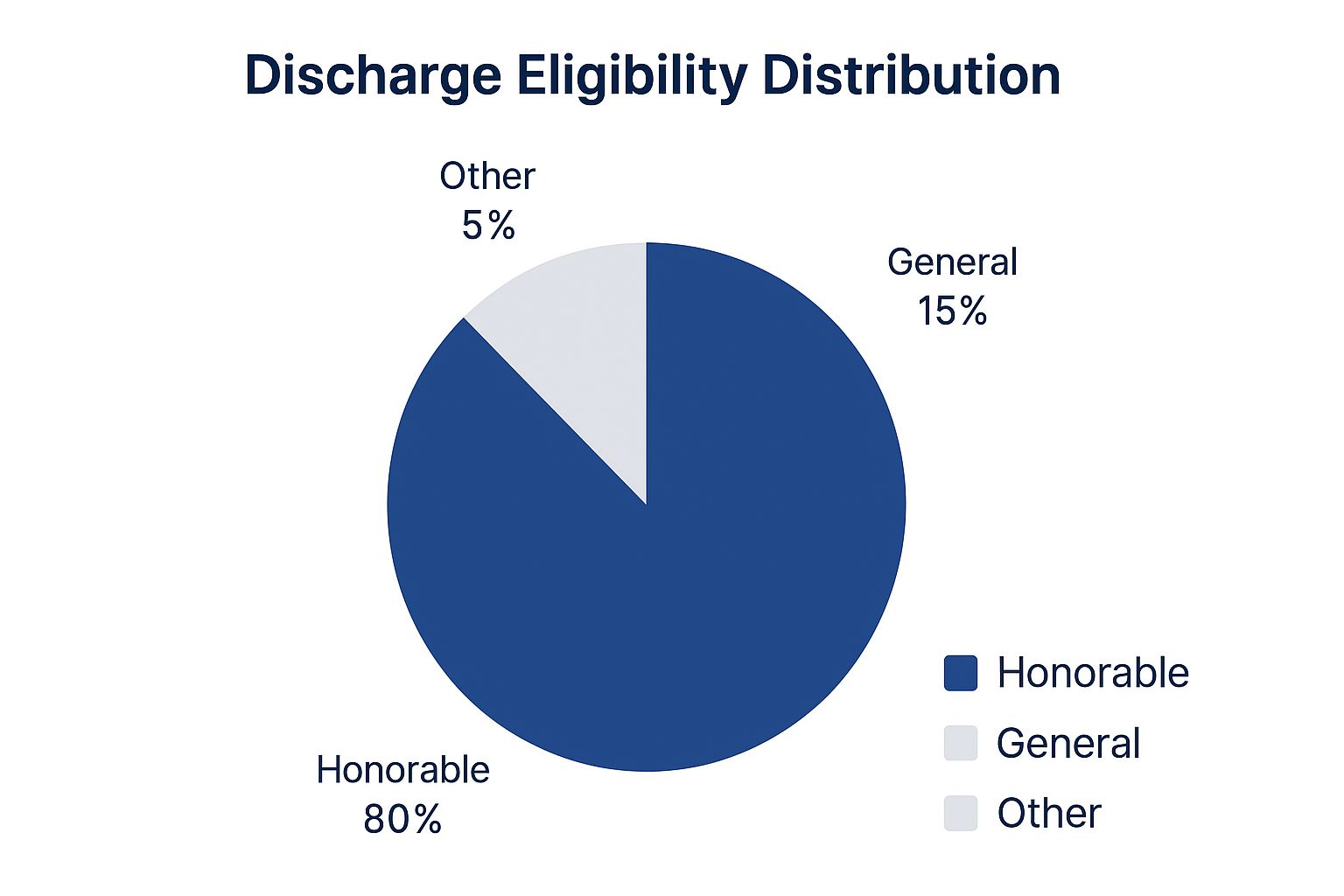
As the infographic shows, most veterans receive an Honorable Discharge. However, for those with a General or Other discharge, understanding the specific requirements for each benefit is crucial.
The following table details benefit eligibility based on discharge status:
VA Benefits Eligibility by Discharge Status
Comparison of benefit access based on different military discharge types
| Discharge Type | Benefit Eligibility | Special Considerations |
|---|---|---|
| Honorable | Eligible for most VA benefits | Generally no restrictions |
| General | May be eligible for some benefits | Eligibility varies depending on the specific benefit and the reason for the general discharge |
| Other Than Honorable | Severely limited eligibility | Often requires a discharge upgrade to access benefits |
| Dishonorable | Ineligible for most VA benefits | Requires a discharge upgrade to be considered |
| Bad Conduct | Ineligible for most VA benefits | Requires a discharge upgrade to be considered |
This table clarifies how different discharge statuses impact access to VA benefits. While an Honorable Discharge offers the most comprehensive access, other statuses may limit or restrict eligibility. It's essential to understand your specific situation.
Documenting Your Service
Proper documentation is also vital. This includes your DD-214 (Certificate of Release or Discharge from Active Duty), which serves as official proof of your service. Any medical records related to service-connected disabilities are also necessary.
For example, if claiming disability benefits for an injury sustained during service, you'll need medical documentation from that time and any subsequent treatments. This documentation supports your claim.
If essential documents are lost, the VA offers resources to help you obtain copies. Starting the documentation process early and staying organized is crucial. For further information on related documentation and processes, refer to this AI Terms Glossary.
Understanding the Specifics of Each Benefit
Finally, eligibility criteria vary for different benefits. One set of requirements might apply to healthcare, while another applies to education or home loan benefits. You could qualify for some benefits but not others.
Thorough research is essential for each benefit you're interested in. Some education benefits might require a minimum service commitment, while home loan benefits might focus on creditworthiness and income.
By understanding these eligibility factors and gathering the necessary documentation, you can begin accessing the veterans benefits you've earned.
Mastering VA Healthcare Eligibility and Enrollment
Navigating veterans benefits eligibility can feel overwhelming. Understanding the rules is paramount, much like understanding consumer rights. For example, knowing your rights during a flight cancellation is as important as understanding VA benefits. Understanding Your Rights When Airlines Cancel Flights offers helpful information in a similar scenario. Accessing VA healthcare can be challenging, but veterans who understand the system can receive the care they need when they need it. This section outlines the key aspects of VA healthcare eligibility and enrollment.
Understanding the Priority Group System
The VA utilizes a priority group system to manage healthcare enrollment and resources. This system categorizes veterans based on factors like service-connected disabilities, income, and unique circumstances.
Veterans with greater needs, such as service-connected disabilities, receive higher priority for enrollment and access to care. It's comparable to a hospital emergency room's triage system where the most critical patients are seen first.
Income Limits and Automatic Qualification
Income limits exist for some priority groups, but certain veterans qualify automatically, irrespective of their finances.
For instance, veterans with a 50% or higher service-connected disability rating are automatically enrolled in Priority Group 1. Former prisoners of war (POWs) also receive automatic qualification. This ensures veterans with significant service-related needs receive necessary care regardless of financial status.
Service-Connected Conditions and Healthcare Access
Service-connected conditions play a significant role in healthcare eligibility. A service-connected disability rating can expedite access to VA healthcare.
The higher the disability rating, the higher the assigned priority group and the more comprehensive the benefits. This system acknowledges the direct correlation between military service and the veteran's healthcare requirements.
Navigating Enrollment and Location Challenges
Even without living near a VA medical center, veterans can still access VA healthcare. The VA provides telehealth services and collaborates with community providers, expanding access beyond traditional VA facilities.
This is especially beneficial for veterans in rural locations or those with limited mobility.
Critical Timing Windows and Insurance Considerations
Understanding enrollment timing is vital. Recently separated veterans have a five-year enhanced eligibility period to enroll in VA healthcare. This period may be extended in specific situations.
Having other health insurance does not preclude eligibility for VA healthcare. In some cases, other insurance can supplement VA benefits, providing more well-rounded coverage.
Appealing Decisions and Accessing Emergency Care
Veterans have the right to appeal enrollment delays or unfavorable eligibility decisions. The VA maintains a formal appeals process for veterans who disagree with a decision.
Even without current enrollment in VA healthcare, veterans might still qualify for emergency care under certain conditions. Understanding these provisions is essential for receiving timely care in critical situations.
Qualifying For VA Disability Compensation That Reflects Reality

The VA disability rating system can be confusing, and many veterans are unsure how to best demonstrate the impact of their service-connected conditions. This section explores how to effectively present your case for a disability rating that accurately reflects your situation.
The Importance of Thorough Medical Records
Medical records are the foundation of any VA disability claim. However, simply having records is not enough. They must clearly connect your current health issues to events or exposures during your military service. Your records need to tell a complete story.
For example, if you are claiming hearing loss, your records should document noise exposure during service. They also need to include diagnoses, treatments, the severity of your hearing loss, and how it affects your daily activities. Comprehensive documentation is essential.
The Power of Buddy Statements
Buddy statements provide firsthand accounts from fellow service members or family members. They offer valuable context and support for your claims. These statements are especially helpful for conditions that are difficult to document medically, such as PTSD.
Effective buddy statements describe specific incidents, observed behaviors, and the overall impact of the condition on your ability to function. A buddy statement for a PTSD claim might describe your reactions in combat or your struggles with anxiety and sleep after returning home. These details can add significant weight to your claim.
Documenting the Unseen: Mental Health and Environmental Exposures
Documenting mental health conditions like PTSD and anxiety requires a different approach than documenting physical injuries. Physical injuries are often immediately visible, while mental health conditions can develop gradually and be less obvious. Thorough documentation of symptoms, treatments, and their impact on your life is crucial.
Conditions resulting from environmental exposures, like burn pits or Agent Orange, can also take years to appear. Documenting potential exposures during your service is important, even if you didn't have immediate symptoms. Linking these exposures to later conditions is critical for receiving appropriate compensation.
Understanding VA Rating Combinations and Maximizing Compensation
The VA uses a combined disability rating, a combination of individual disability ratings, to calculate your monthly compensation. This isn't a simple addition of percentages. A 10% disability rating and a 20% disability rating do not automatically equal a 30% combined rating. The VA uses a formula that considers the diminishing impact of each added disability.
Strategically presenting your claims is crucial for maximizing your compensation. The VA’s disability compensation program provides payment rates that adjust annually. For 2025, rates range from $175.51 per month for a 10% disability rating to $3,831.30 per month for a 100% disability rating to account for cost-of-living changes. Learn more here. Understanding these details can significantly affect your benefits.
Specialized Pathways for Specific Conditions
The VA offers specific claim pathways for PTSD, traumatic brain injuries (TBI), and conditions related to burn pits or Agent Orange exposure. These often have specific evidentiary requirements and evaluation processes. Familiarizing yourself with the specific procedures for these claims is essential.
By understanding the VA’s evaluation process, veterans can build a strong case and receive the compensation they have earned. This is about ensuring your legitimate conditions are recognized and appropriately compensated.
Maximizing Education Benefits Beyond Basic GI Bill Coverage

Your education benefits as a veteran represent a substantial investment in your future. Planning carefully and understanding all available options are key to maximizing these benefits. This section explores strategies to help veterans get the most out of their eligibility for veterans benefits, with a focus on education.
Post-9/11 GI Bill vs. Montgomery GI Bill: Choosing the Right Path
The first step is understanding the differences between the Post-9/11 GI Bill and the Montgomery GI Bill. The Post-9/11 GI Bill typically provides more extensive coverage. This includes tuition and fees, a housing allowance, and a stipend for books and supplies. The Montgomery GI Bill offers veterans a direct monthly payment. However, this amount may not cover the full cost of education at all institutions.
The best program depends on individual circumstances. For example, the Post-9/11 GI Bill might be more beneficial for a veteran attending a public university in their state of residence due to its comprehensive tuition coverage. A veteran attending a private university or pursuing a program with high living expenses might find the flexibility of the Montgomery GI Bill more suitable. Understanding these differences is crucial for informed decision-making.
Transferring Benefits to Family Members: A Valuable Asset
A significant advantage of the Post-9/11 GI Bill is the option to transfer benefits to family members, such as a spouse or child. This can be incredibly helpful for families pursuing higher education.
There are, however, specific eligibility requirements and deadlines for transferring these benefits. Understanding these is essential to capitalize on this opportunity. For example, service time requirements must be met before initiating a transfer. The transfer also requires approval from the Department of Defense before the veteran leaves active duty.
Exploring Vocational Rehabilitation and Employment (VR&E)
The Vocational Rehabilitation and Employment (VR&E) program offers an alternative to traditional GI Bill programs. It provides personalized support to veterans with service-connected disabilities, helping them achieve their employment goals through education and training opportunities.
VR&E can be a valuable tool for veterans whose disabilities affect their ability to pursue traditional education. It offers a more targeted approach to career development, tailored to the specific needs and goals of each veteran.
Combining Benefits and Navigating Time Limits
In some cases, veterans can combine different education benefits for maximum coverage. This could involve using part of the Montgomery GI Bill and then transitioning to the Post-9/11 GI Bill, or using VR&E alongside other programs. Careful planning and coordination with the VA are essential.
Most GI Bill benefits have a time limit. Veterans generally have 15 years from their last date of active duty to use their Post-9/11 GI Bill benefits. Knowing these deadlines is crucial to avoid losing these benefits.
Choosing the Right School and Program
Maximizing your education benefits also involves selecting a school and program aligned with your goals and the value of your benefits. Some schools participate in the Yellow Ribbon Program, which helps cover tuition and fee expenses exceeding the GI Bill cap. Researching institutions and their participation in such programs is an important step.
By understanding all education benefits available and planning strategically, veterans can make their educational aspirations a reality. Remember to apply for benefits through the VA's designated channels. This ensures you fully utilize your eligibility for veterans benefits.
Unlocking VA Home Loan Benefits for Real Estate Success
VA home loans offer incredible advantages for veterans looking to break into the real estate market. However, understanding the nuances of VA loan eligibility is crucial for maximizing these benefits. This section explores how veterans can unlock the full potential of VA loans, drawing upon real-world success stories.
Beyond Basic Service: What Lenders Look For
While military service is the cornerstone of eligibility, lenders delve deeper than just basic service requirements. Like any other loan applicant, veterans undergo a thorough creditworthiness assessment, which includes a review of their credit score and history. Lenders also scrutinize the debt-to-income ratio, comparing monthly debt payments against gross monthly income. This helps gauge a veteran’s ability to comfortably manage loan repayments. This mirrors the evaluation process for civilian borrowers, with a strong emphasis on financial stability.
Decoding the Certificate of Eligibility (COE)
The Certificate of Eligibility (COE) acts as a vital credential, verifying a veteran's eligibility for a VA loan. Obtaining the COE entails submitting your DD-214 and other necessary documentation to the VA. This crucial document is essential for accessing VA loan benefits, confirming service requirements, and enabling lenders to initiate the loan process.
Navigating Funding Fees and Loan Costs
VA loans often come with a funding fee, a percentage of the loan amount designed to reduce the overall cost of these loans for taxpayers. This fee, which can be incorporated into the loan, should be factored into your budget. The funding fee varies depending on several factors, including the down payment amount and whether it's the veteran's first VA loan.
For instance, a veteran making a down payment of less than 5% on their first VA loan might incur a funding fee of 2.3% of the loan amount. This fee helps sustain the VA loan program's long-term viability.
Strategies for Real Estate Success With VA Loans
VA loans aren’t limited to purchasing a primary residence. They can also be used to acquire investment properties, providing veterans with a powerful tool for wealth building through real estate. Additionally, VA loans offer refinancing options for existing mortgages, potentially leading to lower interest rates and reduced monthly payments.
Furthermore, veterans can combine VA loans with other programs, such as down payment assistance programs, to further enhance affordability. This strategic combination helps maximize purchasing power and allows veterans to achieve their unique real estate goals.
Addressing Common Misconceptions
There's a misconception that VA loans come with stringent limitations. While there are limits to the amount the VA guarantees, loan amounts often surpass these limits. The key is collaborating with lenders who possess a deep understanding of VA loans and can effectively navigate the intricacies of these loans. Experienced lenders are adept at structuring loans that accommodate these nuances.
The following table details the eligibility criteria for various VA loan programs:
VA Home Loan Eligibility Requirements
Service requirements and qualification criteria for different VA loan programs
| Service Type | Minimum Service Required | Additional Requirements |
|---|---|---|
| Active Duty | 90 days during wartime | Honorable discharge |
| Active Duty | 181 days during peacetime | Honorable discharge |
| National Guard/Reserves | 6 years | Honorable discharge |
| National Guard/Reserves | 90 days active duty (at least 30 days must be consecutive) during wartime | Honorable discharge |
By thoroughly understanding eligibility requirements, navigating the COE process, and partnering with the right lender, veterans can unlock the full power and potential of VA loan benefits and achieve their homeownership dreams.
Securing Burial and Memorial Benefits for Peace of Mind
Planning for burial arrangements isn't always top of mind, but understanding your eligibility for veterans benefits, particularly those covering burial and memorial services, offers valuable peace of mind for you and your family. This preparation can significantly lessen the burden during a time of grief. Let's explore the available burial benefits and how you can ensure your family is informed and can access these entitlements.
Understanding Burial Benefits Options
The VA offers several burial benefits catering to different needs. These include interment in a national cemetery, providing a dignified final resting place for eligible veterans and their dependents. Burial allowances are also available to help families manage expenses. These financial benefits can assist with funeral costs and transportation of the deceased.
The specific benefits available depend on the veteran's service history. A veteran whose death resulted from a service-connected disability may qualify for different benefits than a veteran who passed away from non-service-connected causes. Understanding this distinction is key to determining which options are available to your family.
Pre-Planning: Making the Process Easier for Your Loved Ones
Veterans who have helped loved ones navigate these benefits emphasize the importance of pre-planning. Clearly communicating your wishes and ensuring your family has access to necessary documents streamlines the process during a difficult time. This might include gathering paperwork, such as your DD-214 and medical records, and designating a family member as a point of contact for the VA. These proactive steps prevent added stress for your family later.
Advance Applications and Military Honors
Some burial benefits require applications in advance. Pre-need eligibility determinations for national cemetery burial, for example, can be made before they are needed, allowing veterans to secure a burial plot ahead of time. Arranging military honors at a funeral requires coordination with the relevant military branch. Making these arrangements beforehand ensures a respectful and dignified service.
Veterans choosing burial in a private cemetery may still be eligible for certain benefits. The VA offers a burial allowance for non-service-connected deaths, which can help offset funeral costs. Families can also request a government headstone or marker for a private cemetery plot.
Coordination With Life Insurance and Benefits for Surviving Spouses
Burial and memorial benefits can complement existing civilian life insurance policies. The burial allowance, for instance, can supplement life insurance payouts to further cover funeral expenses. Coordinating these benefits helps ensure adequate financial support for your family.
Surviving spouses should be aware of their eligibility for memorial services and continued benefits, which might include ongoing healthcare coverage, survivor benefits, and access to support services. Understanding available benefits empowers surviving spouses during a difficult transition. These resources are crucial for long-term stability and well-being. The Homefront Group (https://homefrontgroup.com/) provides specialized support for veterans navigating benefit eligibility, ensuring you and your family receive the support you deserve.
Discovering Hidden Benefits and Specialized Programs
Beyond the commonly known GI Bill and VA healthcare, a wide range of specialized programs exists to address the unique challenges veterans face. Understanding your eligibility for veterans benefits means exploring these often overlooked programs, which can offer crucial support where traditional benefits may not.
Adaptive Housing Grants and Caregiver Support
For veterans with service-connected disabilities, adaptive housing grants can dramatically improve their quality of life. These grants help modify homes to meet specific needs, promoting independence and easing daily difficulties. This could involve anything from installing ramps and widening doorways to adapting bathrooms for wheelchair accessibility.
Caregiver support programs provide financial assistance and resources to family members caring for veterans. These programs acknowledge the vital role caregivers play and offer essential support. For instance, a spouse caring for a veteran with a severe traumatic brain injury (TBI) might receive financial aid through this program.
Vocational Rehabilitation Beyond the Basics
Vocational rehabilitation services extend far beyond simply helping veterans find employment. They deliver comprehensive support, including career counseling, education and training opportunities, and job placement services. This personalized approach ensures veterans receive the resources they need to pursue their career goals.
This program could help a veteran with PTSD transition to a new career. It can also offer job training and job search strategies, considering the individual challenges each veteran faces.
Entrepreneurship, Homeless Prevention, and Mental Health Resources
The VA offers entrepreneurship support programs to help veterans who dream of starting their own businesses. These programs provide guidance, resources, and mentorship to veteran-owned small businesses, assisting veterans in navigating the intricacies of business ownership.
For veterans facing housing insecurity, homeless prevention services are available. These programs provide emergency housing, support services, and resources for securing permanent housing. This crucial intervention helps prevent veterans from becoming homeless and empowers them to rebuild their lives.
Specialized mental health resources, going beyond standard VA healthcare, address the specific mental health needs of veterans. These include counseling for PTSD, substance abuse treatment, and support groups for veterans dealing with mental health challenges. This multifaceted approach targets the unseen wounds of war.
Benefits for National Guard and Reserve Members
National Guard and Reserve members are also eligible for veterans benefits. Depending on training time and deployments, these members may qualify for partial education benefits, healthcare access, and other vital programs.
A Reservist activated for an extended deployment, for example, might qualify for healthcare benefits comparable to those offered to active-duty personnel. This acknowledges the significant contributions of Reserve and National Guard members to national defense.
Navigating Eligibility and Application Processes
Each specialized program has specific eligibility requirements. Understanding these requirements is critical for accessing the benefits available. The VA offers resources and guidance to help veterans navigate the complexities of the system. It's vital to apply for these programs if traditional benefits don't fully address your needs. This ensures you receive the full support you've earned.
The Homefront Group offers expert guidance to veterans seeking to understand and access all the benefits they deserve. Don't navigate this complex process alone. Contact Homefront Group today for a free consultation and discover the specialized programs that can significantly improve your life.