
In a car accident, the seconds that follow are chaotic and critical. For veterans accustomed to structure and protocol, navigating the civilian aftermath can be frustratingly unclear. This guide provides a mission-ready car accident checklist, tailored for veterans, to ensure you control the situation, protect your rights, and secure the benefits you've earned.
We'll move beyond generic advice, offering actionable intelligence for everything from immediate scene safety to initiating complex insurance and VA-related claims. Think of this not just as a list, but as a standard operating procedure for the roadside. You will learn precisely what to document, who to call, and what to say (and what not to say) to police, insurance adjusters, and other drivers.
Each step is designed to empower you with the clarity and confidence needed to handle the legal, medical, and financial challenges ahead. Following this structured approach ensures you gather the necessary evidence and create a comprehensive record from the moment of impact. This preparation is crucial for a successful insurance claim and for protecting your long-term well-being, ensuring you’re not left fighting another battle alone. We will cover how to secure the scene, document evidence, report the incident, and manage medical follow-ups.
1. Ensure Safety First – Move to Safety and Turn on Hazard Lights
In the disorienting moments immediately following a collision, your first instinct must be to secure the scene. This initial action is the most critical item on any car accident checklist because it directly prevents further harm. A stationary vehicle in an active traffic lane is a magnet for secondary accidents, which can often be more severe than the initial impact. Your priority is to create a safe buffer for yourself, your passengers, and the occupants of the other vehicle.
Immediate Safety Protocol
The moment the collision occurs, engage your hazard lights. This is a universal signal of distress that alerts other drivers to a problem ahead, encouraging them to slow down and proceed with caution. Even before you assess damage or speak to anyone, this simple act can save lives.
If your vehicle is still operable and the accident is minor, move it out of the flow of traffic. On a highway, this means getting to the shoulder. In a city, it means pulling into a nearby parking lot or onto a side street. If the car is too damaged to drive, but can be moved, putting it in neutral allows you to push it to safety. However, if your car is undriveable and poses an immediate hazard, professional help is necessary. In these situations, calling for expert roadside assistance services ensures your vehicle is moved safely and efficiently without putting you at further risk.
Creating a Safe Zone
Once your vehicle is in a safer location, your next step is to increase your visibility, especially at night or in poor weather.
- Deploy Warning Devices: Place emergency triangles or flares 50 to 100 feet behind your vehicle to give oncoming traffic ample warning. On a high-speed road or around a blind curve, increase this distance significantly.
- Stay Aware: When exiting your vehicle to place these devices, never turn your back on traffic. Always face oncoming cars so you can react to any potential threats.
The following infographic illustrates the essential, sequential process for securing the scene immediately after an accident.
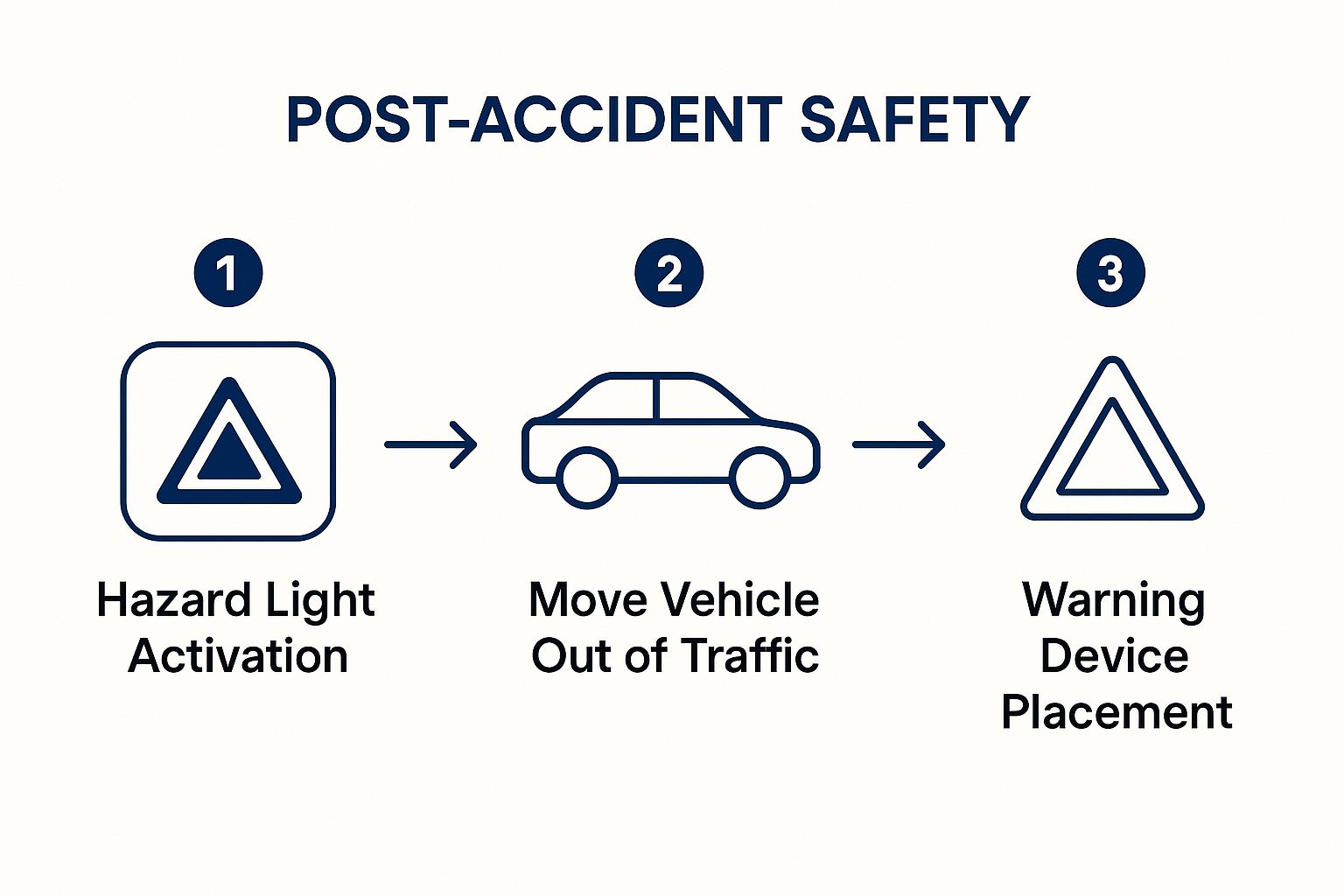
This step-by-step flow highlights that each action builds upon the last to create a progressively safer environment before you proceed with any other post-accident tasks.
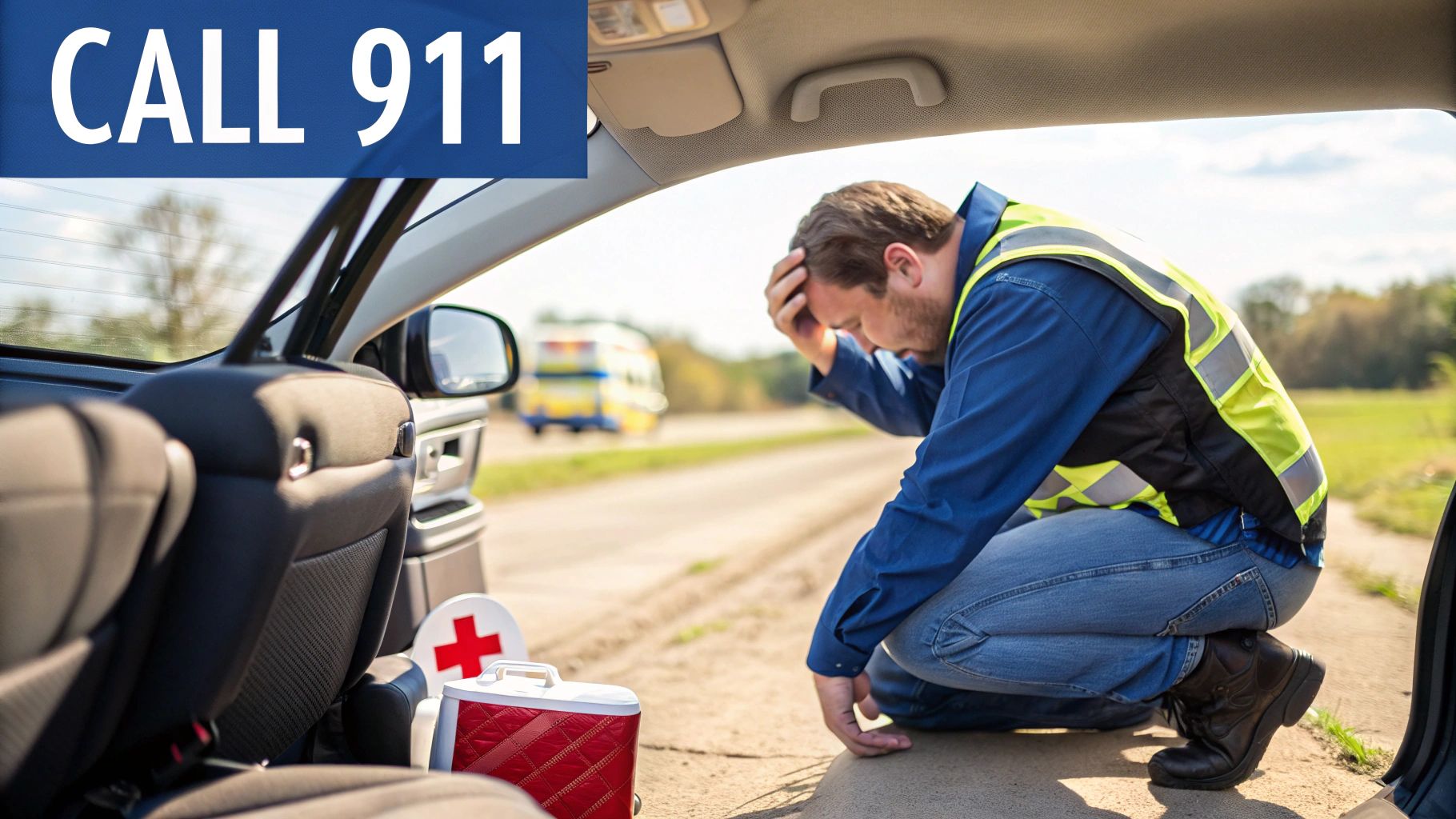
2. Check for Injuries and Call Emergency Services
After securing the scene, the next critical step in any car accident checklist is to immediately assess the physical well-being of everyone involved. Human health is the absolute priority, and the adrenaline surge from an accident can easily mask serious injuries. A systematic check for harm and a prompt call to emergency services are non-negotiable actions that protect all parties.
The shock of a collision can make it difficult to recognize symptoms. Injuries like concussions, whiplash, or internal bleeding often have delayed onset, so a person who claims to be "fine" might require medical attention. Calling 911 ensures that trained medical professionals can perform an on-site evaluation, and it also creates an official record of the incident, which is vital for any subsequent legal or insurance claims.
Prioritizing Medical Assessment
Before anything else, conduct a calm and methodical check. Start with yourself, then your passengers, and finally the occupants of the other vehicle or any pedestrians, if it is safe to do so. Ask direct questions like "Are you hurt?" or "Do you have any pain?" If anyone is unconscious, not breathing, or complaining of severe neck or back pain, do not move them unless they are in immediate danger, such as from a fire.
Even a seemingly minor incident warrants a professional medical opinion. In a low-speed rear-end collision, a driver might feel fine initially, only to develop debilitating neck and shoulder pain hours later. Similarly, the force from an airbag deployment in a side-impact crash can cause burns, chest contusions, or facial fractures that aren't immediately obvious.
When to Call and What to Document
A call to 911 is mandatory if anyone reports any level of injury, pain, or dizziness. When you speak to the dispatcher, provide your precise location, the number of people involved, and a description of any known injuries. This information helps them dispatch the appropriate resources.
- Accept Medical Attention: If paramedics suggest an evaluation, accept it. Refusing on-site care can be used by insurance companies to argue that your injuries were not caused by the accident.
- Document Everything: If possible, take photos of any visible injuries, like cuts or bruises, at the scene.
- Record Professional Details: Get the names and badge numbers of responding officers and the names or unit numbers of the paramedics who provide aid. This information is crucial for your records.
3. Call Police and Obtain Official Accident Report
After ensuring immediate safety, your next critical action is to contact law enforcement. Calling the police to the scene is a non-negotiable step in any car accident checklist, as it initiates the creation of an official, unbiased record of the event. This document is invaluable, serving as the primary source of factual information for insurance companies, legal teams, and any subsequent proceedings. It transforms a chaotic "he said, she said" situation into a documented incident with third-party validation.
The Importance of an Official Report
An official police report provides a neutral account of the accident, capturing essential details while they are still fresh. This includes witness statements, vehicle positions, road conditions, and any citations issued. This report is the bedrock of your insurance claim and potential legal action. For instance, in a multi-vehicle highway accident, an officer's report can provide a preliminary reconstruction of the crash sequence. Even in a seemingly minor parking lot fender-bender where fault is disputed, an officer’s documentation can be the deciding factor. In a hit-and-run scenario, it’s the official start of a criminal investigation.
Interacting with Law Enforcement
When the police arrive, your role is to provide clear, factual information. Stick to what you know and avoid speculating on causes or admitting fault.
- Be Prepared: When you call 911, state your location clearly and report any injuries. This ensures the right emergency services are dispatched promptly.
- Provide Facts, Not Opinions: Calmly explain your side of the story. Describe what you saw and did, but do not guess about the other driver's intentions or what caused the crash.
- Gather Key Information: Politely ask for the officers' names, badge numbers, and the official police report number. Also, inquire about the process for obtaining a copy of the final report.
- Review and Correct: If you overhear the officer making a factual error in their assessment, politely and respectfully correct it. For example, if they misstate the direction you were traveling, it's important to clarify.
4. Document the Scene with Photos and Detailed Notes
After ensuring everyone is safe and emergency services have been called, your next critical task is to become the primary investigator of your accident. Comprehensive documentation, captured immediately at the scene, serves as indisputable evidence for your insurance claim and any potential legal action. Memories fade and details become fuzzy under stress, but photographs and detailed notes provide an objective, time-stamped record of what happened. This step on your car accident checklist is vital because physical evidence can be cleaned up or altered within hours.
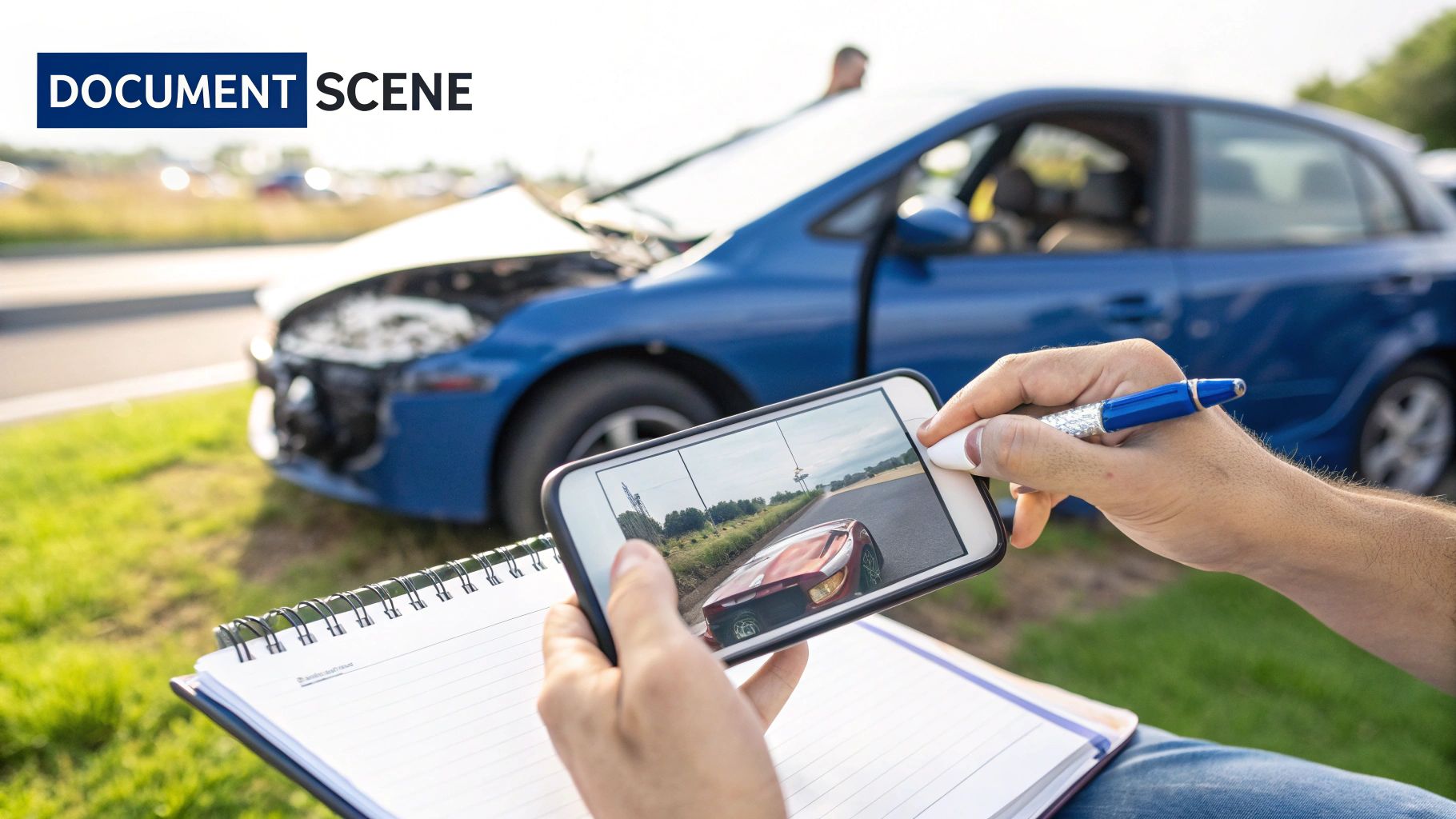
The evidence you gather creates a powerful narrative. For instance, in an intersection collision, photos showing the status of traffic lights or the presence of a stop sign can help establish right-of-way. If weather was a factor, images of icy roads or heavy rain document the conditions you faced. This visual proof can be the deciding factor in proving you were not at fault.
A Comprehensive Visual and Written Record
Use your smartphone to capture everything. Don't just take one or two pictures; be thorough and methodical. Your goal is to recreate the entire scene for someone who wasn't there.
- Capture a Wide View: Take photos from multiple distances, showing the overall context of the accident scene, including the final resting positions of the vehicles.
- Focus on the Details: Photograph the damage to all vehicles involved, making sure to get close-ups of specific impact points. Include the other vehicle's license plate in your shots.
- Document the Environment: Take pictures of skid marks, debris on the road, relevant traffic signs (speed limit, stop signs), and any road hazards like potholes or construction zones.
- Record with Video: A powerful and often underutilized tool is your phone's video recorder. Start a recording and walk around the scene, narrating exactly what happened while the details are fresh in your mind. This creates a compelling personal account to supplement your photos.
This meticulous documentation forms the foundation of a strong claim, providing your insurance adjuster and legal representative with the concrete evidence they need to advocate effectively on your behalf.
5. Exchange Information with All Parties Involved
After securing the scene and checking for injuries, the next critical step in any car accident checklist is to systematically exchange information with everyone involved. This process is not just a formality; it is the foundation of your insurance claim and any potential legal action. Failing to gather complete and accurate details can severely complicate or even derail your ability to receive fair compensation for damages and injuries.
The Protocol for Information Exchange
The objective is to collect a comprehensive record from every driver, passenger, and witness. This information becomes the official record of who was present and who is responsible for insurance coverage. Remain calm and methodical, but avoid discussing who was at fault. Admitting blame, even unintentionally, can be used against you later. Stick strictly to gathering the facts.
A multi-car pileup, for instance, requires diligent coordination to get details from every single driver. Similarly, an accident involving a commercial vehicle means you'll need the driver's personal information and their company's insurance policy details. Use your smartphone as your primary tool to ensure accuracy; photographing documents is faster and more reliable than handwriting them, especially when you are shaken up.
Key Information to Collect
Create a systematic checklist on your phone or a notepad to ensure you don't miss anything.
- From Other Drivers:
- Full Name, Address, and Phone Number
- Driver’s License Number and State
- Insurance Company Name and Policy Number
- License Plate Number, Make, Model, and Color of their Vehicle
- Vehicle Identification Number (VIN), usually visible on the dashboard or driver-side doorjamb
- From Passengers and Witnesses:
- Full Name and Contact Information (phone number and email)
- A brief note on what they saw from their perspective
Always verify the information provided. Ask to see the physical driver’s license and insurance card, and cross-reference the name on the registration with the driver's ID. This small step confirms you are dealing with the correct individual and not facing a fraudulent claim down the road.
6. Identify and Interview Witnesses
While evidence you gather from the scene is vital, an independent third-party account can be the single most powerful tool in resolving a disputed claim. Witness testimony provides an unbiased perspective that corroborates your version of events, making it a crucial component of a comprehensive car accident checklist. Insurance adjusters and legal teams often give significant weight to impartial statements, which can decisively shift a liability dispute in your favor.
Immediate Witness Protocol
Witnesses are not obligated to stay at an accident scene; they often leave within minutes. It is essential to act quickly to identify anyone who may have seen what happened. Your goal is to secure their contact details and a brief summary of their observations before they depart.
Approach potential witnesses calmly and politely. Explain that you were just in an accident and ask if they saw what occurred. People are generally willing to help if approached respectfully. Even a small piece of information, like who had the green light or which driver was speeding, can be invaluable. This immediate action prevents the loss of crucial, time-sensitive testimony.
Gathering Actionable Statements
When you find a willing witness, your objective is to collect accurate and useful information.
- Secure Contact Information: The most important details are their full name and phone number. An email address is also helpful.
- Record Their Account: Ask them to describe what they saw in their own words. Use your phone’s voice recorder (with their explicit permission) to capture their statement. This is often more detailed and natural than a rushed written note.
- Document Their Vantage Point: Ask exactly where they were standing or driving when they witnessed the collision. This context helps establish the credibility and clarity of their viewpoint. For example, a pedestrian on a corner has a different, and potentially better, view of an intersection than another driver two cars back.
By prioritizing this step, you are actively building a stronger foundation for your insurance claim and any potential legal action that may follow.
7. Contact Your Insurance Company Immediately
Once you have secured the scene and exchanged information, one of your next critical calls should be to your insurance provider. Promptly notifying your insurer initiates the claims process and demonstrates your commitment to fulfilling your policy obligations. This step is a cornerstone of any car accident checklist because it sets the wheels in motion for financial recovery and ensures you receive the support you are entitled to under your plan. Failing to report an accident in a timely manner can jeopardize your claim.
Kicking Off the Claims Process
Most insurance policies require you to report an accident as soon as it is reasonably possible, often within 24 hours. Early reporting allows your insurer to begin their investigation while the details are still fresh in everyone's mind and evidence is readily available. Beyond knowing who to call, it's vital to understand the implications of not having insurance at all, especially concerning car accidents.
Many modern insurers have streamlined this process with technology. For instance, Progressive's app allows for immediate photo uploads from the scene, while GEICO's mobile reporting tool can use your phone’s GPS to pinpoint the accident location. These features help create an accurate and immediate record of the event.
What to Have Ready and What to Say
To make the call efficient and effective, gather your information beforehand. Stick to the facts and avoid admitting fault or speculating on the cause of the collision.
- Be Prepared: Have your policy number, the police report number (if available), and the other driver's contact and insurance details on hand.
- Be Factual: Describe the date, time, location, and the basic sequence of events. State what you know, not what you think happened.
- Ask Key Questions: Inquire about your rental car coverage, any medical payment benefits (MedPay), and what your deductible will be.
- Get Your Claim Number: Before ending the call, ensure you have a claim number and the direct contact information for the adjuster assigned to your case. This number will be your reference for all future communications.
8. Keep Detailed Records and Follow Up on Medical Care
A successful insurance claim or legal case hinges on the quality of your documentation. After a collision, maintaining comprehensive records of every detail, from medical treatments to financial losses, transforms your experience from a personal memory into concrete evidence. This part of the car accident checklist is not just about paperwork; it's about building a solid foundation to ensure you are fully compensated for every loss you suffer.
The Importance of a Detailed Paper Trail
The days and weeks following an accident can be a blur of appointments and communications. Relying on memory alone is a recipe for missed details and undervalued claims. Start a dedicated file immediately, either physical or digital, to serve as a central repository for all accident-related documents. This organized approach prevents crucial evidence from being lost and demonstrates to insurance adjusters and legal professionals that you are diligent and serious about your claim.
A thorough record should document not only your injuries and property damage but also the full scope of how the accident has impacted your life. This includes everything from prescription receipts to mileage driven to physical therapy. For those suffering severe injuries like fractures, understanding the healing process is crucial; a well-documented recovery journey, including notes on what helps, can be invaluable. There are even helpful tips for faster fracture healing that can be integrated into your recovery plan and documented in your journal.
Creating Your Comprehensive Accident File
Your record-keeping should be meticulous and consistent. Track everything, no matter how minor it seems at the time.
- Document Medical Care: Keep every bill, report, prescription receipt, and appointment summary. Photograph receipts and reports as a digital backup.
- Log Financial Losses: Track lost wages with pay stubs and a letter from your employer. Also, log related expenses like vehicle storage fees or the cost of a rental car.
- Maintain a Personal Journal: Note your pain levels, physical limitations, and emotional state daily. This narrative provides powerful context to your medical records, illustrating your "pain and suffering."
- Track Related Mileage: Log the miles you drive to and from medical appointments, therapy sessions, and pharmacies. This is a reimbursable expense that adds up quickly.
Car Accident Checklist: 8-Step Comparison Guide
| Item | Implementation Complexity 🔄 | Resource Requirements ⚡ | Expected Outcomes 📊 | Ideal Use Cases 💡 | Key Advantages ⭐ |
|---|---|---|---|---|---|
| Ensure Safety First – Move to Safety and Turn on Hazard Lights | Low – immediate actions, simple steps | Minimal – hazard lights, emergency kit | Prevents secondary accidents; safe environment | All accidents requiring immediate scene safety | Reduces injury risk; visible warnings |
| Check for Injuries and Call Emergency Services | Medium – requires medical assessment skills | Moderate – phone, knowledge of injury signs | Early medical help; legal medical documentation | Accidents with possible injuries | Prevents complications; official records |
| Call Police and Obtain Official Accident Report | Medium – interaction with authorities | Low – phone access | Legal documentation; helps establish fault | Multi-vehicle or serious accidents | Provides unbiased report; required by insurers |
| Document the Scene with Photos and Detailed Notes | Medium – thoroughness needed | Moderate – smartphone or camera | Preserves evidence; supports claims and memory | All accidents where evidence clarity is needed | Visual proof; contradicts false claims |
| Exchange Information with All Parties Involved | Medium – requires communication under stress | Low – pen, paper, smartphone | Enables claims processing; multiple perspectives | Multi-vehicle or witness-involved accidents | Facilitates insurance/legal processes |
| Identify and Interview Witnesses | Medium – needs interpersonal skills | Low – recording device, notebook | Objective accounts; strengthens claims | Disputed or liability-focused accidents | Independent verification; fault establishment |
| Contact Your Insurance Company Immediately | Low – straightforward notification | Minimal – phone or app access | Starts claim process; policy compliance | All accidents requiring claims | Professional guidance; faster claim handling |
| Keep Detailed Records and Follow Up on Medical Care | High – ongoing and detailed documentation | Moderate – filing system, time investment | Comprehensive claims; tracks recovery and expenses | Injuries requiring treatment and recovery | Legal and financial support; recovery tracking |
Your Next Mission: Securing the Legal Support You Deserve
Navigating the immediate aftermath of a vehicle collision can feel like entering a chaotic, unfamiliar battlefield. The moments following an accident are disorienting, but by methodically working through the steps outlined in this car accident checklist, you reclaim control and establish a strong foundation for your recovery. From prioritizing immediate safety and calling for emergency assistance to meticulously documenting the scene and exchanging information, each action serves a critical purpose. Think of this checklist as your field guide, designed to bring order to a high-stress situation and protect your rights from the very start.
The value of this structured approach cannot be overstated. Following these steps ensures you do not miss vital details that could become crucial later. Obtaining an official police report, gathering witness statements, and taking comprehensive photos create an objective record of events. This evidence is your primary defense against inaccurate claims and is the bedrock upon which any successful insurance claim or legal action is built. Similarly, seeking immediate medical attention and maintaining diligent records of your care directly links your injuries to the accident, a connection that is essential for securing fair compensation.
From Checklist to Comprehensive Strategy
While this checklist equips you for the initial encounter, the subsequent campaign involves navigating complex insurance negotiations and potential legal challenges. This is where your mission shifts from immediate action to strategic planning. The information you've gathered is your ammunition, but knowing how to deploy it effectively requires expertise, especially for veterans. A new injury from a car accident can significantly impact existing service-connected disabilities and your VA benefits, adding a layer of complexity that standard personal injury firms may not fully grasp.
Mastering this car accident checklist is your first victory, but winning the war for fair compensation often requires reinforcements. You do not have to face insurance adjusters or opposing legal teams alone. The key takeaway is that your diligence in the first 48 hours is powerful, but it's most effective when paired with professional legal counsel who can translate your groundwork into a winning strategy. Securing this support is not a sign of weakness; it is a calculated, strategic move to ensure you receive the maximum compensation and benefits you are rightfully owed. This allows you to focus on what truly matters: your physical and mental recovery. Your service to the country has earned you the right to dedicated, expert support in your time of need.
Navigating the complexities of a personal injury claim while managing your VA benefits requires a specialized team. Homefront Group, a firm founded by veterans for veterans, understands this unique intersection and is ready to fight for you. Take our free, 3-minute quiz today to see how our network of experts can help you build a winning case and secure the compensation you deserve. Homefront Group