

Imagine the very place you call home—a place that's supposed to represent security and pride—is secretly making you sick. For over 30 years, this was the tragic reality for hundreds of thousands of U.S. Marines, their families, and civilian staff at Marine Corps Base Camp Lejeune. They were unknowingly drinking and bathing in highly toxic water, an exposure that ignited a public health crisis and a decades-long fight for justice.
That fight has finally led to a historic legal path for compensation, offering a measure of relief to those who suffered.
The Story Behind America's Worst Public Health Disaster
The crisis at Camp Lejeune is a slow-motion tragedy, a story of silent, invisible harm that unfolded over three long decades. From 1953 to 1987, the very water meant to sustain life on the base was dangerously laced with a cocktail of industrial solvents and other toxic chemicals. This wasn't a small-scale problem; it was a full-blown environmental catastrophe happening right on a U.S. military base.
Think about the daily routines of military life. Drinking from a water fountain after a run, preparing dinner for your family, bathing your children, or doing a load of laundry—all these simple acts became sources of long-term exposure to poisons. For the Marines focused on their duty and the families building a life there, the water was just water. They had no reason to believe it was anything but safe.
Where Did The Contamination Come From?
The contamination wasn't the result of a single leak but a perfect storm of environmental negligence. Two of the base's main water treatment plants, Tarawa Terrace and Hadnot Point, were pumping water from wells tainted by multiple sources. The primary culprits were volatile organic compounds (VOCs), chemicals notorious for their harmful effects on human health.
The contamination stemmed from a few key sources:
- An Off-Base Dry Cleaning Business: A nearby dry cleaner was improperly dumping industrial solvents, mainly tetrachloroethylene (PCE). This poison seeped into the groundwater and directly contaminated the Tarawa Terrace water system.
- On-Base Operations: The base itself was a major contributor. Leaking underground fuel tanks, spills at industrial sites, and waste disposal lots released a flood of chemicals. These activities introduced trichloroethylene (TCE), a solvent used to clean military equipment, into the Hadnot Point water supply.
This toxic combination meant that multiple contaminated streams fed the water distributed across the entire base, reaching barracks, family housing, schools, and even the hospital.
Understanding the Sheer Scale of the Contamination
To grasp the magnitude of this disaster, you have to look at the numbers. The water at Camp Lejeune wasn't just slightly tainted; it was extremely toxic. The levels of chemicals like PCE and TCE, along with benzene and vinyl chloride, were found at concentrations ranging from 240 to 3,400 times higher than safety standards allow.
This prolonged, high-level exposure is directly linked to the devastating health conditions that have plagued military personnel, their families, and civilian employees for years, including many types of cancer and other severe diseases. You can explore more about the impact of the contamination and see how early claims started to build on this issue.
The tragedy of Camp Lejeune is not just the presence of chemicals, but the violation of trust. Those who pledged to serve our country were unknowingly harmed by the very environment meant to support them.
The contamination was first discovered in the early 1980s, and the most polluted wells were finally shut down by 1985. But by then, the damage was done. Decades of exposure had already set the stage for a lifetime of health battles for up to one million people. This history is precisely why the Camp Lejeune water contamination settlement now exists—to offer a long-overdue path to justice.
How the PACT Act Opened the Door for Justice

For decades, the victims of Camp Lejeune's toxic water were caught in a cruel legal trap. Thousands of people developed horrific illnesses, but whenever they tried to seek justice, they hit a legal brick wall. Their claims weren't dismissed because they lacked merit; they were blocked by a specific legal technicality.
The culprit was a North Carolina law known as a statute of repose. Think of it as a rigid, non-negotiable deadline. This law stated that a lawsuit had to be filed within 10 years of the negligent act. In this case, the contamination—the negligent act—ended in 1987. By the time most people realized their cancer or Parkinson's disease was tied to the water they drank on base, that legal window had long since slammed shut.
This created a heartbreaking catch-22. Victims were undeniably sick, but because their diseases took years or even decades to develop, their legal rights had evaporated before they even knew they had a case. This roadblock effectively silenced an entire generation of Marines, their families, and civilian workers.
A Legislative Key Unlocks a Barred Door
This profound injustice finally came to an end with the passage of the Honoring our PACT Act of 2022. Tucked inside this massive piece of legislation was a critical provision: the Camp Lejeune Justice Act (CLJA). This act served as a master key, finally unlocking the courthouse doors that had been barred for so long.
Essentially, the CLJA created a brand-new, direct legal path for victims to sue the U.S. government for the harm they endured. It specifically overrode the restrictive North Carolina statute, giving victims a fresh, two-year window to file their claims. This was a monumental shift that finally acknowledged the government’s failure to protect those who served.
The PACT Act is more than just a law; it’s a promise kept. It acknowledges the government's responsibility and provides a concrete mechanism for accountability, ensuring that veterans and their families are no longer silenced by legal technicalities.
How the Camp Lejeune Justice Act Works
The CLJA doesn't just open the door; it changes the rules of engagement once you’re inside. It establishes a new cause of action, allowing individuals to seek damages in federal court. To build a successful case, you must show a clear connection between your health condition and the contaminated water.
Thankfully, the law also lowers the burden of proof. Claimants only need to show that it is "at least as likely as not" that their illness was caused by the exposure. This is a much more forgiving standard than what’s typically demanded in complex civil lawsuits, recognizing the unique challenges of proving a case decades after the fact.
This situation is truly one of the most significant environmental health disasters tied to a military installation anywhere in the world. The contamination, spanning from 1953 to 1987, exposed countless people to life-altering chemicals and has completely reshaped the conversation around government accountability. You can explore the full history of the Camp Lejeune contamination on Wikipedia to understand its staggering scope.
Ultimately, the PACT Act and the CLJA are the very foundation of every Camp Lejeune water contamination settlement. Without this groundbreaking legislation, the thousands of claims and lawsuits now underway simply wouldn't exist. It gave a voice and legal standing to victims who had been wrongfully denied both for far too long.
Determining Your Eligibility for a Claim

So, how do you know if you qualify to file a claim under the Camp Lejeune Justice Act (CLJA)? It really boils down to two key questions. Think of it as needing to check two specific boxes to move forward with a Camp Lejeune water contamination settlement.
First, were you there? And second, did you get sick? To have a valid claim, you have to prove both exposure to the contaminated water and a qualifying health condition. Let's unpack what these requirements actually mean for you and your family.
The Exposure Requirement: The 30-Day Rule
The first part of the test is all about your physical presence on the base. To be eligible, you must have lived, worked, or otherwise been exposed to the water at Camp Lejeune for a total of at least 30 days.
It's important to know that these 30 days don't have to be all at once. The rule is about cumulative exposure. Maybe you were there for a 15-day training exercise one year and came back for another 15-day stint later on. That counts. As long as the total time adds up to 30 days or more, you meet this part of the requirement.
The window for this exposure is very specific: it must have happened between August 1, 1953, and December 31, 1987. This period is when the base's water supply was known to be dangerously contaminated. This applies to everyone—Marines, their families, civilian contractors, and even children who were exposed while in the womb.
The Health Condition Requirement: Linking Illness to Exposure
Just being on the base isn’t enough; you also have to connect your time there to a specific health problem. You must have been diagnosed with a medical condition that is plausibly linked to the toxic chemicals found in Camp Lejeune's water. The government has acknowledged that these contaminants can cause a host of devastating illnesses.
For some of these illnesses, the scientific connection is so strong that the Department of Veterans Affairs (VA) has designated them as "presumptive conditions." If you've been diagnosed with one of these, proving your case becomes much more straightforward.
What's a "presumptive condition"? It means the VA has already done the homework and officially recognizes the link between the contaminated water and certain diseases for veterans seeking benefits. For a CLJA claim, this creates a powerful foundation, making it much easier to argue your illness was caused by the exposure.
Don't worry if your diagnosis isn't on that specific list. It absolutely does not disqualify you. Many other serious health issues have been scientifically tied to these chemicals. You’ll just need to provide more robust evidence to draw that line between your diagnosis and your time at Camp Lejeune.
What Are the Presumptive Conditions?
The VA has identified a core group of diseases with a recognized presumptive link to the contamination. While this list was originally created for VA disability benefits, it serves as a powerful starting point for CLJA claims. Anyone with one of these diagnoses has a very strong basis for their case.
The table below outlines the conditions the VA has formally recognized.
Presumptive Health Conditions Linked to Camp Lejeune Water
| Condition Category | Specific Illnesses |
|---|---|
| Cancers | Adult leukemia, Bladder cancer, Kidney cancer, Liver cancer, Multiple myeloma, Non-Hodgkin's lymphoma |
| Other Serious Diseases | Aplastic anemia and other myelodysplastic syndromes, Parkinson's disease |
Beyond these eight presumptive conditions, scientific evidence links the chemicals at Camp Lejeune to a much broader range of illnesses. These include, but are certainly not limited to:
- Breast cancer
- Esophageal cancer
- Lung cancer
- Female infertility
- Hepatic steatosis (fatty liver disease)
- Scleroderma
- Renal toxicity
- Neurobehavioral effects
If your illness isn't on the presumptive list, don't lose hope. This is where an experienced attorney can make all the difference. They can help gather the medical records and scientific research needed to build a convincing case showing your health problems are a direct result of the toxic water. The legal standard set by the CLJA is to show it is "at least as likely as not" that the exposure caused your condition, and that's a burden of proof that can often be met with the right evidence.
The Step-By-Step Claim Filing Process
Navigating a Camp Lejeune water contamination claim can feel like you're staring at a mountain of legal paperwork. It’s intimidating, I get it. But we can break it down into a clear, step-by-step path that makes a lot more sense. Think of it as a roadmap: first, an administrative claim, and then, if needed, a formal lawsuit.
The whole journey kicks off with an administrative claim. This isn't optional—it's a required first step under the Camp Lejeune Justice Act (CLJA). You can't just march into court. You first have to put the government on notice and give them a chance to make things right. This initial phase is critical; it lays the entire groundwork for your case.
Step 1: Gathering Your Evidence
Before you file a single form, you need to gather your proof. Your job is to build a case file that tells a clear story, connecting your time at Camp Lejeune to the toxic water and, ultimately, to the health issues you're facing today.
You’ll need to track down a few key types of documents:
- Proof of Presence: First, you have to show you were on the base for at least 30 cumulative days between August 1953 and December 1987. Military service records like your DD-214 are perfect for this, but base housing records, old pay stubs, or even utility bills can also work.
- Medical Records: This is the heart of your claim. Collect every piece of paper related to your diagnosis, treatments, and prognosis. These records are the concrete evidence of the harm you’ve suffered.
- Proof of Causation: While the CLJA makes it easier to connect your illness to the water, you still need to build that bridge. A letter or statement from your doctor linking your condition to toxic chemical exposure can be incredibly powerful and really strengthen your claim.
This infographic gives a great visual breakdown of how to get your claim rolling.
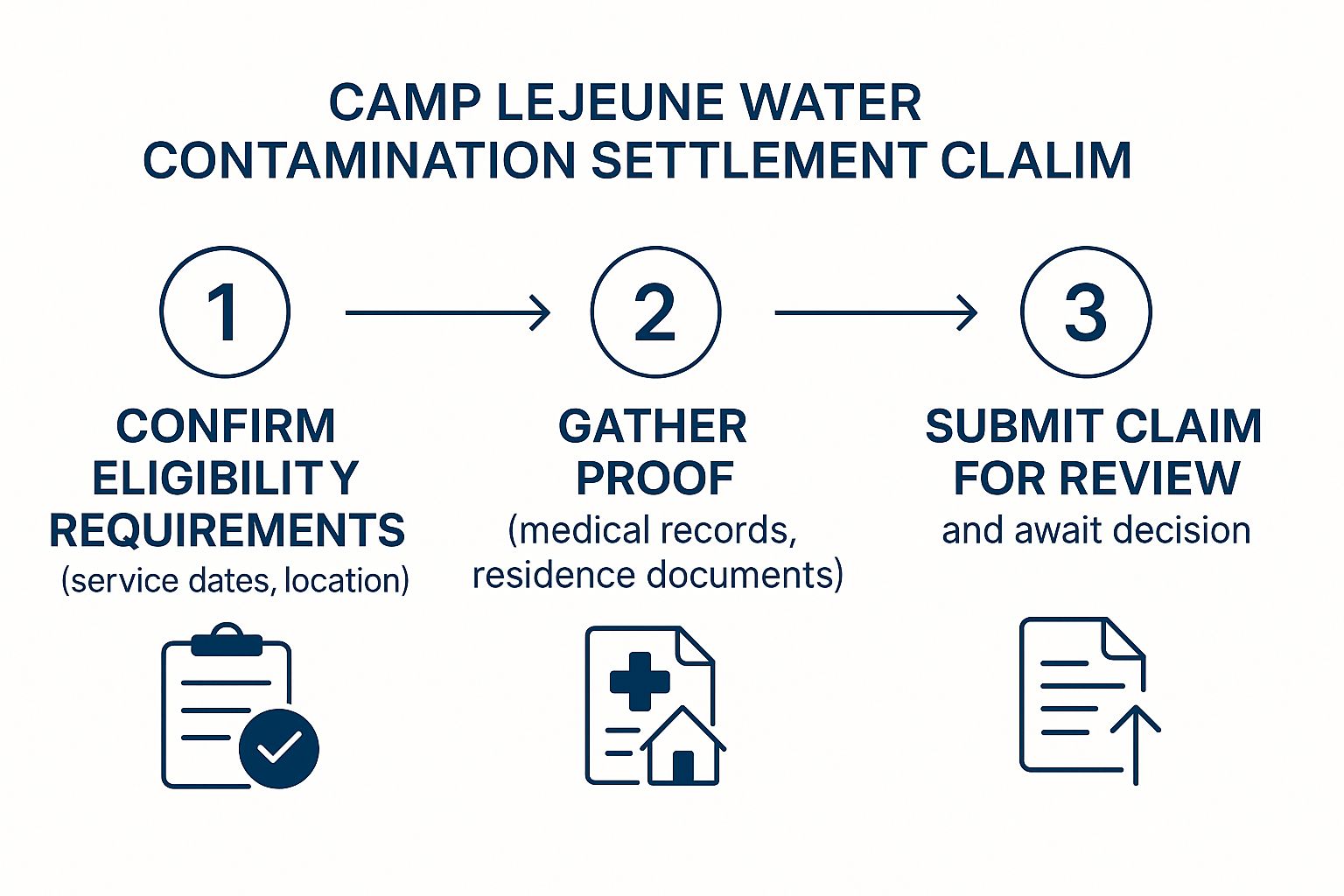
As the graphic shows, it all starts with confirming you're eligible, then shifts to collecting those vital documents before you formally submit your claim.
Step 2: Filing the Administrative Claim
With your evidence in hand, you're ready to file your official administrative claim with the Department of the Navy. They are the "appropriate federal agency" tasked with handling these cases. The claim form will lay out your story: your exposure, your diagnosis, and the specific compensation you're seeking.
Filing this claim is what officially starts the clock.
Once submitted, the government has a strict six-month (180-day) window to review your claim. They can approve it and offer a settlement, or they can deny it.
During these six months, your file is under review. Officials will look over your evidence to see if you meet the criteria for a Camp Lejeune water contamination settlement. It’s a waiting game, really, while the government decides on its opening move.
Step 3: Navigating the Outcome and Filing a Lawsuit
What happens after that six-month review period is where things really start to move. A few things can happen. Best-case scenario? The government makes a settlement offer, which you and your attorney will carefully review.
Unfortunately, what we often see is the government either denying the claim or simply letting the 180-day deadline pass without a word.
If your claim is denied or ignored, your next move is to file a lawsuit. This is your right. Your case then moves from the administrative level into the court system. All CLJA lawsuits are filed in a specific court—the U.S. District Court for the Eastern District of North Carolina, which has exclusive jurisdiction.
Filing a lawsuit empowers your attorney to fight for you more aggressively through legal discovery and, if it comes to it, a trial. For so many veterans and their families, taking this step is absolutely necessary to get a fair result. Having an experienced legal team, like the folks at Homefront Group, to walk you through this entire process is invaluable.
How Settlement Compensation Is Calculated
For so many people affected by this tragedy, the first question is always the same: "What is my claim actually worth?" It’s a completely fair question, but the answer isn't simple. Compensation for a Camp Lejeune water contamination settlement isn't a one-size-fits-all number. Every person's story is different, and the final amount depends on deeply personal factors.
It's best to think of a settlement less like a fixed price tag and more like a detailed assessment of your individual losses. The value is calculated by looking at several key pieces of the puzzle: the specific illness you developed, how severe it is, how long you were exposed to the contaminated water, and the total impact it's had on your life. This covers everything from the financial bills to the personal suffering that doesn't have a clear price.
The Core Factors That Determine a Settlement’s Value
When the government or a court figures out what's fair, they're looking at a combination of factors. These generally fall into two main buckets: economic and non-economic damages.
-
Economic Damages: These are the straightforward, calculable financial hits you’ve taken. Think of things like all your medical bills (both past and future), any wages you lost because you couldn't work, and even the loss of future earning ability if your illness has permanently impacted your career.
-
Non-Economic Damages: This part is tougher to put a number on, but it’s just as real and just as important. It’s about the profound personal toll of your illness—the physical pain and suffering, the emotional distress, the loss of enjoyment in life, and for a spouse, the loss of companionship.
In tragic cases of wrongful death, the calculation also has to include things like funeral expenses and the financial support the person would have provided for their family over a lifetime.
The Elective Option: A Faster Path to Compensation
To help get money to victims more quickly and avoid clogging the courts for years, the Department of Justice and the Department of the Navy came up with a voluntary program called the Elective Option (EO). It's a faster payout system for people with specific, well-documented health conditions known to be strongly linked to the contaminated water.
The EO works on a tiered payment system. Your claim's placement on that tier depends on two main things: your specific diagnosis and the amount of time you spent at Camp Lejeune. It’s a way to create a more predictable and quicker route to a settlement for those who qualify and decide it's the right choice for them.
The whole point of the Elective Option is to get money into the hands of the sickest victims faster. The payouts might be less than what you could potentially win in a full lawsuit, but it offers certainty and helps you avoid the immense stress and time commitment of a trial.
Even so, it's not a fit for everyone. The government has confirmed that as of early 2025, only about 12% of the nearly 401,000 administrative claims filed so far even mention an injury that would qualify under the EO framework. This tells us that while the EO is a useful option for some, the vast majority of cases will likely be resolved through individual negotiations or by going to court.
To give you a clear picture of how this works, the table below shows the specific conditions and payment amounts offered through the Elective Option.
Elective Option Settlement Tiers and Qualifying Conditions
| Tier | Qualifying Conditions | Potential Compensation Range |
|---|---|---|
| Tier 1 | Kidney Cancer, Liver Cancer, Non-Hodgkin's Lymphoma, Leukemias, Bladder Cancer | $150,000 (30-364 days of exposure) to $300,000 (365+ days of exposure) |
| Tier 2 | Multiple Myeloma, Parkinson's Disease, Kidney Disease (End-Stage Renal Disease), Systemic Sclerosis/Scleroderma | $100,000 (30-364 days of exposure) to $250,000 (365+ days of exposure) |
This table lays out the government's pre-set offers. It's crucial to remember that taking an EO payment is a choice. You always have the right to reject the offer and pursue a traditional lawsuit, where your potential compensation could be higher—though it's never guaranteed. This is a big decision, and talking it over with an experienced Camp Lejeune lawyer is the best way to figure out what makes the most sense for you and your family.
Why an Experienced Attorney Is Your Best Ally
You might be wondering if you can just file a Camp Lejeune claim yourself. Technically, yes, you can. But in reality, trying to do so is like navigating a legal minefield blindfolded. The Camp Lejeune Justice Act created a specific, complex process with unforgiving deadlines, strict rules about evidence, and a government ready to defend its position.
For most victims, going it alone is a huge gamble. It's a risk that could easily end with a denied claim or a settlement that falls far short of what you truly deserve.
Working with a seasoned attorney isn't just about getting help with paperwork; it's about leveling the playing field. Lawyers who specialize in these types of toxic exposure cases bring a specific skill set to the table—one you simply can't gain overnight. They know exactly what it takes to build a successful Camp Lejeune water contamination settlement claim from the very beginning.
Building Your Strongest Possible Case
The real value of a lawyer shines through when it's time to gather proof. They have the experience to dig up military service records from decades ago, track down the specific medical files that matter, and bring in expert witnesses who can connect the dots between your health condition and the contaminated water.
Your legal team's job is to:
- Create a rock-solid timeline proving you were at Camp Lejeune during the contamination period.
- Assemble a complete medical history that documents the full impact of your illness.
- Anticipate and challenge the government's defense tactics, which are often designed to drag out the process and pay as little as possible.
They take all the legal headaches and communications with the Department of Justice off your plate. This frees you up to focus on what actually matters: your health and your family.
The government isn't treating these claims like an apology for past mistakes. They are fighting them aggressively, just like a major corporation would. An attorney ensures you aren't outmatched or intimidated.
Understanding the Contingency Fee Model
Of course, the first question on many people's minds is, "How can I afford a lawyer?" This is where the contingency fee model makes justice accessible to everyone. In simple terms, it means you pay absolutely nothing out of your own pocket to get started.
Your lawyer only collects a fee if they win your case, either through a settlement or a court award. That fee is a pre-determined percentage of the final amount you receive. This system allows every single victim, no matter their financial situation, to have a top-notch legal expert fighting for them without any risk. You have nothing to lose and a dedicated ally to gain.
Common Questions About the Camp Lejeune Settlement
It’s completely normal to have questions when you're dealing with something as complex and personal as the Camp Lejeune water contamination settlement. Let's walk through some of the most common concerns we hear from veterans and their families.
Can I File a Claim for a Family Member Who Has Passed Away?
Yes, you can. It's a heartbreaking reality that many who were exposed have since passed away from illnesses linked to the contaminated water.
If your loved one lived or worked at Camp Lejeune between 1953 and 1987 and died from a related condition, their legal representative can file a wrongful death claim. This allows the family, through the deceased's estate, to pursue the compensation their loved one was entitled to.
Will This Settlement Affect My VA Benefits?
This is a big one, and the short answer is no—this settlement won't cancel your VA benefits. However, the way the law is written involves something called an "offset."
Think of it this way: any award you receive from a Camp Lejeune settlement will be reduced by the amount the government has already paid for that same illness through the VA, Medicare, or Medicaid. It’s designed to prevent being paid twice for the same injury, but it absolutely does not cancel your ongoing or future VA benefits.
What Is the Final Deadline to File a Claim?
This is the most time-sensitive detail you need to know. The PACT Act, which made these claims possible, set a firm, unmovable deadline.
You must have your administrative claim officially filed by August 10, 2024. If you miss that date, you unfortunately lose your right to seek compensation under this act forever. Time is truly of the essence.
The legal road ahead for a Camp Lejeune claim can feel overwhelming, but you don't have to walk it alone. The Homefront Group is here to guide veterans and their families toward the justice they've long deserved. Take our 3-minute quiz today to see how we can help you with your claim.