
Navigating the VA Rating System: Why Appeals Matter Now
Many veterans find their VA disability rating doesn't accurately reflect the impact of their service-connected conditions. This can result in inadequate compensation and a sense of unfairness. Understanding how the VA calculates these ratings is the first step toward securing a more appropriate rating. This involves recognizing the key difference between individual condition assessments and combined ratings.
The VA doesn't simply add individual ratings together. Instead, they employ a complex system that considers the impact of each condition on the veteran's remaining healthy percentage.
For example, a veteran with a 50% rating for one condition and a 30% rating for another won't receive a combined rating of 80%. The 30% rating is applied to the remaining 50% considered healthy after the first condition, resulting in a combined rating of 65%. This nuanced calculation method means even a small increase in an individual rating can significantly affect the overall combined rating and monthly compensation.
This is why appealing for even a seemingly minor increase can make a substantial difference. Appealing a VA disability rating isn't solely about increasing the percentage; it's about accurately representing the impact of your conditions on your quality of life.
Understanding VA Compensation Rates
When veterans appeal their VA disability ratings, understanding the compensation rates and their calculation is vital. The VA determines ratings by considering each condition's impact on the veteran's health. For example, in 2025, a veteran with a 10% disability rating receives $175.51 monthly, while a 20% rating yields $346.95.
This calculation involves percentages of percentages, ensuring each additional condition affects the overall rating based on the veteran's remaining healthy percentage. Therefore, when appealing, veterans must consider how each service-connected condition contributes to their overall rating and compensation. The 2025 cost-of-living adjustment (COLA) is 2.5%, impacting these rates. More detailed statistics are available on the VA website. This highlights how even small adjustments can compound over time.
When to Consider Appealing
So, when is appealing the right choice? Several indicators suggest your rating deserves reconsideration. These include worsening symptoms, new diagnoses related to existing service-connected conditions, or a clear disconnect between your current rating and its actual impact on your daily life.
However, appealing isn't always the best approach. Sometimes, alternatives like filing a supplemental claim with new evidence are more effective. Understanding the nuances of the VA rating system empowers you to make informed decisions about the best strategy for your situation.
Mastering The Appeals Process: Your Strategic Roadmap
Beyond the often confusing terminology, the VA appeals process is a system that thousands of veterans successfully navigate each year. This section breaks down the complexities of appealing a VA disability rating into actionable steps. We'll explore the different options available under the Appeals Modernization Act, from Supplemental Claims to Higher-Level Reviews and Board Appeals. We'll use real-world examples to illustrate the most effective routes for various situations. We'll also cover important timelines, effective methods for tracking your appeal's status, and common issues that can cause delays.
Understanding Your Appeal Options
The Appeals Modernization Act offers three main avenues for appealing a VA disability rating:
-
Supplemental Claim: This option is best when you have new and relevant evidence to support a higher rating. For example, if your condition has worsened since your initial claim, a Supplemental Claim allows you to submit updated medical records, new diagnoses, or reports from specialists.
-
Higher-Level Review: If you think the initial decision contained a factual error, such as a misinterpretation of medical evidence or an incorrect application of rating criteria, a Higher-Level Review may be the right choice. This involves a senior VA claims adjudicator reviewing your case. You do not need to submit new evidence for a Higher-Level Review.
-
Board Appeal: A Board Appeal involves requesting a hearing before the Board of Veterans’ Appeals. This is often the most suitable route for complex cases or when previous appeals haven't been successful. A Board Appeal allows you to present your case to a Veterans Law Judge and submit new evidence.
Selecting the correct path is crucial for improving your chances of a successful outcome.
The Appeals Process: A Step-by-Step Guide
The infographic below provides a general overview of the process for appealing a VA disability rating.
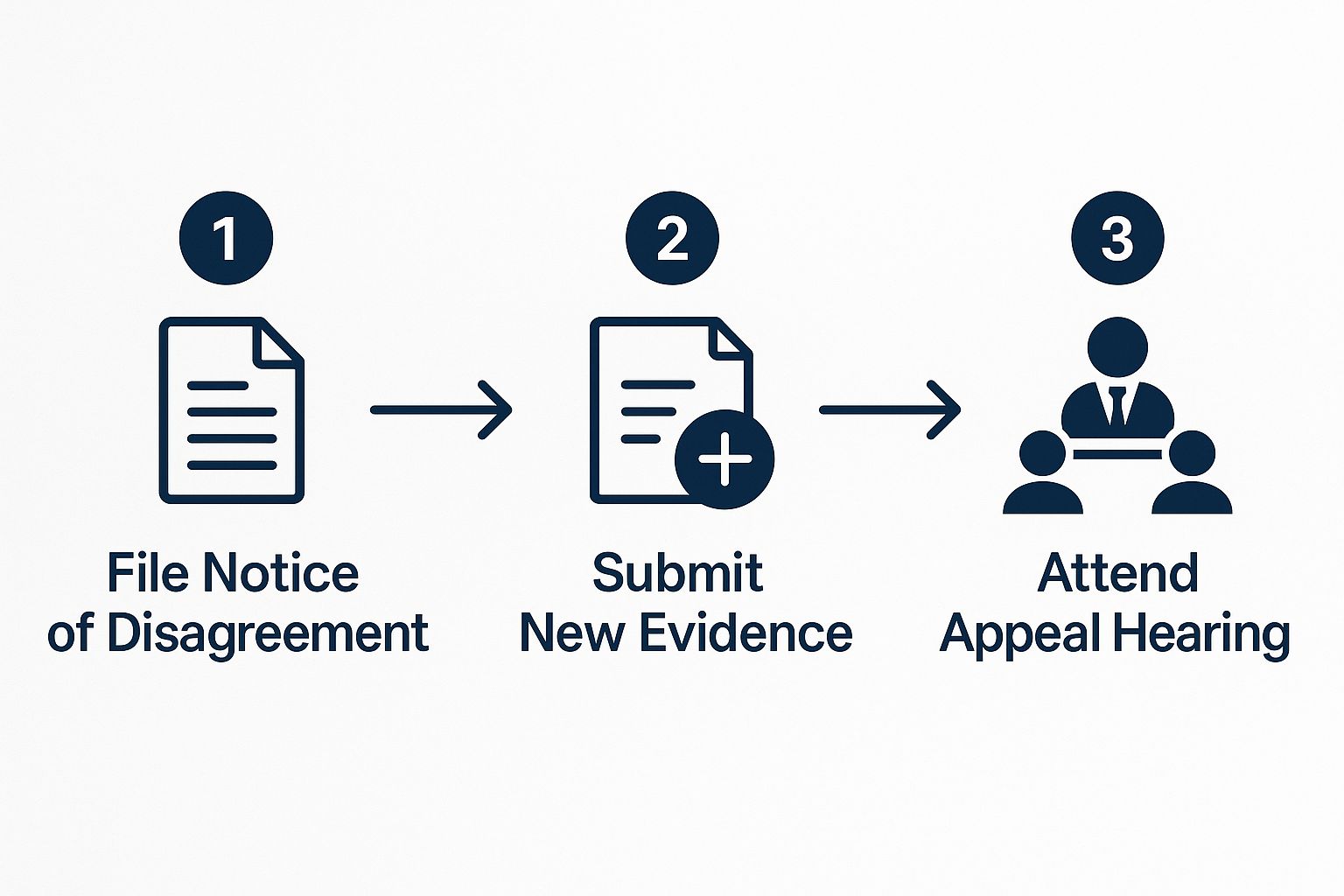
This visual representation illustrates the three key steps in many appeals: filing a Notice of Disagreement, submitting new and relevant evidence, and attending a hearing. While the specifics may vary depending on your situation, these steps form the basis of most successful appeals.
Timelines, Tracking, and Strategic Decision Points
Appealing a VA disability rating can be a time-consuming process. Understanding the larger picture can help support your appeal. Thinking about how an Integrated Marketing Strategy works can offer useful perspectives. It's important to be prepared for potential delays and to monitor the status of your appeal. The VA offers online tools and resources to track your claim's progress. Staying organized and communicating effectively with the VA are essential for preventing unnecessary hold-ups.
The appeals process often requires patience and involves submitting additional evidence to support your claim for a higher rating. Veterans can get help from advocates or attorneys. According to historical data, the VA has been trying to make the appeals process more efficient, working to reduce wait times and improve processing. However, delays are still common. Being aware of the current compensation rates is essential during this time.
Unwritten Rules and Insider Tips
In addition to the formal procedures, understanding some less obvious aspects of the appeals process can greatly affect the outcome. Presenting a clear and concise narrative that connects your service, your condition, and its effect on your life is key. Making sure your medical evidence aligns with the VA’s rating criteria is critical for showing the severity of your disability. Learning from the experiences of other veterans who have successfully navigated the appeals process can also offer valuable insights.
Building an Irrefutable Evidence Package for Your Appeal
The success of your VA disability appeal often depends on the quality of your evidence, not just the quantity. This means strategically gathering and presenting documentation that strongly supports your claim for a higher rating. This goes beyond simply submitting medical records. It requires a comprehensive approach connecting your service, your condition, and its impact on your life.
Leveraging Key Evidence Types
Several types of evidence can strengthen your appeal. Disability Benefits Questionnaires (DBQs) are valuable tools designed to collect specific information about your condition. Completed by medical professionals, DBQs offer a standardized format the VA recognizes.
Additionally, compelling Independent Medical Opinions (IMOs) from specialists can provide expert perspectives that reinforce your claims, especially for complex conditions. These IMOs offer an unbiased, professional evaluation of your disability and its connection to your service.
- DBQs: Standardized forms completed by healthcare providers
- IMOs: Expert medical opinions supporting your claim
The Power of Personal Accounts
Symptom journals also play a vital role. These journals provide a detailed record of your symptoms, their severity, and their impact on your daily life. For example, a veteran experiencing chronic pain might document the frequency, duration, and intensity of pain episodes, along with how it affects sleep, mobility, and the ability to perform daily tasks.
Lay statements provide valuable firsthand accounts from family, friends, or colleagues about how your disability affects you. For instance, a spouse might describe how a veteran’s PTSD impacts their sleep, social interactions, and ability to handle stress. These statements should be specific, focusing on observable behaviors and impacts.
- Symptom Journals: Detailed records of your symptoms and their effects
- Lay Statements: Firsthand accounts from family and friends
To illustrate the effectiveness of different evidence types, consider the following table:
Evidence Types for VA Disability Appeals
| Evidence Type | Effectiveness Rating | Best For | How To Obtain |
|---|---|---|---|
| Medical Records | Medium | Establishing a diagnosis | Request from your healthcare providers |
| DBQs | High | Providing specific details about a condition | Request from a healthcare provider familiar with VA disability claims |
| IMOs | High | Complex cases or disagreements with the VA | Consult with an independent medical professional |
| Symptom Journals | Medium | Showing the impact of symptoms on daily life | Maintain a consistent, detailed log of your symptoms |
| Lay Statements | Medium | Corroborating the impact of your disability | Request from family, friends, or colleagues |
| Service Records | High | Connecting your condition to your service | Request from the National Archives |
This table summarizes the various types of evidence and their potential impact on your appeal. By understanding the strengths of each type, you can build a stronger case.
Specialized Approaches for Challenging Conditions
Many conditions, such as mental health disorders, chronic pain, and those with fluctuating symptoms, can be particularly challenging to document. Traditional medical records often fail to capture their full scope. Therefore, specialized evidence strategies are essential.
For mental health conditions, detailed descriptions of the frequency, intensity, and duration of symptoms are crucial. Lay statements from therapists, counselors, or support group leaders can offer valuable perspectives. For chronic pain, documentation should focus on the functional limitations and its impact on daily activities. This might include records of physical therapy, pain management programs, or mobility limitations.
Conditions with fluctuating symptoms require careful documentation of the frequency and severity of flares. Symptom journals and medical records corroborating these fluctuations can be particularly useful in demonstrating their unpredictable nature and overall impact.
Organizing Your Evidence for Maximum Impact
Presenting your evidence clearly and organized is as important as the evidence itself. This includes using a table of contents, clearly labeling each document, and ensuring accuracy and current information. A well-organized package not only simplifies the VA's review but also demonstrates your commitment to a successful appeal. This meticulous approach can significantly improve your chances of achieving a favorable outcome.
Understanding the Real Financial Impact of Successful Appeals

Appealing a VA disability rating is often done with the goal of improving a veteran's financial well-being. A successful increase in your rating can bring about significant financial changes that go beyond a simple increase in monthly compensation. Understanding the key events affecting your claim, such as an inciting incident, can significantly impact your finances. This section clarifies how these changes translate into real-world financial advantages, providing a better understanding of the benefits a successful appeal can offer.
Calculating the Increase in Monthly Compensation
One of the most direct financial impacts of a successful appeal is the increase in your monthly payments. The amount of this increase correlates directly with the change in your disability rating. For example, moving from a 50% rating to a 70% rating results in a substantial rise in monthly compensation.
However, it's important to remember that dependents, such as a spouse or children, also affect the total compensation amount. This means a veteran with dependents will receive more each month than a veteran with the same disability rating but no dependents.
Accurately calculating these amounts is essential to fully grasping the financial implications of your appeal.
Retroactive Payments: A Significant Financial Boost
Another key financial benefit of a successful appeal is the potential for retroactive payments. These payments cover the time between the effective date of your increased rating and the date you receive the decision. This can amount to a considerable lump sum, providing much-needed financial relief and stability.
For example, if your appeal process took two years and resulted in a higher rating effective one year earlier, you would receive a retroactive payment for that one-year period. These lump sums can be used to pay off debts, invest for the future, or simply bolster your financial security.
To help illustrate the financial difference between various disability ratings, let's look at the following table:
VA Disability Rating Financial Comparison
This table shows the financial difference between disability rating levels, including monthly compensation amounts and additional benefits. Note: These figures are for illustrative purposes only and should not be considered official. Consult the VA website for the most up-to-date compensation rates.
| Disability Rating | Monthly Compensation | With Spouse | With Spouse & Child | Additional Benefits |
|---|---|---|---|---|
| 10% | $165.92 | $182.19 | $194.09 | Generally not eligible for additional benefits |
| 30% | $466.49 | $514.09 | $543.04 | May be eligible for some additional benefits |
| 50% | $967.84 | $1,050.46 | $1,105.66 | Often eligible for additional healthcare and educational benefits |
| 70% | $1,546.81 | $1,668.36 | $1,748.85 | Increased access to healthcare and other benefits |
| 100% | $3,621.95 | $3,922.88 | $4,117.14 | Full range of benefits, including healthcare, education, and housing assistance |
As you can see, the financial impact of different disability ratings can be substantial. Higher ratings not only lead to increased monthly payments but also open doors to additional benefits.
Cascading Benefits of a Higher Rating
Beyond the immediate financial gains, a higher disability rating can unlock a range of additional advantages. These may include greater access to healthcare services through the VA, enhanced educational opportunities, and various state-level benefits.
These additional benefits further enhance the overall financial impact, lowering out-of-pocket expenses and improving quality of life. Understanding these potential benefits can help you make informed decisions about pursuing an appeal and seeking professional representation. Learn more about the financial impact of VA disability ratings.
By considering the complete financial picture, you can accurately evaluate the potential value and return of appealing your VA disability rating. The potential increase in monthly compensation, combined with retroactive payments and additional benefits, can create significant positive change in your financial well-being. Veterans often appeal their ratings to secure this improved financial footing, particularly those with higher ratings and dependents. The financial benefits can be especially impactful for veterans rated 30% or higher with dependents. For example, in 2025, the monthly rate for a veteran with a 100% disability rating increased by $93.45 due to the 2.5% COLA (Cost of Living Adjustment). This highlights the importance of accurate initial ratings and the potential gains from successful appeals.
Choosing Your Advocate: VSOs, Attorneys, and Claims Agents
Securing a favorable VA disability rating often depends on the quality of your representation. Choosing the right advocate can significantly influence your appeal's outcome. This section offers an unbiased comparison of your options, from the free support of Veterans Service Organizations (VSOs) to contingency-fee attorneys and independent claims agents. We'll explore their strengths, weaknesses, and when each type is most effective.
Veterans Service Organizations (VSOs)
VSOs offer free assistance to veterans navigating the VA system. Organizations like the American Legion, Disabled American Veterans (DAV), and Veterans of Foreign Wars (VFW) provide trained advocates to assist with the appeals process.
- Advantages: Free service, vast experience with VA claims, and often have local offices for convenient access.
- Limitations: High caseloads can result in less individualized attention, and they may not possess the in-depth legal expertise needed for complex appeals.
VSOs are a great starting point, especially for straightforward appeals or for veterans new to the VA system. However, for appeals involving intricate legal questions, other options may be more appropriate.
Attorneys: Legal Expertise for Complex Appeals
Attorneys specializing in VA disability law bring legal expertise to your appeal. They are prepared to manage complex cases, represent you at hearings, and challenge unfavorable decisions. They typically work on a contingency-fee basis, meaning they are paid only if your appeal is successful.
- Advantages: Extensive legal knowledge, ability to provide robust representation, and payment only upon a successful outcome.
- Limitations: Contingency fees can be significant, and finding an attorney with experience specific to your disability is crucial.
Attorneys are often a good choice for appeals involving intricate medical conditions or legal questions. They can deliver the focused legal guidance needed to navigate complicated procedures and protect your rights.
Claims Agents: Independent Advocacy
Claims agents are independent advocates who help veterans with their VA claims. They often possess a background in VA procedures and can offer individualized support. Similar to attorneys, they often work on a contingency fee basis.
- Advantages: Personalized service, focused specifically on VA claims, and they present an alternative to VSOs and attorneys.
- Limitations: Varying levels of expertise make verifying their credentials and experience essential.
Claims agents can be a suitable choice for veterans seeking personalized support without needing the full legal scope of an attorney. Thoroughly researching their qualifications and history before making a decision is critical.
Key Questions and Due Diligence
Selecting the right advocate requires careful thought and asking relevant questions.
- Experience: How many similar appeals have they handled, and what were the results?
- Communication: How will they keep you updated on your case's progress?
- Fees: What are their fees, and how are they structured (e.g., hourly, contingency)?
Due diligence goes beyond basic accreditation. Search for testimonials, reviews, and request references. This careful research will allow you to choose the advocate best suited to represent your individual circumstances.
Building a Productive Partnership
Maintaining clear communication with your advocate is paramount. This involves explicitly stating your goals, providing all necessary documentation promptly, and actively engaging in your case.
By understanding your options, asking pertinent questions, and communicating effectively, you can forge a strong working relationship with your advocate. This collaboration maximizes your chances of receiving a favorable VA disability rating and obtaining the benefits you are entitled to. Remember, the representative you select can make a significant impact. Choose wisely, and don't hesitate to seek a second opinion if needed.
Avoiding the Critical Mistakes That Derail Appeals
Even seasoned veterans can unintentionally jeopardize their appeals due to common, avoidable errors. This section highlights mistakes that frequently result in denials and delays. We'll explore the nuances evaluators often pick up on, such as weak language in personal statements, misaligned evidence and rating criteria, and inadequate documentation of symptom progression. For each issue, we'll offer practical solutions employed by successful appellants. We'll also address the emotional toll of appealing—managing frustration and staying persistent—providing effective coping strategies to keep your appeal progressing while protecting your well-being.
Common Pitfalls and How to Avoid Them
Beyond missing deadlines, several less obvious errors can weaken your appeal. One common mistake is using vague language in personal statements. Instead of stating "My back hurts a lot," detail the pain's characteristics, location, frequency, and impact on your activities. For instance: "I experience sharp, stabbing pain in my lower back daily, particularly when lifting or sitting for extended periods. This prevents me from engaging in activities I previously enjoyed, such as playing with my children." This level of detail provides the evaluator with a clearer understanding of your condition.
Another frequent issue is a disconnect between the submitted evidence and the VA's rating criteria. Each disability has specific criteria that determine the rating percentage. Your evidence must directly address these criteria to showcase the severity of your condition. For example, if appealing for a higher PTSD rating based on social impairment, your evidence needs to clearly demonstrate how your symptoms affect your social functioning.
Insufficient documentation of symptom progression is another area where appeals often falter. If your condition has worsened, provide evidence that clearly illustrates this change. Updated medical records, specialist reports, and consistent symptom journals are vital for demonstrating the progression of your disability.
The Importance of Accurate and Consistent Information
Accuracy and consistency are paramount throughout the appeals process. Discrepancies between your statements, medical records, and other evidence can trigger concerns for evaluators. Ensure all information you provide is accurate, consistent, and supports your claim for a higher rating.
For example, if your personal statement mentions difficulty sleeping due to pain, your medical records should confirm this symptom. If your lay statements describe limitations in your daily life, those limitations should align with the symptoms recorded in your medical evidence.
Maintaining this consistency strengthens your appeal and prevents unnecessary delays arising from discrepancies. This is particularly critical considering the VA's current challenges with processing appeals efficiently.
Managing the Psychological Impact of Appeals
Appealing a VA disability rating can be emotionally draining. The process can be lengthy, demanding patience and persistence. Facing denials or delays can be frustrating and disheartening. It's crucial to develop coping strategies to manage these difficulties and protect your mental health throughout the process.
Here are some strategies that can help:
-
Build a support system: Connect with other veterans, family, or support groups. Sharing experiences and challenges can provide emotional support and helpful advice.
-
Practice self-care: Engage in activities that support your well-being, such as exercise, meditation, or spending time outdoors. Prioritizing your physical and mental health can equip you to better manage stress and remain focused on your appeal.
-
Celebrate small victories: Acknowledge and appreciate each milestone achieved in the process. This can help maintain motivation and a positive perspective.
-
Seek professional help: If you're struggling to cope with the emotional strain of appealing, don't hesitate to seek support from a mental health professional.
By addressing these common pitfalls and adopting healthy coping strategies, you can substantially improve your prospects for a successful appeal while safeguarding your well-being.