If you're a veteran or a family member whose life has been impacted by Agent Orange, you could be entitled to significant VA disability benefits. The most important thing to grasp right away is that the path to compensation has changed over the years. Today, it’s less about filing an Agent Orange lawsuit and more about filing a VA disability claim based on what’s called presumptive service connection—a system designed to make the process much more straightforward for you.
Understanding Your Rights to Agent Orange Benefits
When many veterans hear the phrase “Agent Orange lawsuit,” their minds often go back to the massive class-action battles that made headlines decades ago. While those legal fights were historic, the way you get compensation today is completely different. It's not about taking the government or chemical manufacturers to court; it's about putting together a solid VA disability claim. Understanding this difference is the first, and most critical, step.
Think of the modern system as a dedicated pathway built just for veterans like you. Thanks to years of relentless advocacy and scientific study, the Department of Veterans Affairs (VA) now automatically assumes that certain health conditions are linked to Agent Orange exposure. This only applies if you served in specific locations during specific times, but if you meet those criteria, you have what's known as presumptive service connection. This single policy removes what used to be the biggest roadblock for veterans seeking help.
What Is a Presumptive Condition?
So, what does "presumptive" really mean? In simple terms, it means you don't have the burden of proving that your illness was directly caused by the chemicals you were exposed to during your service. The VA has already done that work and officially acknowledges the connection.
Your job is to focus on two key pieces of evidence:
- A current medical diagnosis of an illness that appears on the VA's official list of presumptive conditions.
- Your military service records that show you were boots on the ground in a location where the VA presumes you were exposed.
This system was put in place to cut through the red tape and make sure veterans could get the care and compensation they earned, without getting bogged down in a complex legal battle to prove a link that science has already established.
At its heart, presumptive service connection is a promise. It says that if you served in a qualifying location and now have one of these illnesses, the VA will connect the dots for you. It’s the nation’s way of acknowledging the long-term health consequences of your service.
From Lawsuits to VA Claims: A Quick History
This major shift from courtroom battles to a streamlined claims process didn't happen overnight. It was the direct result of the Agent Orange Act of 1991. This groundbreaking law, passed because of the tireless work of veterans and their families, ordered the VA to establish the presumptive condition system we have today.
This means that while the original lawsuits were essential for forcing the issue into the national spotlight, your most direct and effective route to benefits now runs through the VA. The process is centered on proper documentation, not litigation.
To get started, it's helpful to know exactly what the VA is looking for. The table below breaks down the essential components you'll need to gather for your claim.
Core Components of an Agent Orange VA Claim
| Element | What It Means for Your Claim |
|---|---|
| Current Diagnosis | You must have a current medical diagnosis from a healthcare provider for a condition on the VA's presumptive list. A past illness that is now resolved won't qualify. |
| Proof of Service | Your military records (like a DD-214) must show you served in a qualifying location during the specified timeframes (e.g., Vietnam, Korean DMZ, Thailand). |
| Medical Evidence | This includes doctor's reports, test results, and hospital records that detail your condition's severity and when it began. |
| Nexus (for non-presumptive) | If your condition isn't on the presumptive list, you'll need a medical opinion (a "nexus letter") directly linking it to your Agent Orange exposure. |
Putting these pieces together correctly is the key to a successful claim. By providing clear medical and service records, you can unlock access to monthly disability payments, VA healthcare, and even survivor benefits for your family.
The Historic Agent Orange Class Action Lawsuit
To really get a grip on the VA benefits available today, you have to look back at the landmark legal battle that first dragged the horrific impact of Agent Orange into the public eye. The claims system we know didn't just materialize; it was built on the backs of thousands of Vietnam veterans who banded together to demand justice. This was the original Agent Orange lawsuit, a fight that changed everything.
The story really starts in the years after the Vietnam War. Vets were coming home and, alarmingly, started developing a host of severe health problems. We're talking about aggressive cancers, strange neurological disorders, and birth defects in their children. A grim pattern was forming, and they believed it pointed straight back to their exposure to the chemical defoliant Agent Orange. Feeling stonewalled and desperate, they decided to take on the massive corporations that made the stuff.
This groundswell of anger and determination led to a massive class action lawsuit filed in New York on January 8, 1979. Officially known as In re Agent Orange Product Liability Litigation, the case united veterans and their families against five of the main chemical companies that manufactured the herbicide. Their argument was simple but powerful: the highly toxic dioxin in Agent Orange was the direct cause of their suffering. You can explore the detailed legal history of this foundational case to see how they built their argument.
Why Was the Government Not Sued?
It’s a fair question: why sue the chemical companies and not the U.S. government that actually sprayed the chemical? The answer is a tricky bit of legal history called the Feres doctrine.
At its core, this doctrine prevents service members from suing the federal government for injuries that happen as a direct result of their military service. The idea was to stop military decisions from being constantly challenged in court and to maintain discipline.
Because of the Feres doctrine, veterans were legally blocked from taking the government to court over their exposure. Their only recourse was to go after the corporations that had profited from making Agent Orange. This is a critical point—it forced the fight into the civil court system and laid the groundwork for the legislative action that would come later.
This infographic breaks down the key moments in that early struggle.
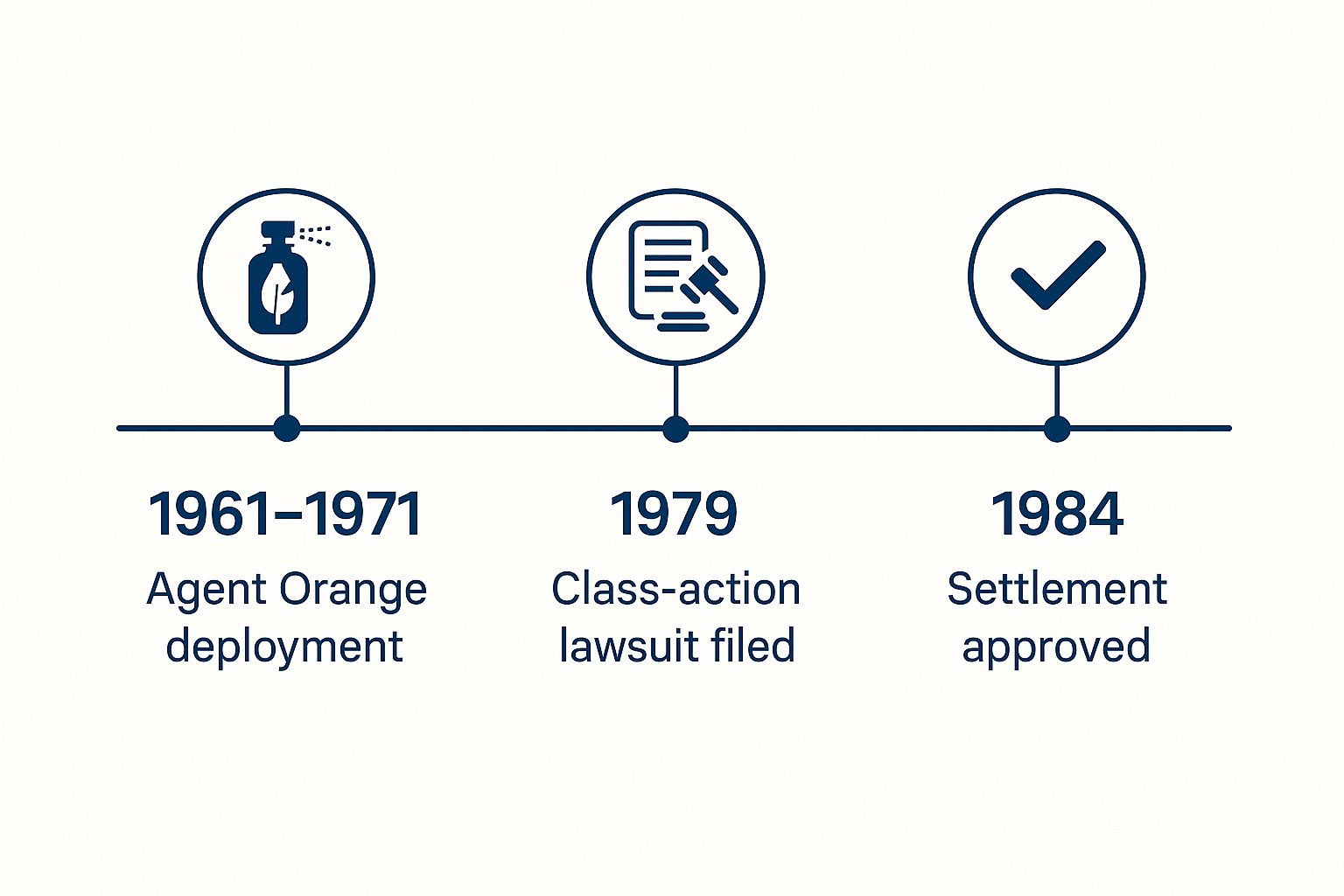
As the timeline shows, it was a long, painful wait for these veterans. More than a decade passed between the start of Agent Orange spraying and the filing of their lawsuit.
The 1984 Settlement and Its Legacy
After years of legal trench warfare, the lawsuit reached a turning point. In May 1984, literally on the eve of the trial, the chemical companies agreed to settle. They created a $180 million fund to compensate the veterans and their families. It sounds like a lot of money, but when spread across tens of thousands of people, it was far from enough.
The settlement felt like a bittersweet victory. It provided some financial help and, just as importantly, public validation that the veterans' pain was real. But the companies never admitted they did anything wrong, and the settlement didn't create a legal precedent that officially linked Agent Orange to their health problems.
The Agent Orange Veteran Payment Program was born from this settlement, distributing funds until it ran out in 1994. For countless veterans, the small checks they received felt like a slap in the face for a lifetime of health struggles.
In the end, the true legacy of the original Agent Orange lawsuit wasn't about the money. It was the powerful statement it made. It showed that a group of determined veterans, when they stood together, could force the nation to confront an ugly truth. Their relentless fight for justice is what ultimately paved the way for the Agent Orange Act of 1991 and the presumptive benefits system we rely on today.
How the Agent Orange Act of 1991 Changed Everything
The first big Agent Orange lawsuit was a major victory, no doubt about it. But as the years passed, it became painfully clear that fighting individual court battles for limited settlement funds wasn't going to solve the massive health crisis facing veterans. A temporary fix wasn't enough; we needed a permanent, systemic solution.
The fight moved from the courthouse to Congress, pushed forward by veterans and their families who refused to be forgotten. That relentless advocacy paid off, leading to a true turning point in this long struggle.
The Agent Orange Act of 1991 was a landmark piece of legislation that completely changed the game for veterans seeking benefits. Before the Act, trying to get compensation was like hacking your way through a dense, unmarked jungle. The 1991 Act was like the government finally bulldozing a clear, paved highway directly to the VA. It wasn't just a suggestion—it was a mandate that forced the Department of Veterans Affairs (VA) to overhaul its entire process.
The Power of Presumption
Before 1991, the weight on a veteran's shoulders was immense. You had to prove, personally and scientifically, that your specific illness was caused by your exposure to Agent Orange during your service. For most, that was an impossible task. How could an individual gather the complex scientific data needed to draw that direct line?
The Agent Orange Act of 1991 flipped that unfair burden on its head. It created a powerful legal concept called "presumptive service connection."
This new framework was simple but profound. If you served in a specific location during a specific time and later developed a disease on the VA's official list, the connection was presumed. The VA had to automatically assume your condition was a result of your service. Suddenly, the burden of proof was lifted from the veteran and placed on the system where it belonged.
The creation of presumptive conditions was a game-changer. It was a formal acknowledgment that the science linking herbicides to certain diseases was solid. It meant that every single veteran didn't have to re-prove that same link over and over again. It was the government finally recognizing the debt owed to those who served.
This change came about because Congress could no longer ignore the voices of veterans who felt abandoned. The Act required the VA to presume exposure for anyone with "boots on the ground" in Vietnam and for "Brown Water" veterans who served on the inland waterways. This was a massive shift from the VA's original stance, which only recognized a single skin condition, chloracne. That narrow view was challenged in the 1986 Nehmer class action lawsuit, which argued that a strong scientific association should be enough. You can read more about the ongoing impact of this legislation and how it continues to shape veterans' rights today.
A System Built on Science and Accountability

One of the smartest parts of the Act was that it wasn't just a one-and-done solution. The law built in a mechanism for the future by mandating that the Institute of Medicine (now the National Academy of Medicine) conduct scientific reviews every two years.
This ensures the list of presumptive conditions is a living document. As science evolves and finds new links between herbicide exposure and illnesses, the list grows. This forward-thinking approach has led to many major conditions being added over the years, including:
- Ischemic Heart Disease
- Parkinson's Disease
- Type 2 Diabetes
- Hypertension (High Blood Pressure)
- Prostate Cancer
The Nehmer Lawsuit Upholding the Law
Even with a great law on the books, making sure the VA followed it was another battle. The Nehmer v. Department of Veterans Affairs class action lawsuit proved essential for holding the VA's feet to the fire.
This lawsuit established a crucial rule: when a new condition gets added to the presumptive list, the VA has to find every veteran who was previously denied for that condition and pay retroactive benefits. The payments go all the way back to the date of the veteran's original claim, no matter how long ago it was.
Thanks to this ruling, billions of dollars in retroactive payments have been made to veterans and their surviving family members. It’s a powerful reminder that even the best systems require constant vigilance. The history of the Agent Orange lawsuit and the 1991 Act proves that the benefits available today stand on a foundation built from decades of hard-won advocacy and undeniable science.
Qualifying for Benefits with Presumptive Conditions

This is where the rubber meets the road for most veterans seeking benefits. The entire journey, from the historic Agent Orange lawsuit to a successful VA claim today, really comes down to one powerful concept: presumptive conditions. Getting a handle on this is the key to unlocking the compensation you've earned.
Think back to the early days. A veteran had to prove, from scratch, that their specific illness was a direct result of Agent Orange exposure. It was like being asked to build a bridge across a canyon, piece by piece, all on your own. A presumptive condition is the VA's way of building that bridge for you. They've officially connected the dots between certain diseases and your military service, so you don't have to.
So, if you served in a specific location during a specific time and later developed a certain illness, the VA presumes the two are linked. The burden of proof shifts dramatically. You no longer have to prove what caused your illness; you just have to prove your diagnosis and your service history.
What Conditions Are on the Presumptive List
The list of presumptive conditions wasn't created overnight. It's the result of decades of scientific studies and tireless advocacy from veterans just like you. Today, the VA recognizes a whole range of diseases, from various cancers to metabolic disorders.
If you've been diagnosed with any of the conditions below, you might have already met one of the most important eligibility requirements.
Cancers:
- Bladder cancer
- Chronic B-cell leukemias
- Hodgkin’s disease
- Multiple myeloma
- Non-Hodgkin’s lymphoma
- Prostate cancer
- Respiratory cancers (including lung, larynx, and trachea)
- Soft tissue sarcomas (of certain types)
Other Serious Illnesses:
- AL amyloidosis
- Hypertension (high blood pressure)
- Hypothyroidism
- Ischemic heart disease
- Parkinson’s disease & Parkinsonism
- Type 2 diabetes mellitus
Keep in mind, this is just a snapshot. The VA officially recognizes over 50 conditions as presumptive. If you have a diagnosed illness not on this list, it's crucial to check the VA's complete, up-to-date list to be certain.
Where Did You Serve
Having a presumptive condition is just one side of the coin. The other is proving you were in a place where the VA agrees you were likely exposed to Agent Orange or other toxic herbicides. This is what's often meant by having "boots on the ground" in a qualifying area.
Thanks to recent legislation like the PACT Act, the map of qualifying locations has grown significantly. This expansion has opened the doors to benefits for thousands of veterans who were unfairly denied in the past.
Think of it like a key and a lock. Your diagnosed presumptive condition is the key. Your service in a qualifying location is the lock. You need both to open the door to VA benefits. One without the other won't work.
Here are the primary locations and service windows that the VA recognizes for presumed exposure.
Qualifying Service Locations and Dates
Vietnam and Surrounding Waters
- Republic of Vietnam: Any service between January 9, 1962, and May 7, 1975. This covers service with boots on the ground, on a U.S. military vessel in inland waterways, or on a vessel operating within 12 nautical miles of the coast.
Korean Demilitarized Zone (DMZ)
- Near the DMZ: Any service between September 1, 1967, and August 31, 1971.
Thailand Military Bases
- Any U.S. or Royal Thai military base: Service between January 9, 1962, and June 30, 1976.
Other PACT Act Locations
The PACT Act broadened the scope to include several other areas where herbicides were tested, stored, or used.
- Laos: December 1, 1965 – September 30, 1969
- Cambodia: April 16, 1969 – April 30, 1969 (at Mimot or Krek, Kampong Cham Province)
- Guam or American Samoa: January 9, 1962 – July 31, 1980
- Johnston Atoll: January 1, 1972 – September 30, 1977
This also includes veterans involved in transporting, storing, or handling Agent Orange, such as certain Air Force reservists who worked on C-123 aircraft after the Vietnam War.
If your service records, like your DD-214, confirm you were in one of these places during these timeframes, you've checked the second critical box. With both pieces in place, the path forward becomes much simpler—less like fighting an old Agent Orange lawsuit and more about gathering the right documents for your claim.
A Step-by-Step Guide to the VA Claims Process

Filing a VA claim for an Agent Orange presumptive condition can feel like a mountain of paperwork. It's easy to get lost in the forms and procedures. But don't worry—we're going to break it all down into simple, manageable steps. This isn't like the old Agent Orange lawsuit days; think of it more like assembling a puzzle where each piece of evidence brings you closer to the finish line.
Your mission here is to build a rock-solid claim that clearly shows the VA you qualify. It really comes down to gathering the right documents, filling out the forms correctly, and understanding what the VA is looking for. A well-organized claim is your best shot at getting an approval without any frustrating delays.
Step 1: Gather Your Essential Documents
Before you touch a single application form, your first task is to gather your records. Think of yourself as a detective building a case. Every document is a crucial piece of evidence, and having everything organized from the start will make the rest of the journey much smoother.
You'll need two main types of proof: one to show where and when you served, and another to show your current medical diagnosis. These documents are the bedrock of your claim.
Your Document Checklist:
- Proof of Service: For most veterans, this is your DD-214 (Certificate of Release or Discharge from Active Duty). This form is gold—it has all the details about your service dates and locations.
- Medical Records: This is everything related to your presumptive condition. Get reports from your VA doctors, private physicians, hospital stays, and any lab or test results you have.
- Personal Statements: While a presumptive claim doesn't always need them, a "buddy letter" from someone you served with or a heartfelt statement from your spouse can be incredibly powerful. They add a human element and show how the condition impacts your day-to-day life.
Getting these documents together is your first major win. Once they're in hand, you’re ready to tackle the application itself.
Step 2: Complete and Submit Your VA Application
With your evidence collected, it’s time to file. The VA has a few different ways you can submit your claim, so you can pick what works for you. The key form you’ll be working with is VA Form 21-526EZ, Application for Disability Compensation and Related Compensation Benefits.
Here’s how you can get it done:
- Online: Using the official VA.gov website is typically the quickest way. The online portal walks you through each step and lets you upload your documents right then and there.
- By Mail: If you prefer paper, you can download the form, fill it out, and mail it to the VA's Claims Intake Center.
- In-Person: You can always go to a VA regional office and get help from a VA employee to submit your application.
- With a Representative: Many veterans work with a VA-accredited representative, like a Veterans Service Officer (VSO). They can file the claim for you and are a fantastic resource.
Critical Tip: The moment you start an online application, the VA logs an "intent to file." This is huge because it locks in your potential start date for benefits. Even if it takes you a few months to get all your evidence in, as long as you finish within a year, your back pay could be calculated from that earlier date.
Step 3: Understand the VA Review and Decision Process
Once you hit "submit," the waiting game begins. The VA will now review everything you sent. Their job is to verify two key facts: that you served in a qualifying location and that you have a diagnosed presumptive condition. It’s that simple.
During this review period, you’ll likely be scheduled for a Compensation & Pension (C&P) exam. This is a medical evaluation with a VA-contracted doctor who will assess your condition. It is absolutely essential that you go to this appointment—missing it can bring your claim to a screeching halt.
If the VA confirms your service and your diagnosis, you'll receive a decision letter. This letter will include a disability rating, from 0% to 100%, which reflects how seriously your condition affects you. That percentage is what determines the amount of your monthly tax-free disability payment.
Getting a successful outcome isn't about luck. It’s about being prepared. By gathering your evidence methodically and following these steps, you can navigate the process with confidence and get the benefits you rightfully earned.
Answering Your Questions About Agent Orange Claims
Even with a clear roadmap, the journey to securing benefits can feel filled with specific "what-ifs" and potential roadblocks. It's completely normal to have lingering questions, and getting them answered is a critical part of the process.
Let's dive into some of the most common questions we hear from veterans and their families. Think of this as a final briefing, designed to give you the clarity and confidence you need to take the next step.
What Happens If My Initial Claim Is Denied?
First, don't panic. Seeing a denial letter from the VA is incredibly disheartening, but it is far from the end of the road. Many veterans who are receiving benefits today were denied at first. The most important thing is to understand why the VA said no and then to act strategically.
Your decision letter will explain the reason for the denial. Often, it comes down to a lack of medical evidence tying your condition to your service, or insufficient proof that you served in a qualifying location. Once you know the problem, you have a few ways to fight back.
Your Appeal Options After a Denial:
- File a Supplemental Claim: This is often the best first move. You can add new and relevant evidence that wasn't in your original file, like a new doctor’s report or recently discovered service records.
- Request a Higher-Level Review: If you're convinced the VA made a legal or procedural mistake, you can ask a more senior adjudicator to review the exact same file. You can't add new evidence with this option.
- Appeal to the Board: This is a more formal path where you can appeal directly to the Board of Veterans' Appeals, and you can even request a hearing with a Veterans Law Judge.
You generally have one year from the date on your denial letter to file an appeal. Moving quickly is crucial, as it preserves your effective date for any potential back pay you are owed.
How Long Does the VA Claims Process Take?
This is the million-dollar question, and unfortunately, there’s no single, satisfying answer. The time it takes the VA to process an agent orange lawsuit-related claim can vary dramatically. It really depends on the complexity of your case, how complete your application was, and the workload at the VA regional office handling your file.
As a general rule of thumb, you can probably expect the process to take anywhere from four to eight months from filing to decision. Some claims get decided faster, while more complex cases—especially those needing multiple C&P exams or extra evidence gathering—can certainly take longer.
The VA has an online tool that lets you check your claim status. While it won't give you a finish date, seeing your claim move from "under review" to "gathering of evidence" can offer some much-needed peace of mind.
Can Survivors Receive Agent Orange Benefits?
Yes, absolutely. The VA offers crucial support for the surviving spouse, dependent children, and sometimes dependent parents of a veteran whose death was caused by a service-connected condition. This benefit is called Dependency and Indemnity Compensation (DIC).
If a veteran was receiving disability for a presumptive Agent Orange illness and that illness either directly caused or contributed to their death, their surviving family members may be eligible for these monthly, tax-free payments.
To apply for DIC, you'll generally need to provide:
- The veteran’s death certificate listing the cause of death.
- Proof of your relationship (marriage or birth certificate).
- The veteran’s service records, like their DD-214.
Filing for DIC is a separate process, but it builds on the evidence from the veteran’s original disability claim. For many families who have lost their hero, these benefits are a financial lifeline.
Can I File for Exposure Outside of Vietnam?
Yes. For decades, the VA’s focus was almost exclusively on veterans who set foot in Vietnam. But thanks to tireless advocacy and evolving science, the list of recognized exposure locations has grown significantly, especially with the passage of the PACT Act.
The VA now presumes exposure for veterans who served in a number of other locations during specific timeframes.
Expanded Exposure Locations Include:
- Thailand: On any U.S. or Royal Thai military base from January 1962 to June 1976.
- Korean DMZ: In or near the Demilitarized Zone from September 1967 to August 1971.
- Laos & Cambodia: During specific, limited periods in the late 1960s.
- Guam, American Samoa, & Johnston Atoll: During various periods when herbicides were stored, tested, or transported.
This expansion is a massive victory for veterans who served in these areas and developed the same devastating health conditions. If your service history matches one of these locations, your path to filing an agent orange lawsuit-related claim is now much more straightforward.
Navigating the maze of VA claims and appeals can feel like a full-time job, but you don't have to do it alone. The Homefront Group is here to provide the expert legal support you need to secure the benefits you and your family rightfully deserve. Our team of veteran advocates is ready to help you build a strong case. Take our 3-minute quiz today to see how we can help.