
Yes, there's a well-established connection between Agent Orange and peripheral neuropathy. The Department of Veterans Affairs (VA) officially recognizes early-onset peripheral neuropathy as a presumptive condition for veterans who qualify.
What does that mean for you? If you develop symptoms of this nerve damage within one year of your last possible date of exposure, the VA automatically presumes it's linked to your military service. This is a huge advantage, as it streamlines the path to getting the disability benefits you deserve for the pain, numbness, and weakness that come with this condition.
The Unseen Link Between Agent Orange and Your Nerves

For decades, countless veterans returned home only to start a new, private war against chronic health problems. One of the most common, yet frequently misunderstood, of these is peripheral neuropathy—a frustrating condition that happens when the nerves outside your brain and spinal cord get damaged.
The link to Agent Orange isn't just a theory; it's a recognized medical fact. The herbicide contained a highly toxic contaminant called dioxin, and the connection between that toxin and nerve damage is now undeniable.
Making sense of this connection is the first real step toward getting the help you’ve earned. Many vets live with tingling, burning sensations, or sharp, jabbing pains in their hands and feet, never realizing it could trace back to their service. You might find yourself struggling with balance, fumbling with buttons, or feeling pain with every step. It’s easy to write these things off as just "getting older," but for many, it's a direct result of a service-connected exposure.
A Quick Overview of Key Concepts
Let's break down the essential pieces of this puzzle. The relationship between your service, the chemical exposure, your medical diagnosis, and the VA’s rules can feel like a maze. But when you lay it all out, the path forward starts to look a lot clearer.
The VA’s presumptive service connection for early-onset peripheral neuropathy is a critical advantage. It removes the burden of proving that Agent Orange caused your condition, a task that can be incredibly difficult decades after exposure.
This guide is here to untangle the complexities. We'll walk you through what peripheral neuropathy feels like, the science behind the nerve damage, and exactly how to navigate the VA claims system to your advantage.
To get started, the table below provides a quick, high-level summary of the most important elements. Think of it as your cheat sheet.
Agent Orange and Neuropathy At a Glance
| Concept | What This Means for Veterans |
|---|---|
| Agent Orange | A toxic herbicide used extensively during the Vietnam War era. If you served in a qualifying location and timeframe, the VA presumes you were exposed to it. |
| Peripheral Neuropathy | This is damage to the nerves outside your brain and spinal cord. It typically causes pain, numbness, and weakness, most often felt in the hands and feet. |
| Presumptive Connection | A huge benefit. The VA automatically assumes your neuropathy is service-connected if you're diagnosed within one year of exposure, which makes your claim much simpler. |
| Filing a Claim | To get started, you'll need to gather your service records and a formal medical diagnosis. This is the foundation for filing for VA disability, which provides tax-free monthly compensation. |
Hopefully, this table gives you a solid starting point. Now, let’s dig into the details of each of these concepts so you can build the strongest possible claim.
What Does Peripheral Neuropathy Actually Feel Like?
To really grasp the connection between Agent Orange and peripheral neuropathy, you have to go beyond the medical textbooks. Let's forget the dry, clinical definitions for a moment.
Think of your body's nervous system as a massive, incredibly complex electrical grid. Your brain and spinal cord are the power station, and the peripheral nerves are the millions of wires running out to every single part of your body—your hands, feet, skin, and even internal organs. These wires carry vital messages back and forth, telling your muscles to move and your skin to feel.
Now, picture those wires becoming damaged. They're frayed, short-circuiting, or sending chaotic, scrambled signals. That's peripheral neuropathy in a nutshell. It's not one single feeling; it's a frustrating mix of symptoms that can completely turn your life upside down. For so many veterans, this starts as a faint tingling in the feet or hands and, over time, gets progressively worse.
The Different Types of Nerve Sensations
That "faulty wiring" analogy is a great way to understand why the symptoms can be so wildly different from person to person. The feeling you get all depends on which type of nerve fiber is on the fritz. Your peripheral nervous system has three main kinds of nerves, and each one sounds a different alarm when it's in trouble.
- Sensory Nerves: These are your "feeling" nerves, in charge of sensations like touch, temperature, and pain. When they misfire, you might feel a tingling "pins and needles" sensation that won't quit, a deep burning, or sharp, jabbing pains that feel like you're getting zapped with electricity.
- Motor Nerves: These are the nerves that control your muscles. Damage here often shows up as muscle weakness, painful cramps, or uncontrollable twitching. Simple things like buttoning a shirt, holding a coffee cup, or just feeling steady on your feet can suddenly become a major challenge.
- Autonomic Nerves: These are the silent workers, managing all the things you don't think about, like your heart rate, blood pressure, and digestion. When these nerves are affected, you might experience dizzy spells, problems with sweating, or bladder issues.
For a lot of veterans, the most disorienting part of peripheral neuropathy is the numbness—the total loss of normal feeling. You might not feel a blister forming on your foot until it’s a serious problem, or walk with a constant, unnerving feeling that you’re on an unstable surface. This lack of feedback from your own body is not just confusing, it can be downright dangerous.
How Neuropathy Impacts Daily Life
These symptoms are far more than just small inconveniences. They can fundamentally alter your ability to get through the day and enjoy the things you love.
Constant pain can destroy your sleep, night after night. Muscle weakness might force you to give up hobbies you've enjoyed for years, like woodworking or playing with your grandkids. The sheer unpredictability of it all—having a decent day followed by a terrible one—can be incredibly taxing, both mentally and emotionally.
This is why understanding exactly how neuropathy affects you is so important. Being able to clearly explain to your doctor and the VA that you're dealing with burning pain versus numbness, or loss of balance versus muscle cramps, gives them the critical details they need. While the neuropathy linked to Agent Orange has its own patterns, it can be helpful to learn about other types of nerve pain to understand the full picture. For instance, some conditions cause very specific, localized pain, and seeing how those compare—like by understanding Morton's Neuroma and finding relief—can give you a broader perspective.
Recognizing and naming your symptoms is the very first step toward getting the validation and support you earned.
The Science Connecting Dioxin Exposure to Nerve Damage
For decades, veterans have known there was a connection between their service and the strange nerve symptoms that appeared later in life. What was once a painful puzzle is now supported by solid science, finally validating what so many have experienced firsthand.
The link isn’t just a theory; it’s grounded in the toxic chemistry of Agent Orange. The real troublemaker is a contaminant called 2,3,7,8-tetrachlorodibenzo-p-dioxin, but everyone just calls it TCDD or dioxin. Think of dioxin as a microscopic saboteur that gets into your body and sticks around for years, quietly disrupting critical systems.
Your peripheral nerves—the delicate "wiring" that connects your brain and spinal cord to the rest of your body—are especially vulnerable. Dioxin is known to trigger oxidative stress, which is a kind of cellular rust that damages tissues. It can also kick off inflammation that directly attacks the nerve fibers or the protective coating around them, known as the myelin sheath.
How Dioxin Short-Circuits Your Nerves
When these nerve fibers get damaged, they can't send clear signals anymore. The result is the frustrating and often painful chaos of peripheral neuropathy: the burning, tingling, numbness, and muscle weakness that so many veterans report.
This damage rarely happens overnight. It's often a slow burn, a gradual decline that can take years to fully emerge and worsen over time. This scientific understanding is so important because it confirms your experience. Your symptoms aren't just in your head; they are a known biological outcome of being exposed to this toxin.
The VA’s decision to grant a presumptive service connection for early-onset peripheral neuropathy is built directly on this science. It's a formal acknowledgment that the link between agent orange and peripheral neuropathy is strong enough to give veterans the benefit of the doubt.
The Dose-Response Relationship
One of the most powerful pieces of the scientific puzzle is what's called a "dose-response" relationship. It’s a simple concept: the more you were exposed to Agent Orange, the higher your risk of developing serious health issues like peripheral neuropathy. Studies have shown this pattern again and again.
For instance, a 2022 review looking at years of data found a clear, dose-dependent link between dioxin exposure and the rates of peripheral neuropathy in Vietnam veterans. Those with the highest measured dioxin levels in their bodies had a much greater chance of being diagnosed with neuropathy as time went on. For a closer look, you can review the study's findings on how Agent Orange exposure correlates with chronic neurological diseases.
This evidence confirms that the amount of exposure matters. It's a powerful validation that your service environment and where you were stationed could be the direct cause of the health challenges you face today.
Navigating the VA Presumptive Condition for Neuropathy
For veterans grappling with the daily pain and frustration of nerve damage, the VA claims process can feel like a maze. But there's a vital shortcut you need to know about: the presumptive service connection. Honestly, understanding this concept is one of the most important things you can do when filing a claim for agent orange and peripheral neuropathy.
So what does "presumptive" actually mean? Think of it like this: instead of you having to track down decades-old records to prove your military service directly caused your nerve damage, the VA simply "presumes" the link is there. It's their way of acknowledging the overwhelming scientific evidence connecting certain service experiences to specific health problems. For peripheral neuropathy, this is a game-changer, but it comes with a few very specific rules you have to follow.
The Two Pillars of Presumptive Eligibility
To get on this faster track, it's not enough to just have a diagnosis. The VA has laid out two crystal-clear conditions, and you have to meet both of them. Getting these two things right is the key to unlocking a much simpler and more successful claim.
If you don't meet these requirements, you can still file, but it gets a lot harder. You'll have to prove a direct service connection, which usually means getting a medical nexus letter from a doctor explicitly linking your neuropathy to your time in service—a tough ask after so many years.
That's why focusing on these two pillars from the start is so critical.
The presumptive rule exists because the VA recognizes it's just not fair to ask a veteran to prove an invisible injury with a piece of paper from 50 years ago. It’s a policy built on common sense and solid science.
Here are the two non-negotiable requirements you must meet:
- The One-Year Rule: Your peripheral neuropathy must have shown up (manifested) within one year of your last possible exposure to Agent Orange. For most, this clock starts ticking on the last day of active service.
- The 10% Disability Rule: The condition had to be at least 10% disabling within that same one-year window. This means the symptoms were more than just a minor annoyance; they had a real, noticeable impact on your daily life.
These rules are firm. If your symptoms started popping up 13 months after you left the service, you unfortunately fall outside the presumptive window.
Who Qualifies for Presumed Exposure?
The next piece of the puzzle is proving you were in a place where the VA agrees you were likely exposed to Agent Orange. It's not enough to have just served during the Vietnam era; you need to show your service fits specific locations and timeframes.
Thankfully, the VA keeps a pretty clear list of what counts. If your service records put you in one of these groups, you automatically check the "exposure" box for your claim.
Here are the key groups who are presumed to have been exposed:
- Vietnam "Boots on the Ground" Veterans: Anyone who set foot in the Republic of Vietnam between January 9, 1962, and May 7, 1975.
- Blue Water Navy Veterans: Sailors who served on ships within the 12-nautical-mile limit of Vietnam during that same timeframe.
- Korean DMZ Veterans: Service members stationed on or near the Korean Demilitarized Zone between September 1, 1967, and August 31, 1971.
- C-123 Aircraft Personnel: Reservists and active-duty personnel who flew, maintained, or had repeated contact with C-123 aircraft between 1969 and 1986.
Peripheral neuropathy is an incredibly common diagnosis among veterans, with symptoms ranging from mild to completely debilitating. This infographic gives a good visual breakdown of how severe these cases tend to be.
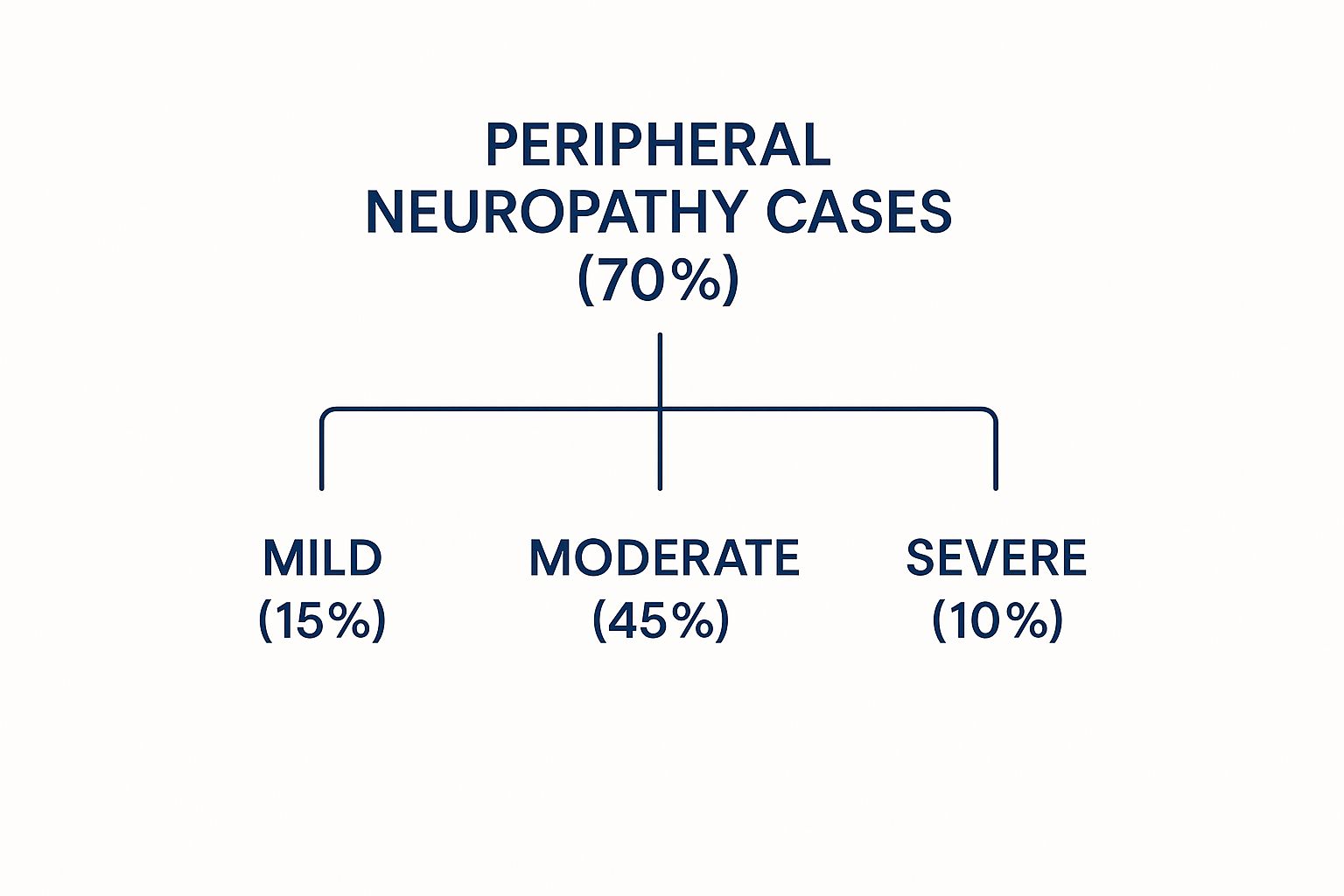
As you can see, the vast majority of cases are considered moderate, which underscores just how much this condition impacts the lives of veterans. Knowing where your own experience fits on this spectrum is a crucial part of building your VA claim.
How to File a Successful VA Disability Claim

Successfully filing a VA disability claim for agent orange and peripheral neuropathy isn't about luck—it's about preparation. Think of yourself as the project manager of your own case. Your mission is to build a complete, organized, and compelling package that gives the VA a clear and undeniable path to approval.
This process is so much more than just filling out a form. It's about telling your story, backed by solid evidence. You need to connect the dots for the VA, drawing a straight line from your military service to your exposure and, finally, to your current health condition. A rock-solid claim is always built on three pillars: medical evidence, service records, and a clear narrative.
Let's break down how to tackle this. What seems like a mountain of paperwork can be broken down into a manageable series of steps. This is your roadmap to building a claim that truly reflects what you've been through and helps you get the benefits you've earned.
Step 1: Assemble Your Evidence
Before you even glance at an application form, your first job is to gather your intelligence. This means collecting every document that will form the backbone of your claim. I can't stress this enough: rushing this step is one of the most common reasons for frustrating delays and denials.
You’re focusing on three key types of proof:
- Proof of Diagnosis: You need a current, official diagnosis of peripheral neuropathy from a qualified medical professional. A quick mention of symptoms in your chart isn't enough; it has to be a formal diagnosis in your medical records.
- Proof of Service and Exposure: This is where your DD-214 and other service records are critical. They must clearly show that you served in a location and timeframe the VA recognizes for Agent Orange exposure, like having "boots on the ground" in Vietnam.
- Proof of Connection (Nexus): For veterans who fall under the presumptive connection (meaning neuropathy symptoms appeared within one year of service), this part is much simpler. If that's not you, you'll likely need a "nexus letter" from a doctor stating that it is "at least as likely as not" that your neuropathy is connected to your military service.
Crucial Tip: Get a complete copy of your medical records from your family doctor, any specialists you've seen (like a neurologist), and the VA health system. Read through them yourself to make sure the diagnosis is clear and that your symptoms are described accurately.
Step 2: Document the Impact on Your Life
A medical diagnosis tells the VA what condition you have. Your personal statement tells them how it actually affects you. This is your opportunity to paint a picture that goes beyond clinical terms and shows the real, day-to-day impact of your neuropathy.
This document, often called a "Statement in Support of Claim," is one of the most powerful tools in your arsenal. Don't just write, "I have pain in my feet." Instead, describe how that constant burning pain makes it impossible to stand for more than 10 minutes, keeping you from cooking a meal for your family or playing with your grandkids.
What to Include in Your Personal Statement:
- A Timeline of Your Symptoms: When did the tingling, numbness, or pain first start? How has it gotten worse over time? Be as specific as you can with dates or timeframes.
- Specific Daily Struggles: Explain how your symptoms interfere with everyday life. Do you drop things because of weakness in your hands? Do you feel unsteady on your feet and struggle with balance?
- Impact on Work and Hobbies: Detail how your condition has limited your ability to do your job or even forced you to give up hobbies and activities you used to love.
Step 3: Complete the Correct VA Forms
With your evidence gathered and your personal story written, it's time to tackle the official paperwork. The main form you'll need is VA Form 21-526EZ, Application for Disability Compensation and Related Compensation Benefits.
Filling this form out correctly is all about attention to detail. Double-check that all your personal information, service history, and the conditions you are claiming are 100% accurate. Even a small mistake can lead to a major delay. You can submit this form online through the VA.gov website, by mail, or with the help of a knowledgeable Veterans Service Officer (VSO).
The evidence linking Agent Orange to various neuropathies is only getting stronger. For instance, a major 2014 study of over 111,000 South Korean veterans discovered that the rates of both single-nerve (mononeuropathy) and multiple-nerve (polyneuropathy) damage went up as Agent Orange exposure levels increased. The research also showed that other health problems, like diabetes, could make the nerve damage even worse. You can read more about these robust findings on neuropathy risk in the published study.
Step 4: Submit and Follow Up
After you submit your claim, the waiting game begins. But your work isn't quite over yet. The VA will likely schedule you for a Compensation and Pension (C&P) exam. Attending this appointment is mandatory. If you don't show up, it’s a fast track to getting your claim denied.
The C&P exam is a medical evaluation with a VA doctor or a contracted physician. Their job is to assess the severity of your peripheral neuropathy, which helps the VA determine your disability rating. Be completely honest and thorough when you describe your symptoms. Don't exaggerate, but just as importantly, don't downplay your pain just because you might be having a "good day." This exam is a critical piece of the puzzle.
Common Questions About Neuropathy and VA Claims
Trying to navigate the VA claims process for agent orange and peripheral neuropathy can open up a can of worms. Even when you think you have a handle on the rules, your specific situation can feel like a confusing exception. Let's tackle some of the most common questions and concerns veterans run into, with practical advice to help you push past those hurdles.
Think of this as your go-to troubleshooting guide. We’ll walk through real-world challenges, from what to do if you missed a key deadline to how to handle a claim denial. The goal here is to give you the clarity and confidence to move forward.
What if My Neuropathy Diagnosis Came Years After Service?
This is a big one, and probably the most frequent question we hear. For the VA to grant a presumptive service connection for peripheral neuropathy, there’s a strict time limit: your symptoms had to show up and be at least 10% disabling within one year of your last day in an area where you were exposed to herbicides.
If your official diagnosis came years down the road, you can absolutely still file a claim, but it won’t be presumptive. This just means the ball is back in your court to prove the connection. You'll need to establish a direct service connection by providing a few key pieces of evidence that aren't required for a presumptive claim.
The most critical piece of that puzzle is a medical nexus letter. This is a document from a qualified doctor who has reviewed your file and can state that your neuropathy is "at least as likely as not" caused by your Agent Orange exposure during service.
You'll also need to gather proof showing your symptoms started much earlier, even without an official diagnosis. This could be things like:
- Your own personal statement: A detailed account of when the tingling, numbness, or pain began and how it's gotten worse over time.
- Buddy letters: Written statements from your spouse, friends, or fellow service members who remember you complaining about symptoms or saw you struggling with them way back when.
How Does the VA Rate Disability for Peripheral Neuropathy?
The VA rates peripheral neuropathy based on how much your symptoms mess with your day-to-day life. There isn't a single, specific diagnostic code just for this condition, so they rate it "analogously," which is a fancy way of saying they use the rating criteria for nerve paralysis—most often, the sciatic nerve for problems in your legs and feet.
Your rating can range anywhere from 10% to 80% or even higher, depending on which nerves are affected and how bad the impairment is. The VA typically breaks down the severity into three levels:
| Severity Level | Potential VA Rating | Common Characteristics |
|---|---|---|
| Mild | 10% | Symptoms are present, but they only have a minor impact on your ability to move or feel things. |
| Moderate | 20% – 40% | Symptoms cause noticeable problems, like weakness, trouble with buttons, or difficulty walking. |
| Severe | 60% – 80% | You have a significant loss of function, serious muscle wasting (atrophy), or your foot dangles (foot drop). |
The key takeaway here is that your medical records need to be incredibly detailed. It’s not enough for your doctor to just write "peripheral neuropathy." Your file must clearly document the specific loss of sensation, loss of motor function (weakness), or nerve pain (neuralgia) you're experiencing. This level of detail is what directly shapes your final disability rating.
Can I Get Benefits for Other Agent Orange Conditions?
Yes, absolutely. In fact, you should file a claim for every single condition you have that the VA recognizes as being linked to Agent Orange. The VA has a long list of presumptive diseases, including Type 2 diabetes, Parkinson's disease, Ischemic Heart Disease, and many forms of cancer.
Filing for agent orange and peripheral neuropathy doesn't stop you from claiming other related conditions. Each health problem is looked at and rated on its own.
After each condition gets its own rating, the VA uses a unique formula—often called "VA Math"—to figure out your total combined disability rating. It’s definitely not simple addition. It’s crucial to file a separate claim for each condition to make sure you get the full compensation you're entitled to for all your service-connected health issues.
What Are My Options if My Neuropathy Claim Is Denied?
Getting a denial letter in the mail is a gut punch, but it is not the end of the road. The very first thing you should do is read that entire letter, front to back, to understand exactly why the VA said no.
Some common reasons for denial are:
- Missing that one-year deadline for a presumptive claim.
- Medical evidence wasn't strong enough to confirm the diagnosis or how severe it is.
- You didn't provide enough proof that you served in an exposure area.
- You missed a required Compensation and Pension (C&P) exam.
Once you know the "why," you have a few ways to appeal. You can file a Supplemental Claim if you have new evidence, ask for a Higher-Level Review by a senior VA employee, or appeal to the Board of Veterans' Appeals. This can get complicated fast, and getting help from a good Veterans Service Officer (VSO) or an accredited attorney is a smart move to build the strongest appeal possible.
The journey to securing the benefits you earned can be challenging, but you don't have to do it alone. The team at Homefront Group is dedicated to helping veterans cut through the red tape and get the justice they deserve. If you're facing a denied claim or are unsure where to start, take our 3-minute quiz to see how we can help. Learn more about how Homefront Group can assist with your VA claim.