For veterans trying to understand the link between Agent Orange and COPD, the situation can be frustrating. The short answer is that the VA does not automatically presume COPD is caused by Agent Orange exposure. But that's far from the end of the road—many veterans have successfully secured benefits for respiratory conditions tied directly to their service.
Unpacking the Connection Between Agent Orange and COPD

It’s a story many veterans know all too well: service in Vietnam, Korea, or another affected area, followed years later by a debilitating respiratory diagnosis. The connection to toxic herbicides might seem obvious to you, but navigating the official VA position is often the biggest challenge. Getting a handle on this landscape is the first, most crucial step in building a strong claim.
Think of Chronic Obstructive Pulmonary Disease (COPD) as an umbrella that covers a few different progressive lung diseases. The core issue is that they all block airflow, making it harder and harder to breathe. The two most common conditions under this umbrella are:
- Chronic Bronchitis: This is a long-term inflammation of your airways that causes a persistent, mucus-producing cough.
- Emphysema: This condition slowly destroys the tiny air sacs (alveoli) in your lungs, which means your body struggles to get the oxygen it needs.
Even though the VA might not have a presumptive rule for COPD as a single diagnosis, it's important to remember that it does recognize other respiratory illnesses. The specific conditions that make up your COPD diagnosis could be key to your claim.
To help clarify the most important points, here's a quick summary of what you need to know.
COPD and Agent Orange Key Considerations
| Factor | Explanation |
|---|---|
| VA Presumptive Status | COPD is not currently on the VA's list of presumptive conditions for Agent Orange exposure. This means benefits are not automatic. |
| Medical Evidence | Scientific studies are mixed. While some research shows higher rates of COPD in exposed veterans, the link isn't considered definitive enough for presumptive status. |
| Path to Benefits | You must establish a direct service connection. This requires proving your COPD is "at least as likely as not" caused by your in-service exposure. |
| Required Evidence | A successful direct service connection claim needs three things: a current COPD diagnosis, proof of an in-service event (like exposure to Agent Orange), and a medical nexus letter from a doctor linking the two. |
Understanding these distinctions is critical as you prepare to file your claim.
The State of the Medical Evidence
When you dig into the science, you find a mixed bag of results regarding a direct link between herbicide exposure and COPD. Research has firmly connected Agent Orange to a list of cancers, but the evidence for non-cancerous lung diseases like COPD is more ambiguous.
Some studies have pointed to higher rates of COPD among veterans who reported symptoms after being exposed to Agent Orange. However, other studies that relied purely on clinical lung function tests (spirometry) didn't find as clear of a statistical connection. You can read more about the nuances in the research into Agent Orange and its respiratory effects on medicalnewstoday.com.
This gray area in the research is exactly why a powerful, well-documented VA claim is so critical. Because there's no automatic presumption, the responsibility falls on you, the veteran, to draw a clear line between your military service and your current health condition.
What This Means for Your VA Claim
Since COPD isn't on the presumptive list for Agent Orange, you can't just submit a diagnosis and proof of service and expect an approval. Instead, you have to build your case on the basis of a direct service connection.
This means you are responsible for proving three things:
- You have a current, official medical diagnosis of COPD or a related respiratory illness.
- You have evidence of an event, injury, or exposure during your service (for example, proof you served where Agent Orange was sprayed).
- You have a medical "nexus" opinion—a statement from a qualified doctor that connects your diagnosis directly to your military exposure.
It's a process that requires more legwork and solid evidence, but with the right documentation and strategy, a successful outcome is absolutely possible.
What Is COPD and How Does It Feel?

To build a strong VA claim, it’s crucial to understand what you're up against and be able to explain it clearly. So, let's talk about Chronic Obstructive Pulmonary Disease (COPD) and what it actually feels like to live with every day. It’s far more than a medical acronym; it’s a daily battle for millions of people, including many veterans.
COPD isn't just one disease. It’s a group of progressive lung conditions that slowly rob you of your ability to breathe easily. The two most common are chronic bronchitis and emphysema. Imagine your airways are a network of open pipes. With COPD, those pipes become inflamed, damaged, and narrower, making it incredibly hard for air to get in and out.
Experiencing COPD in the Real World
Living with COPD forces your lungs to work overtime just to perform their most basic function. Many describe it as feeling like you're constantly trying to breathe through a thin coffee stirrer, especially when you exert yourself. This isn't just a minor annoyance; it's a life-altering reality that shows up in very real ways.
The daily symptoms you experience are often the most powerful evidence you can provide for a VA claim. They paint a clear picture of how this disease impacts your ability to live your life.
Here are some of the common symptoms you might be dealing with:
- Persistent Cough: A nagging cough that just won't quit, often bringing up mucus. It’s frequently brushed off as a "smoker's cough," but it's a tell-tale sign of inflamed airways.
- Shortness of Breath: Getting winded from simple activities that you never used to think twice about, like climbing a flight of stairs, carrying in groceries, or walking across the yard.
- Wheezing: That high-pitched whistling or squeaky sound when you breathe. It's the sound of air being forced through narrowed passageways in your lungs.
- Chest Tightness: A constant feeling of pressure or squeezing in your chest, as if you can never get a full, satisfying breath.
This is a serious health problem nationwide. An estimated 16 million Americans have been diagnosed with COPD, and it's a leading cause of death. While smoking is a major cause, about 15% of cases are tied directly to environmental and workplace exposures—including toxic chemicals like those in Agent Orange. You can find more COPD risk factors and statistics at hillandponton.com.
By understanding these specific symptoms and having a clinical diagnosis, you'll be much better prepared to communicate the real-world impact of your condition to doctors and the VA. This is the first step in building a solid foundation for your disability claim.
Exploring the Medical Evidence for Your Claim
When you're building a VA claim for a condition that isn't on the presumptive list, you have to shift gears from your personal experience to hard medical evidence. This is especially true for veterans trying to connect Agent Orange and COPD. Diving into the scientific research can feel intimidating, but it's one of the most powerful tools you have. While science rarely gives a simple "yes" or "no" answer, it often reveals powerful connections that can make or break your case.
Researchers use specific terms to describe these connections, like "correlation" and "odds ratio." A correlation is just a pattern—it shows that when one thing is present (like Agent Orange exposure), another thing (like a health condition) tends to show up more often. It's not a direct smoking gun, but it's a strong signal that the two are related.
An "odds ratio" puts a number on how strong that relationship is. If a study finds an odds ratio of 1.5, it means the exposed group had 50% higher odds of developing the disease than the unexposed group. This kind of statistic is exactly what can help convince the VA.
Key Research Findings for Veterans
So, what does the research say? While there isn't one single study that definitively proves Agent Orange causes COPD, that doesn't mean your case is a dead end. Instead, a lot of compelling research has zeroed in on the diseases that fall under the COPD umbrella, like chronic bronchitis and emphysema. And there, the links are much clearer.
One of the most important pieces of evidence comes from a 2013 study of Korean veterans who served in the Vietnam War. This study found that vets who reported high levels of herbicide exposure also had much higher rates of chronic bronchitis and emphysema.
The results were striking. The odds ratio for chronic bronchitis was between 1.53 and 1.90. What that means in plain English is that these veterans faced a 53% to 90% increased risk compared to their unexposed comrades. This isn't just a small statistical bump; it's a significant, measurable connection.
This is precisely the kind of research that helps build a solid medical argument for your claim. It forges a powerful link between the toxic exposure you endured and the specific breathing problems you're living with today.
This scientific evidence is your ammunition. The VA might not have COPD on the Agent Orange presumptive list, but if you can show a strong, data-backed link to one of its root causes—like chronic bronchitis—you dramatically strengthen your overall case.
Applying Evidence to Your Claim
Knowing about this research helps you and your doctor frame your condition in language the VA understands. It lets you create a nexus letter that does more than just state a diagnosis; it explains why your service is likely the cause.
For breathing conditions like COPD, modern diagnostic tools can provide even more firepower. Advanced pulmonary segmentation techniques can create detailed images of your lungs, offering objective, visual proof of damage that supports your doctor's opinion.
By focusing on the proven connections between herbicide exposure and conditions like chronic bronchitis, you can build a much stronger argument for a direct service connection. This approach bridges the gap between your personal story and the hard data the VA needs to approve your claim.
Here is the rewritten section, designed to sound like it was written by an experienced human expert.
What "Presumptive Condition" Really Means for Your VA Claim
If you're getting started with a VA claim, you'll hear the term "presumptive service connection" a lot. It sounds like legal jargon, but it's actually one of the most powerful tools a veteran has, especially when it comes to toxic exposures.
Think of it this way: the VA is basically "connecting the dots" for you. When a condition is presumptive, the VA officially agrees that certain military exposures are known to cause specific health problems. It's a game-changer because it takes the heaviest weight off your shoulders—proving that your service caused your illness. The VA has already established that link by law.
How This Makes Your Claim Easier
Having a presumptive condition completely changes the focus of your claim. Instead of hunting down a doctor to write a complex nexus letter that ties your condition directly back to your service, you only need to show two key things:
- You have a current medical diagnosis for that specific presumptive illness.
- Your service records place you in a qualifying location during a specific time.
For Agent Orange exposure, the classic example is service in the Republic of Vietnam between January 9, 1962, and May 7, 1975. If you can prove you were there and have a diagnosis for a condition on the VA's Agent Orange presumptive list, service connection is practically a given.
The Complication with Respiratory Conditions
Now, here's where things get tricky for veterans struggling with Agent Orange and COPD. As it stands, COPD is not on the presumptive list for Agent Orange. But that absolutely does not mean it's a dead end.
You have to look closer at the specific diseases that often get lumped together under the COPD diagnosis. Many of them are recognized as presumptive, just for different exposures. This is a huge clue.
The PACT Act, for instance, made conditions like chronic bronchitis and chronic rhinitis presumptive for many veterans who served near burn pits in the Gulf War and post-9/11 conflicts. This shows the VA is acknowledging how airborne toxins wreck respiratory health.
While that doesn't directly help an Agent Orange claim based on presumption, it tells us something important about strategy. Your doctor’s diagnosis needs to be as specific as possible. Filing a claim for "chronic bronchitis"—which is a key part of your COPD—is a much more direct route than filing for "COPD" in general.
Knowing this lets you build a smarter, more targeted claim. You’re aligning your medical evidence with the exact illnesses the VA already recognizes. In essence, you're speaking the VA's language, and that dramatically boosts your chances of getting the benefits you've earned.
How to Build and File a Winning VA Claim
When you're filing a VA disability claim for COPD tied to Agent Orange, you need to be strategic. Since COPD isn't on the presumptive list for Agent Orange, the burden of proof is squarely on your shoulders. Think of it less like filling out forms and more like being a detective, carefully assembling every piece of evidence to build an undeniable case. Your mission is to show the VA, without a shadow of a doubt, that your lung condition is a direct result of your service.
The entire process really boils down to three critical components. First, you need an official, current diagnosis of COPD from a doctor. Second, you have to prove you were in a place where Agent Orange was used during your service. Finally—and this is the lynchpin—you must have a medical "nexus" that convincingly links the first two pieces together.
The Three Pillars of a Successful Claim
Building a rock-solid claim means gathering specific documents. Each piece of paper has a job to do, and if one is missing, it can bring the whole thing crashing down. When you submit a well-organized file that lays out all the necessary information clearly, you make it easier for the VA to connect the dots and approve your claim.
Here’s what you need to start collecting:
-
A Current Medical Diagnosis: This isn't just a single piece of paper. Gather all your medical records related to your COPD—Pulmonary Function Tests (PFTs), spirometry results, doctor’s notes, medication history, and any records of hospitalizations. The more detailed, the better.
-
Proof of In-Service Exposure: Your DD-214 is the star player here, but other service records can help. These documents must place you in a location and timeframe the VA recognizes for Agent Orange exposure, such as having "boots on the ground" in Vietnam.
-
A Medical Nexus Letter: For a non-presumptive condition like this, the nexus letter is often the single most important document in your entire file. It’s an official letter from a medical expert who states that, in their professional opinion, your COPD is “at least as likely as not” caused by your exposure to Agent Orange during your service.
The image below gives you a good visual of what your nexus letter needs to explain: how the toxic exposure you experienced could realistically lead to a chronic disease like COPD.
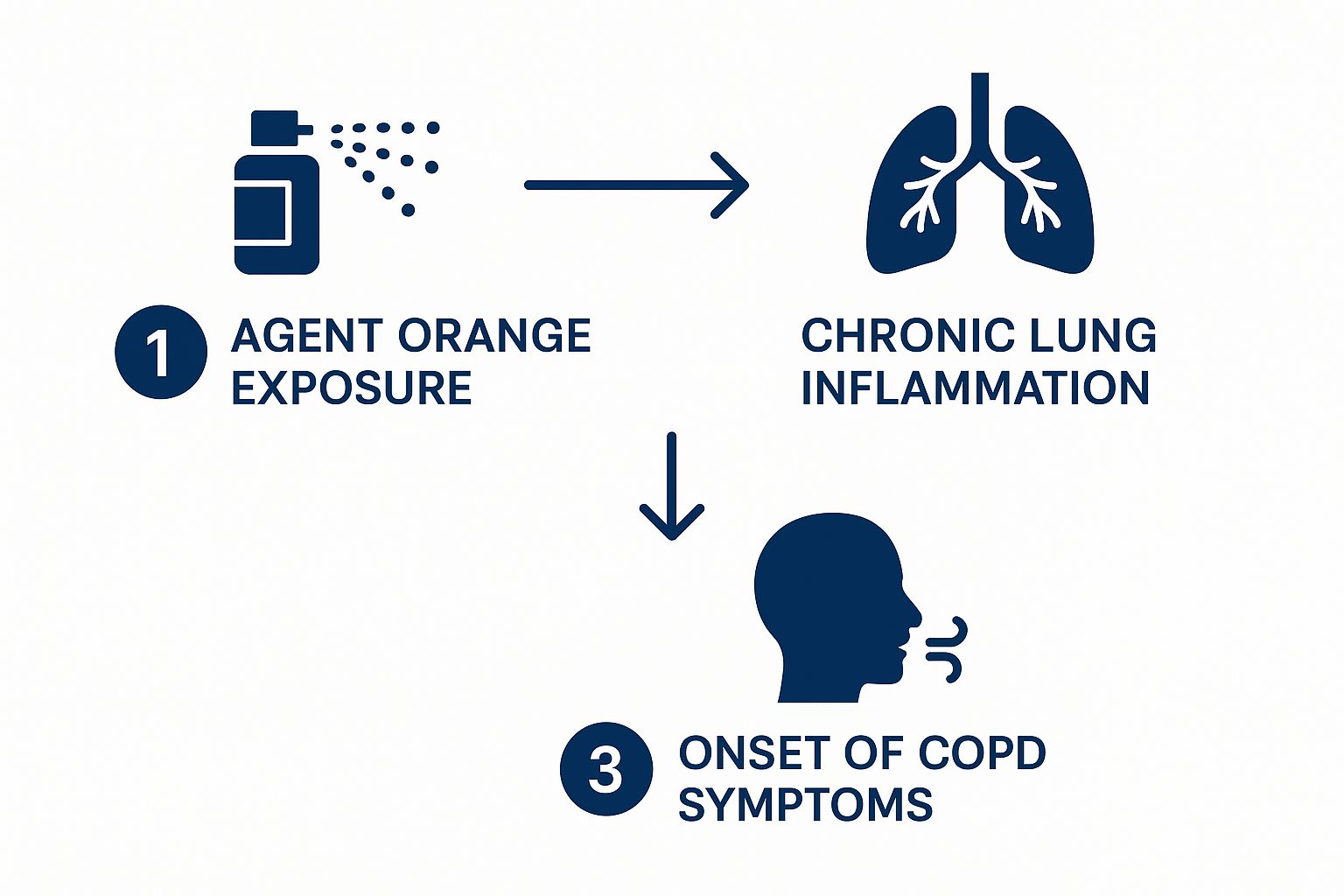
This is the exact pathway your evidence needs to illustrate for the VA reviewer—a clear line from the cause (exposure) to the effect (your diagnosis).
To help you get organized, here’s a checklist of the essential documents you'll need to gather to build a strong claim.
| Essential Documents for Your VA Claim |
| :— | :— | :— |
| Document Type | Purpose | Where to Obtain |
| DD-214 or other Service Records | Proves location, dates, and nature of your service. | National Archives, your personal records. |
| Complete Medical Records | Details your current COPD diagnosis, severity, and treatment history. | Your doctor’s office, specialists, hospitals, VA medical centers. |
| Medical Nexus Letter | Establishes the direct link between your service exposure and your COPD. | A private physician, specialist, or a medical expert familiar with VA claims. |
| Buddy Statements/Lay Evidence | Provides firsthand accounts of your exposure or the progression of your symptoms. | Fellow service members, family, friends, or former colleagues. |
| VA Form 21-526EZ | The official application form for disability compensation. | The official VA.gov website. |
Having all these documents prepared and organized before you file can make a huge difference in the outcome and speed of your claim.
The Crucial Role of a Nexus Letter
Because there's no presumptive service connection for COPD and Agent Orange, your nexus letter acts as the bridge. A generic note from your doctor saying "this veteran has COPD" just won't cut it. A truly effective nexus letter is detailed and specific. It must reference your personal medical history, your service records, and cite scientific research that supports the link between herbicide exposure and respiratory diseases.
A powerful nexus letter does more than state a conclusion; it tells a story backed by medical science. It should explain the biological plausibility—how the dioxin in Agent Orange could have triggered the chronic inflammation that ultimately led to your COPD diagnosis.
Don't forget the human element, either. Strong "buddy statements" from service members who can verify your exposure, or letters from family members who have witnessed the decline in your breathing over the years, add a powerful and personal layer to your claim. These firsthand accounts help paint a complete picture for the VA.
Filing for benefits for Agent Orange and COPD is a marathon, not a sprint. It takes careful preparation and a clear understanding of what the VA needs to see. By meticulously gathering your records and securing a compelling nexus letter, you can build a claim that is tough to deny and finally get the support you earned.
Got Questions About Agent Orange and COPD? We've Got Answers.
When you're trying to figure out a VA claim, especially for something as serious as Agent Orange and COPD, it's natural to have a lot of questions. The whole process can feel like a maze. Getting clear, no-nonsense answers is the first step toward building a claim that can succeed. Let's tackle some of the most common questions we hear from veterans.
Is COPD on the Agent Orange Presumptive List?
This is the big one, and the answer is no, not directly. Chronic Obstructive Pulmonary Disease (COPD) as a general term is not currently on the VA's list of presumptive conditions for Agent Orange. It's one of the most common points of confusion for veterans just starting out.
But that doesn't mean your claim is a dead end. Think of "COPD" as an umbrella. While the umbrella itself isn't on the list, some of the specific diseases it covers are recognized for other types of exposure. For example, chronic bronchitis is presumptive under the PACT Act for burn pit exposure. This proves the VA is willing to service-connect these kinds of respiratory illnesses.
So, for your claim, it’s often much smarter to file for the specific condition your doctor diagnosed, like chronic bronchitis or emphysema, instead of just using the broad "COPD" label.
What if My COPD Claim Was Denied Before?
A denial stings, but it's not the end of your claim—far from it. Think of it as a first draft. If your claim was turned down, especially before laws like the PACT Act came along and broadened benefits for lung conditions, you should absolutely consider refiling.
The path forward is usually a Supplemental Claim. This type of claim is designed for you to add new and relevant evidence that directly addresses why the VA said no the first time.
A denial letter isn't a final "no." It's a roadmap. It tells you exactly what was missing from your first attempt. Use it to gather the right evidence and build a much stronger case for round two.
This new evidence might be a more powerful medical nexus letter, statements from fellow service members who saw your symptoms develop, or new medical records that clearly show how severe your condition has become.
How Do I Prove I Was Exposed to Agent Orange?
The good news is, you usually don't have to. You don't need a specific photo of you being sprayed. The VA "concedes" (or assumes) you were exposed if your service records put you in the right place at the right time.
The VA will generally presume you were exposed if you meet criteria like these:
- You served in the Republic of Vietnam between January 9, 1962, and May 7, 1975. This includes having "boots on the ground," serving on inland waterways (Brown Water Veterans), or being on a ship within 12 nautical miles of the coast (Blue Water Veterans).
- You served in or near the Korean Demilitarized Zone (DMZ) during certain timeframes.
- You were a crew member on specific C-123 aircraft used for spraying missions.
Your DD-214 and other official service records are the key pieces of evidence you'll need to lock in this presumption of exposure.
Can I Get Benefits for COPD if I Smoked?
Yes, absolutely. Having a history of smoking does not automatically disqualify you from receiving VA benefits for COPD. This is a critical point. The VA can't legally deny your claim just because another risk factor, like smoking, exists.
This is where a solid medical nexus letter is non-negotiable. A qualified medical expert can make the argument that your military toxic exposure was "at least as likely as not" a major factor in causing or worsening your COPD.
They can explain that even with a smoking history, the chemical exposure from your service played a substantial role. The law actually requires the VA to weigh all the evidence and, when things are close, give the veteran the benefit of the doubt.